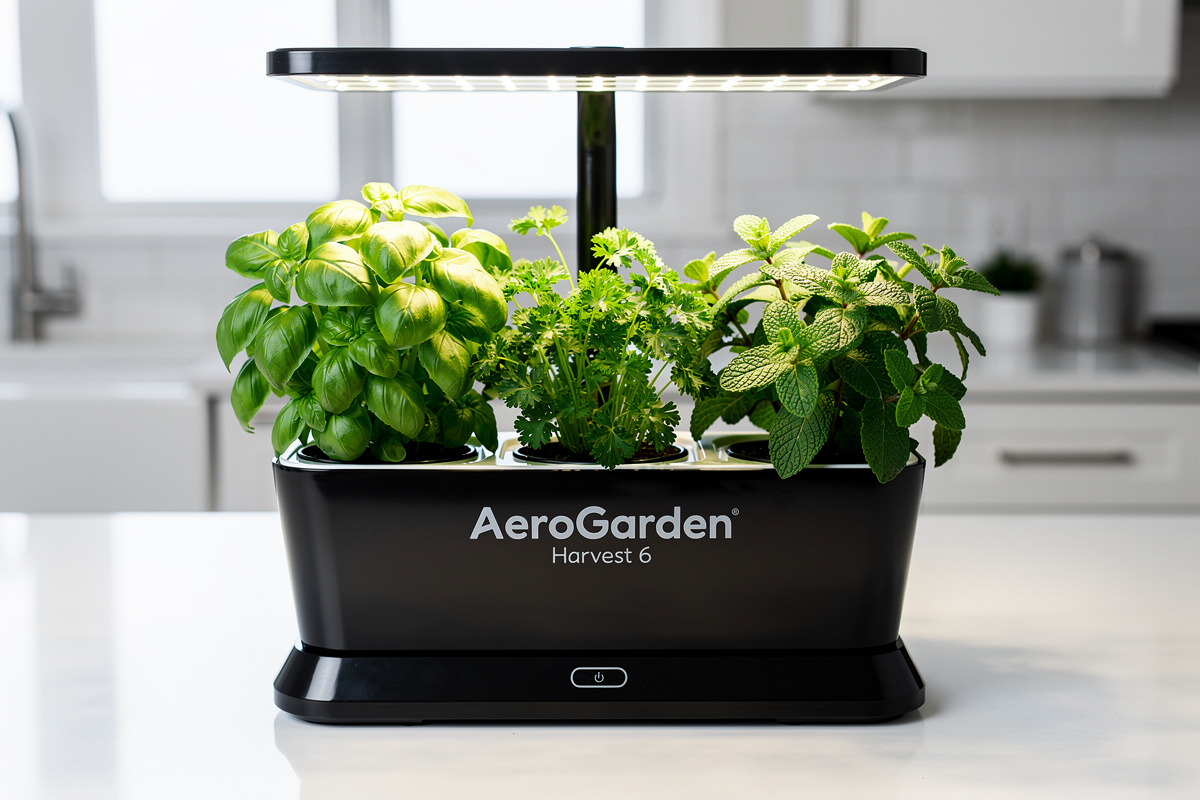
The AeroGarden Harvest 2.0 is one of the bestselling indoor hydroponic gardens of the past decade — 6 plant pods, a 15-watt LED grow light, app + Alexa + Google integration, roughly $90 to $100 retail. (AeroGarden quietly renamed it “Harvest Lite” after the brand’s 2025 relaunch under Scotts Miracle-Gro, and the LED panel dropped from the older Harvest’s 20W to a 15W panel on the current spec sheet — most retailers still list it as the Harvest 2.0.) I don’t run one on my own bench — my systems are DWC totes and NFT channels I built and instrument myself — so this isn’t a personal 16-week grow log. What follows is built from AeroGarden’s own spec sheet, verified owner grow reports, and my own read on the light math (PPFD, DLI, watts-per-pod) against what I already track on my reservoirs. The verdict: best value entry into hydroponics for most kitchens, with a couple of design quirks worth knowing before you buy.
Quick Verdict: Buy It If…
Buy the AeroGarden Harvest 2.0 if: you want fresh herbs year-round, you cook with basil/cilantro/parsley/dill weekly, you have 12 inches of counter space, you want app-based reminders without paying premium for vertical tower designs. Skip it if: you want enough harvest volume to actually replace grocery salads, you have an art-piece kitchen aesthetic (the Click and Grow looks better at 2x the price), or you want a system that grows full-size tomatoes (the taller Bounty models handle that; the Harvest does not).
Specs
| Spec | Detail |
|---|---|
| Plant capacity | 6 pods (1.4 inch diameter each) |
| Max plant height | 12 inches under light hood |
| Light | 15-watt full-spectrum LED, 16-hour timer |
| Water reservoir | 1 gallon (3.8L) |
| Footprint | 10.6 x 6.3 x 16.4 inches (manufacturer spec) |
| Connectivity | Wifi 2.4GHz, AeroGarden app, Alexa, Google |
| Power consumption | 15W LED + 4W pump = ~19W average |
| Annual electricity (16 hr/day) | $16 to $20 |
| Warranty | 1 year |
What It Grows Well
Cross-referencing owner grow logs against the light math (a 15W panel over a 12-inch canopy isn’t much PPFD to work with, which is the same ceiling I run into on my own low-power seedling shelves) gives a consistent picture crop by crop:
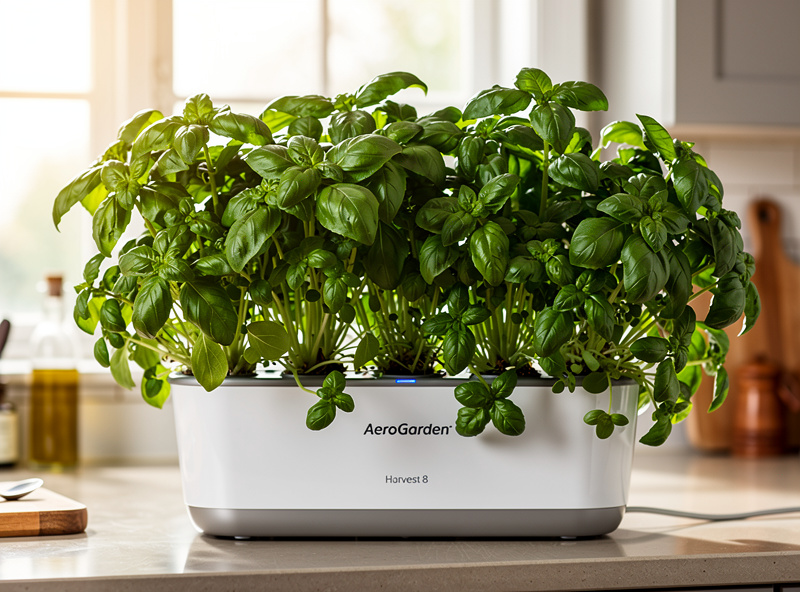
- Basil: Excellent, by consensus. 4 weeks to first harvest, then weekly cuts for 3-4 months. Owners consistently report one pod is enough for regular pesto batches plus weekly garnish — basil is a low-light-tolerant herb, which is exactly why it does well under a 15W panel where a fruiting crop wouldn’t.
- Parsley, cilantro, dill: Excellent. Faster than basil (3 weeks to first harvest). Cilantro reliably bolts at 8-10 weeks; parsley and dill keep producing 4+ months.
- Mint: Excellent. Best long-term performer by most owner accounts — 6+ months from a single pod with continuous harvest (mint is aggressive enough it barely notices a light shortfall).
- Lettuce (loose-leaf, butterhead): Good. 4-5 weeks to harvest; cut-and-come-again gives a second harvest 2 weeks later. Cycle limit: 8-10 weeks before plants get woody. Reported yield: 2 pods feed 1 person 2 salads per week.
- Cherry tomatoes: Mixed, and this is where the light budget shows. Pods grow well for the first 8 weeks, but plants outgrow the 12-inch light height by week 10. Owners report roughly 30-50 cherry tomatoes per pod over 4 months before the canopy hits the hood. The taller-armed Bounty (24 inches, 40W) is the better fit for a full fruiting cycle.
- Peppers: Don’t try in the Harvest. Plants outgrow the light height before they set fruit.
- Strawberries: Disappointing by most accounts. Plants survive but rarely fruit at 15W. Fruiting crops generally want more PPFD than a 6-pod countertop unit is built to deliver — it’s the same gap I watch for when I move a crop from a seedling shelf onto real grow lights on my own bench.
For broader plant-selection context, see my Best Plants for Hydroponic Growing guide.
Setup Experience
Out-of-box setup takes 15 to 20 minutes for first-time users. Steps: assemble light arm (3 screws), fill reservoir, drop in plant pods, add starter nutrients (pre-measured packet), connect wifi via app, set the bedtime light schedule. The AeroGarden app walks through the entire process with photos.
The wifi setup is reliable in 2026 — better than 2020-era models that had connection drop issues. App connects via 2.4GHz; if your home network is split (separate 5GHz network), make sure phone is on 2.4GHz during setup.
The Pod Ecosystem
AeroGarden’s biggest advantage is pod variety. They sell 50+ different seed pod packs:
- Salad Greens Mix (mixed lettuce, kale)
- Italian Herbs (basil, parsley, oregano, thyme)
- Heirloom Cherry Tomato
- Sweet Pepper Mix
- Mountain Meadow Flowers (decorative)
- Mushroom Mix (note: mushroom kit grows in pucks, not pods, but uses Harvest body)
3-pack pods cost $9-12 each. 9-pack starter pods cost $20-25. Annual cost replacing pods every 2-3 months: $80-120.
You can also use AeroGarden’s “Grow Anything” kit ($20 for 3 baskets) to grow from your own seeds. This drops per-cycle cost to under $1 in seeds, but requires more germination experience.
The App and Smart Features
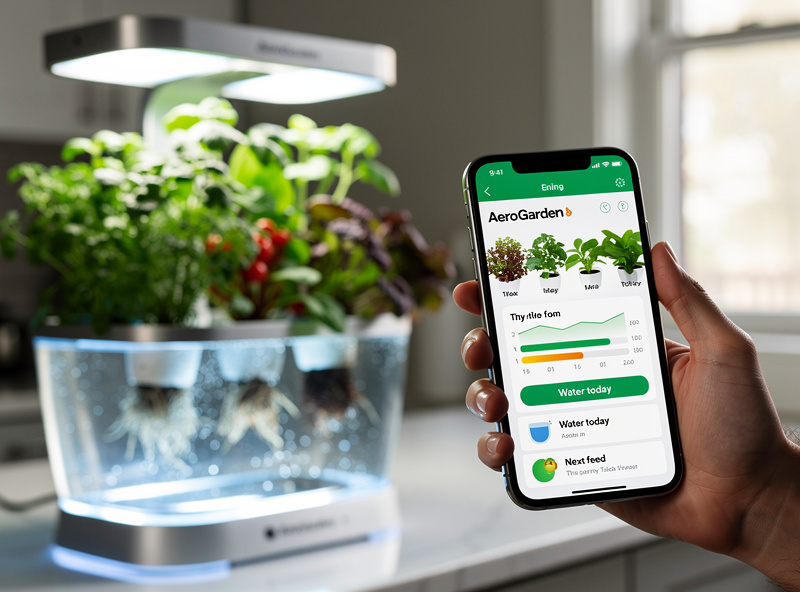
The AeroGarden app is solid — better than Click and Grow’s, less polished than Levoit’s. Core features:
- Manual on/off and dim control for the light
- Schedule customization (default 16 on, 8 off)
- Plant tracking (you note when you planted each pod, app reminds you when to harvest)
- Water and nutrient reminders (push notifications when reservoir is low)
- Vacation mode (reduces watering pump cycle for week-long absences)
- Alexa and Google voice (“Alexa, turn off kitchen garden”)
What it doesn’t do: pH/EC monitoring (you don’t get sensor readouts), automatic nutrient dosing (you add manually based on app reminder), or external sensor pairing. This is a ~$95 unit, so the absence of these is fair — even AeroGarden’s flagship Bounty Elite at $275 doesn’t hand you a pH or EC readout. That instrumentation layer is the whole reason I run my own EC/pH pens and a PAR meter instead of trusting an app light-schedule to tell the full story.
Pump and Watering Reality
The Harvest’s pump runs 30 seconds every 5 minutes during light hours, off during dark. The pump is audible at 28-32 dB — about as loud as a quiet desk fan. Most users don’t mind in a kitchen; some find it annoying in a bedroom. Don’t put the Harvest near where you sleep.
The water reservoir holds 1 gallon. Refill cadence:
- Week 1-2 (small plants): refill every 10-14 days
- Week 3-4: refill every 7-10 days
- Week 5+ (mature plants): refill every 4-7 days
The app reminds you, and the unit beeps on the device when reservoir is below 20 percent.
Common Issues and Fixes
Algae growth on the reservoir cover. Light leaks past pod baskets cause green algae over 4-8 weeks. Wipe with paper towel. Use a black foam ring (sold separately for $5) around any unused pod slots — algae stops growing.
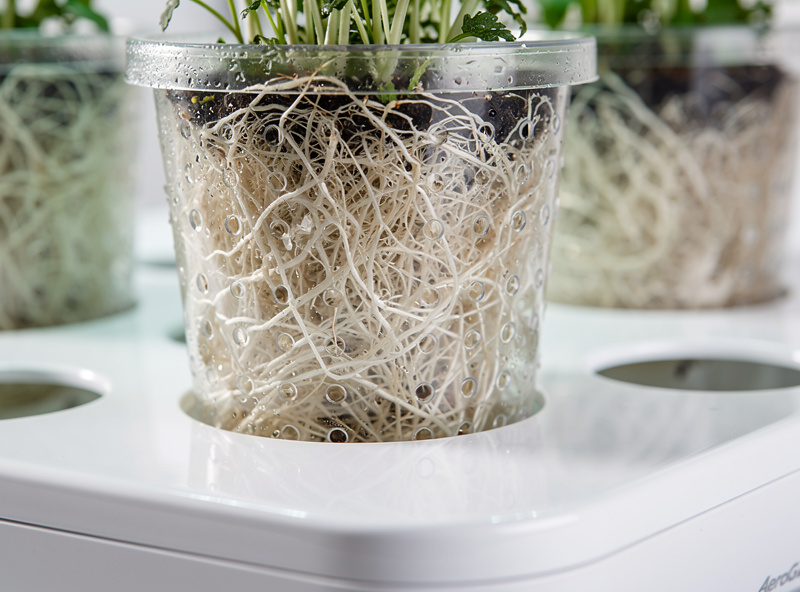
Roots tangling the pump. By week 6-8, roots from mature plants can reach the pump intake. Trim with scissors. The pump survives short-term root contact; long-term it labors and the unit detects pump strain via the app.
Bolting in cilantro and lettuce. Hot kitchen environments (above 75°F average) bolt these crops fast. Move to a cooler corner if your kitchen runs warm.
Wifi disconnection. Reset the unit by holding the light button 10 seconds. Re-pair via app. AeroGarden firmware updates have improved this in 2024-2025; current models rarely lose connection.
For broader troubleshooting, see my Common Hydroponic Mistakes guide.
Cost Over 3 Years
| Item | Cost |
|---|---|
| Initial unit | $90-100 |
| Year 1 pods (4 replant cycles, 6 pods each) | $80-120 |
| Year 1 nutrients (12 packets) | $25 |
| Year 1 electricity | $18 |
| Year 1 total | $213-263 |
| Year 2 (no replacement unit needed) | $123-163 |
| Year 3 | $123-163 |
| 3-year total | $459-589 |
The electricity line assumes roughly 18 cents per kWh, the 2026 average US residential rate per EIA data — check your own utility bill, since rates swing widely by state. Compared to grocery store herb purchases ($40-50/month for serious herb cooks): grocery 3-year cost is $1,440-1,800. AeroGarden saves roughly $850-1,300 over 3 years for households that actually use what they grow.
AeroGarden Harvest 2.0 vs Bounty vs Farm
One lineup note before the table: AeroGarden’s larger Farm 12/24/XL models — the ones that used to top this comparison — were discontinued when Scotts Miracle-Gro relaunched the brand in spring 2025 after a brief shutdown. If you see one listed new, that’s old stock; used/secondhand units also carry parts-support uncertainty. The Bounty Elite (specs confirmed on AeroGarden’s current Bounty product page) is now the top of the lineup.
| Model | Pods | Light | Max Plant Height | Price | Best For |
|---|---|---|---|---|---|
| Harvest 2.0 (Harvest Lite) | 6 | 15W | 12 inches | $90-100 | Herbs, salad greens, beginner |
| Harvest Elite 360 | 6 | 20W | 12 inches | ~$125 | Same footprint as Harvest, more light, stainless trim |
| Bounty | 9 | 40W | 24 inches | ~$230 | Herbs + cherry tomatoes, small peppers |
| Bounty Elite | 9 | 50W | 24 inches | ~$275 | Wifi/touchscreen, sleeker design |
The category sweet spot is the Harvest for most homes. Bounty justifies roughly 2x the price only if you want cherry tomatoes, peppers, or 9-pod variety — and given the Farm line is gone, Bounty Elite is now the ceiling if you want to stay inside AeroGarden’s own ecosystem rather than moving to a real reservoir-based system.
Honest Pros and Cons
Pros: Best value entry to hydroponics. Largest pod ecosystem in the category. Reliable wifi and app. Solid track record (10+ years on the market). Grows herbs and lettuce excellently. Easy 15-minute setup.
Cons: Pump noise mild but constant. Volume too small to replace grocery greens. Can’t grow tall plants (peppers, full tomatoes). Pod prices add up if you buy retail (use bulk packs). 1-year warranty is short for a ~$95 device.
For larger-volume alternatives, see my Lettuce Grow Farmstand guide.
Is the AeroGarden Harvest 2.0 worth buying?
Yes for households that cook with herbs weekly or eat 1-2 salads per week. The 6 pod capacity grows enough basil, parsley, mint, and lettuce to replace $30 to $50 in monthly grocery purchases. The unit pays back in 6 to 12 months on herbs alone.
What can you grow in an AeroGarden Harvest?
Excellent: basil, parsley, cilantro, dill, mint, chives, loose-leaf lettuce, butterhead lettuce, kale. Good: cherry tomatoes (under 12 inches tall, then outgrow). Don’t try: full-size tomatoes, peppers, strawberries (need more light), root vegetables.
How loud is the AeroGarden Harvest pump?
The pump runs 30 seconds every 5 minutes during light hours at 28 to 32 dB — comparable to a quiet desk fan. Most users don’t mind in a kitchen but find it disruptive in a bedroom. Don’t place the unit next to where you sleep.
How often do AeroGarden Harvest pods need replacing?
Lettuce and salad greens last 4 to 8 weeks per cycle. Herbs last 3 to 6 months per pod with continuous harvest. Cherry tomatoes last 4 to 6 months. Most growers replant on a rolling basis every 2 to 3 months.
Does the AeroGarden Harvest connect with Alexa?
Yes. The Harvest 2.0 connects to wifi (2.4GHz only) and integrates with Alexa, Google Home, and the AeroGarden app. Voice commands include light on/off and dimming. App features include scheduling, plant tracking, and water/nutrient reminders.
How much electricity does an AeroGarden Harvest use?
About 19 watts average (15W LED + 4W pump). Running 16 hours per day costs roughly $16 to $20 per year at 2026 average US residential electricity rates (around 18 cents/kWh per EIA data). The unit is energy-efficient compared to growing under standalone shop lights.