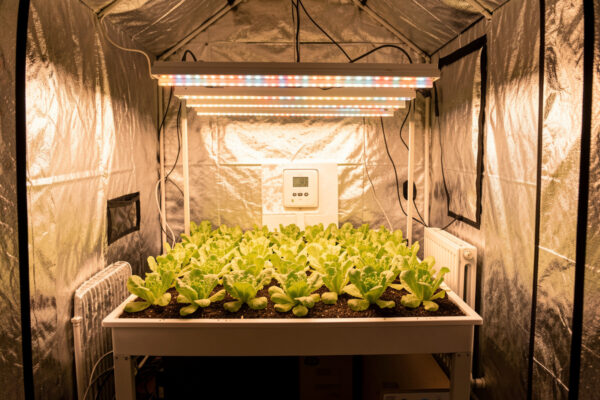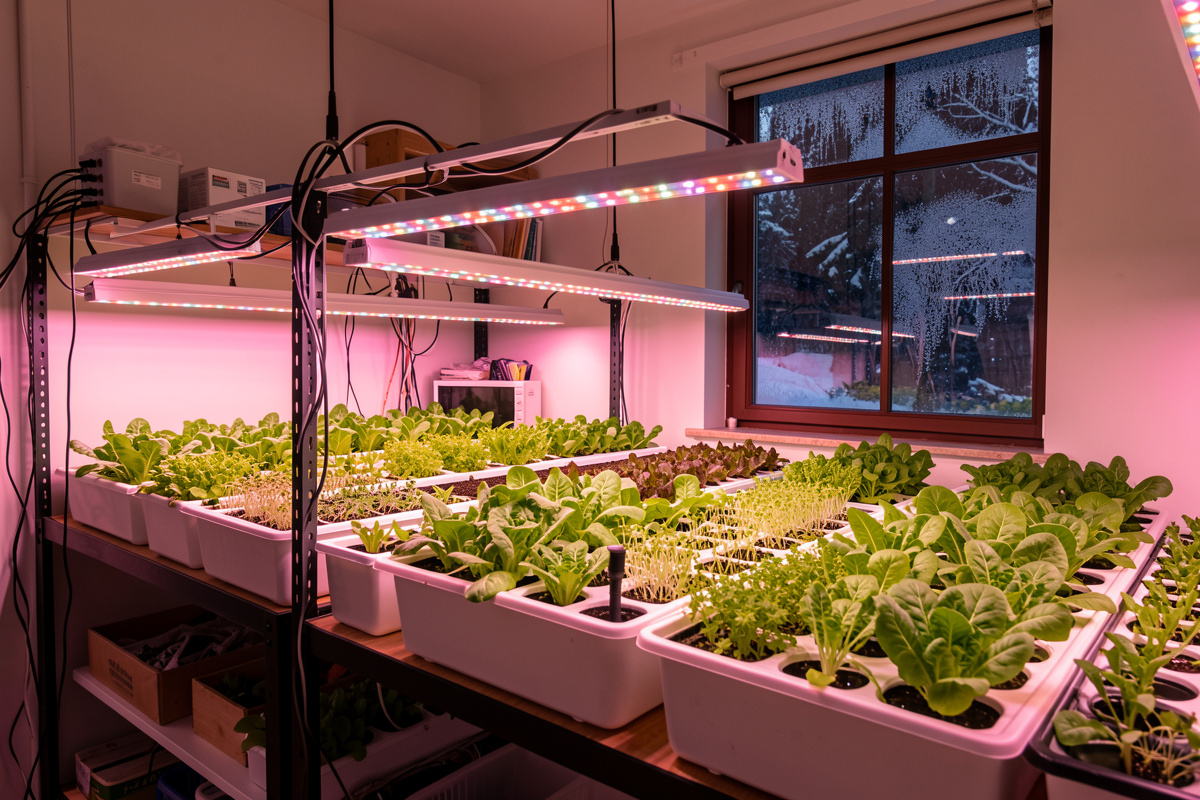
Cold-climate indoor hydroponics is a different sport than growing in a warm garage or a Mediterranean sunroom. In a Nordic winter the water in my reservoir wants to sit at 12°C, the tap runs at 5°C, the sun clears the horizon for barely six usable hours, and the moment the radiators kick on the humidity crashes below 30%. Every one of those numbers fights your roots. I grow indoors in Sweden and I run DWC, NFT, Kratky and ebb-and-flow side by side through the darkest months, logging EC, pH, PPFD and res temp on each one — and this hub is the whole cold-season playbook I wish someone had handed me the first winter I watched a res of lettuce simply stop.
Here is the part nobody warns you about: cold-climate hydroponics doesn’t fail loudly. Nothing wilts, nothing browns overnight. The plants just quietly refuse to grow. EC stops dropping because the roots aren’t drinking, new leaves come in half-size, and you spend three weeks blaming your nutrients when the real culprit is a 13°C root zone and a daily light integral of four. Get the environment right and cold-climate growing is genuinely wonderful — no pests fly in December, algae barely moves, and a well-lit tent is the warmest, greenest corner of a Swedish house. This guide is how I get there.
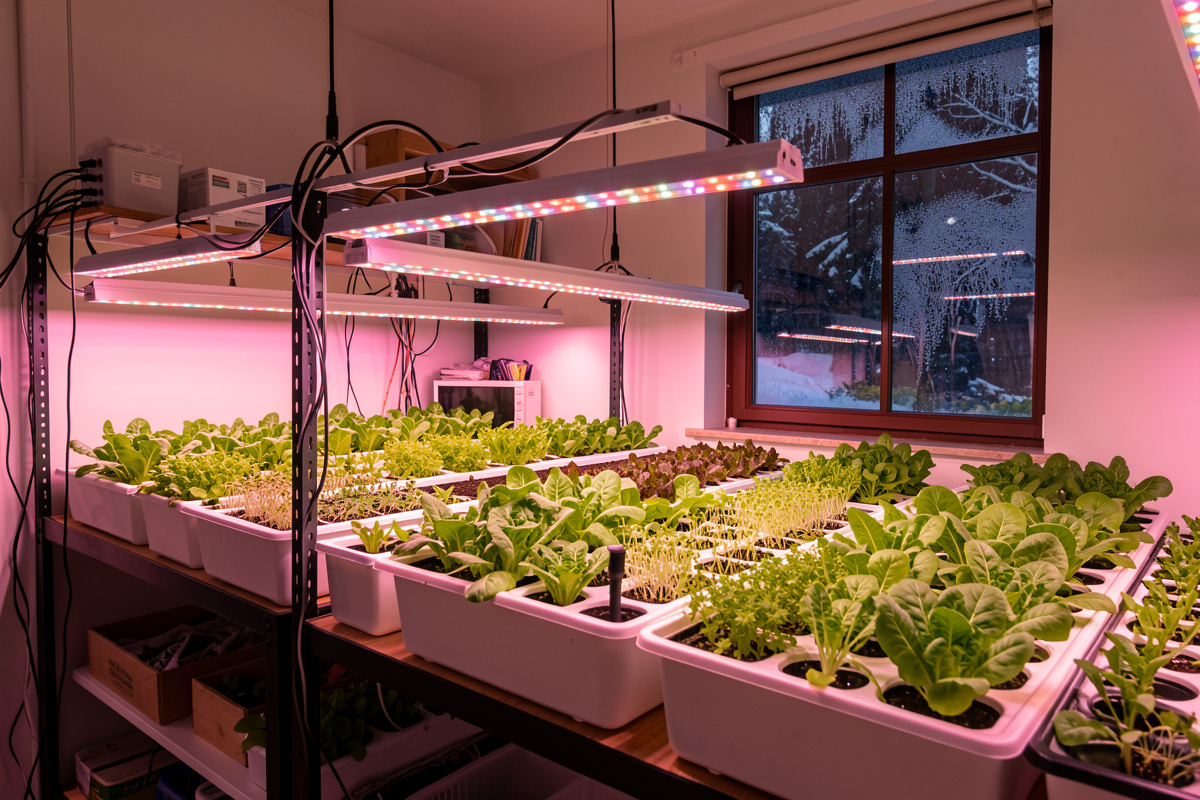
Why Does Cold-Climate Hydroponics Need Its Own Playbook?
Because four things go wrong at once, and they compound. Cold pulls the root-zone temperature under the 18–22°C sweet spot where nutrient uptake actually happens; short days starve the canopy of light; indoor heating drops relative humidity into the 20–30% range that spikes VPD and stresses transpiration; and cold walls create condensation and cold spots that no thermostat reading tells you about. Warm-climate growers solve none of these because they never meet them. (If you want the full year-round picture beyond winter specifically, I lay out temperature, humidity, VPD, CO2 and airflow together in my grow room environment guide.)
In my logs the tell is always the same. Growth rate falls off a cliff while everything looks healthy. The first winter I ran DWC seriously I lost most of a lettuce cycle to a res that averaged 13°C. The pen read a clean EC of 1.2 mS/cm and a pH of 5.8, the air stones were bubbling, and the plants sat there for a fortnight doing almost nothing. That failure is what turned this site from “grow by feel” into “log everything,” and it is why cold-climate growing earns its own set of rules. You are not managing a garden; you are managing four coupled control loops — temperature, light, humidity, and water chemistry — where a Nordic winter has already nudged every one of them off target before you plug anything in.
The good news is that all four are controllable and cheap to instrument. A stick thermometer, an EC pen, and a $30 PAR meter tell you within a day whether the problem is heat, light, or chemistry. Most of what follows is just me showing you what the meters read and what I do when they read wrong.
How Cold Is Too Cold for a Hydroponic Reservoir?
Root-zone temperature under about 15°C (59°F) stalls nutrient uptake; under 12°C most crops effectively pause. I target 18–20°C (65–68°F) in the res year-round, and in winter that means actively adding heat rather than fighting it. Cold water holds more dissolved oxygen, which is one gift of the season, but slow root metabolism cancels the benefit — the roots simply can’t use the food.
The counterintuitive summer rule flips in winter. In July I fight to keep the res below 22°C because warm, low-oxygen water is a Pythium invitation; my canonical danger line is anything over 22°C. In January the whole problem inverts: the res drifts toward room temperature, and an unheated spare room in a Swedish winter sits at 14–16°C. A 25–50W aquarium heater with an external thermostat is the single highest-return purchase for cold-season growing, and I cover exactly how I size and place one in keeping a reservoir warm enough in an unheated room.
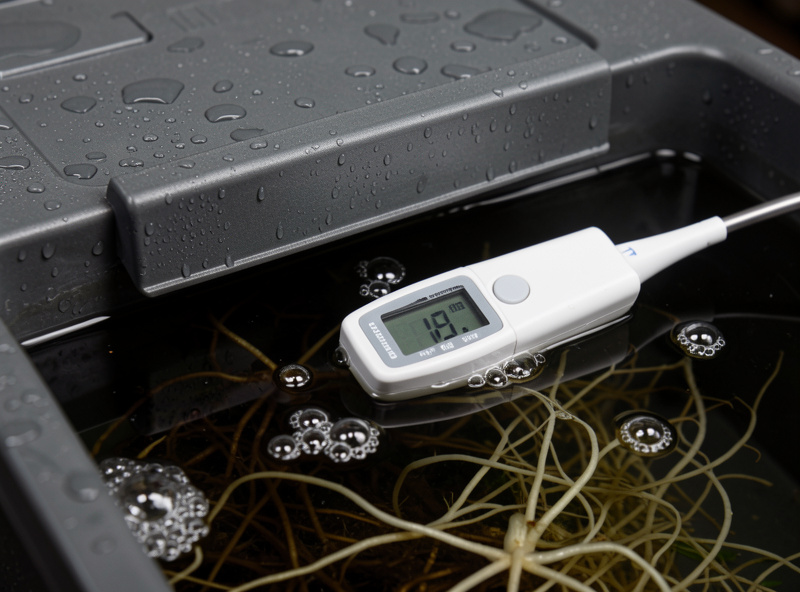
The second cold-water trap is the res change itself. When my tap runs at 5°C and I dump 20 litres of it straight onto an 18°C root mass, I’ve just cold-shocked the plant harder than a week of slow drift ever would. I temper every drop of change water to within a couple of degrees of the res before it touches roots — the why, and the two ways I do it, are in cold tap water and your res. Between an actively heated reservoir and tempered change water, root-zone temperature stops being the thing that quietly kills a winter cycle.
How Much Supplemental Light Do You Need in Winter?
Leafy greens want a daily light integral (DLI) of roughly 12–17 mol/m²/day; fruiting crops want 20–30. At my latitude in December the sun delivers a small fraction of that even at a south window, so essentially 100% of usable winter light comes from the fixture. That is the number that decides everything else: your fixture wattage, your hang height, and how many hours it has to run.
DLI is just PPFD multiplied by seconds of light per day, converted to moles. If my LED bar delivers 250 µmol/m²/s at canopy and I run it 16 hours, that’s 250 × 16 × 3600 ÷ 1,000,000 = 14.4 mol/m²/day — right in the leafy-green band. Drop the PPFD to 150 or the photoperiod to 12 hours and you fall out of it, which is exactly how winter lettuce ends up thin and slow. I walk through the full arithmetic, with a PAR meter in hand at different hang heights, in winter DLI math, and I lay out the actual clock schedule I run — on-times, ramp, and why I don’t just leave the light on 24/7 — in photoperiod through short days.
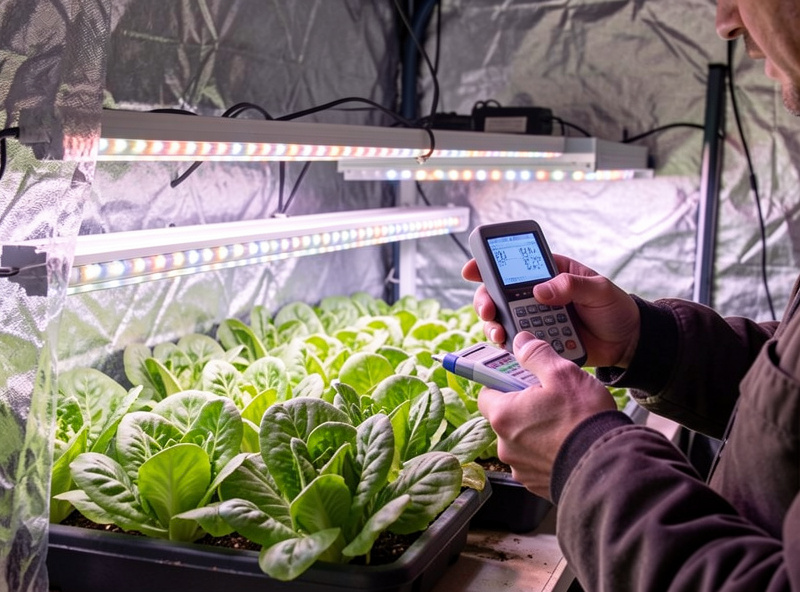
The mistake I see constantly — and made myself — is buying a cheap “full spectrum” panel off a marketplace by wattage alone and never metering it. Advertised watts tell you nothing about PPFD at your canopy. A $30 quantum-style PAR meter pays for itself the first week because it turns “I think the light’s enough” into a number you can trust. If you want a fixture to start from, I search for quantum-board-class LED grow lights and then verify the real output with the meter rather than the box.
As an Amazon Associate I earn from qualifying purchases.
What Happens to Humidity When the Heating Comes On?
Winter heating turns your grow space into a desert. Warm the room from 15°C to 22°C without adding moisture and the relative humidity can fall from a comfortable 55% to below 25%, which pushes vapour-pressure deficit (VPD) toward 1.8–1.9 kPa — far above the 0.8–1.2 kPa band leafy greens transpire happily in. High VPD forces the plant to close stomata, and growth slows even when light and nutrients are perfect.
The math is worth internalising. At 22°C the air can hold about 2.64 kPa of water vapour when saturated. At 30% RH it’s holding 0.79 kPa, so the deficit is 1.85 kPa. Nudge humidity up to 60% and the deficit drops to about 1.06 kPa — back in range — without touching the temperature at all. In a small winter tent I hold that band with the transpiration of a full canopy plus, on the driest weeks, a small ultrasonic humidifier on a hygrostat. The full winter-humidity picture, including why the driest room in the house is usually the one with the radiator running, is in low humidity in winter grow rooms. Get VPD wrong and you’ll chase phantom nutrient deficiencies for weeks; get it right and the same res suddenly performs.
Which Crops Actually Thrive in a Cold-Climate Winter Setup?
Fast leafy greens and hardy herbs win the winter. Butterhead and loose-leaf lettuce, spinach, pak choi, kale, mustards, arugula and Swiss chard all crop well at cooler root zones and modest DLI, and they forgive the shorter light day far better than any fruiting crop. Tomatoes and peppers are possible but expensive — they demand a 20–30 DLI you’ll pay for in electricity every single short day.
My winter default is a DWC tote of butterhead running alongside a Kratky jar of loose-leaf as the no-pump control, with basil and mint holding down the warmest corner of the tent. Cool-tolerant greens actually taste better after a cold spell — spinach and mache sweeten as they concentrate sugars against the cold, one of the quiet pleasures of Nordic winter growing. The crop-by-crop breakdown, with the EC and DLI target I run for each, is in best crops for a cold-climate winter hydro setup. Match the crop to the season and half of the cold-climate difficulty simply disappears — you stop forcing a heat-loving plant to survive conditions it hates.
How Do You Keep the Grow Space Warm Without Cooking Your Wallet?
Insulate the cold surfaces before you add heat. A grow tent pushed against an uninsulated exterior wall bleeds heat all night, creates a cold spot the thermostat never sees, and drives condensation that feeds mold. A single sheet of foam board or reflective bubble insulation between the tent and that wall does more for stable temperature than turning a heater up ever will, and it costs almost nothing to run because it runs on nothing.
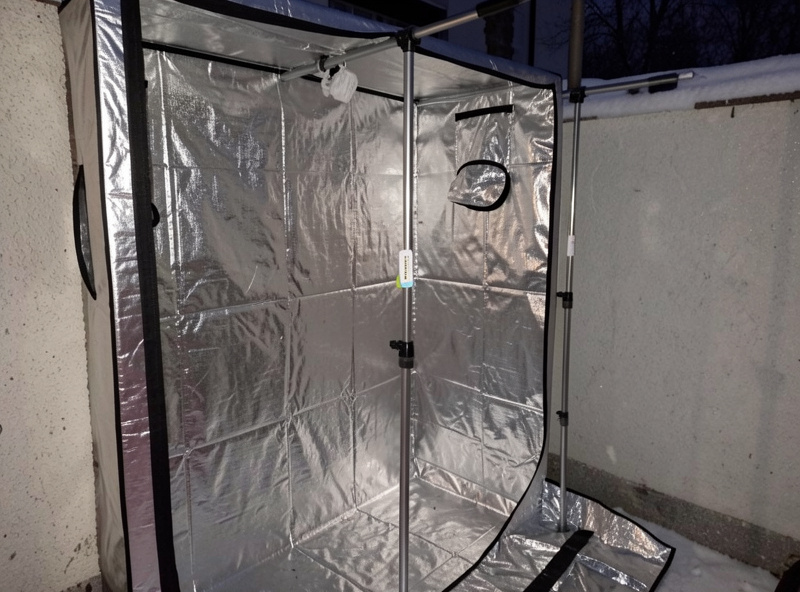
My rule is passive first, active second. Insulate the wall, seal the obvious draughts, let the LED fixture’s own waste heat do work (in winter that “inefficiency” is a feature), and only then add a small thermostatically controlled heater for the res or the tent air. I printed my own light hangers and a thermometer clip so the probe sits at canopy height rather than reading the warm air near the fixture — the same 3D printer that prints my reservoir lids. The full insulation walkthrough, including how I stop the cold-wall condensation without trapping stale air, is in insulating a grow tent against a cold wall. A well-insulated tent holds temperature so steadily that a 25W heater does what a 150W one couldn’t in a leaky space.
Which Hydroponic Method Handles Cold Best?
All four methods I run work in winter, but they don’t handle cold equally. The table below is how I’d rank them for a cold room, based on running them side by side on the same crops with the same meters. The short version: a large-volume DWC res is the most thermally stable thing you can grow in, and thin-film NFT is the most exposed.
| Method | Thermal mass | Cold-room risk | Easiest winter fix | My winter verdict |
|---|---|---|---|---|
| DWC (deep water culture) | High — large water volume buffers temp swings | Low, if heated | Aquarium heater in the res | My winter workhorse |
| Kratky (passive) | High — big static volume | Low, but no heater circulation | Insulate the vessel; site it warm | Best no-pump control crop |
| Ebb & flow (flood-drain) | Medium — media buffers, res sits cold between floods | Medium | Heat the res, insulate the tray | Fine for fruiting if heated |
| NFT (nutrient film) | Low — thin film chills fast in the channel | High | Insulate channels, heat + circulate res | Doable but the most finicky |
If you’re choosing a first winter system in a cold room, start with DWC: the thermal mass forgives mistakes and a single cheap heater keeps the whole thing in band. I keep the NFT running because I like leafy-green throughput, but it’s the rig I check first on the coldest mornings because that thin film in the channel is the first thing to chill.
What’s My Actual Winter Startup Sequence?
When I bring a cold room online for the season I do it in a fixed order, because each step depends on the one before. Skip the sequence and you’ll be troubleshooting three coupled problems at once instead of one at a time.
First, insulate the cold wall and seal draughts — passive stability before anything electrical. Second, hang and meter the light: set hang height to hit my target PPFD at canopy, then set the photoperiod to land the DLI in band. Third, fill and heat the res, then temper the first change water so I’m not shocking new transplants. Fourth, set the humidifier’s hygrostat to hold VPD in the 0.8–1.2 kPa window once the heating’s running. Only then do I transplant, and for the first week I log EC drift, res temp and canopy PPFD daily until the numbers are boring. Boring is the goal — a winter res that reads the same every morning is one that’s actually growing.
The instruments carry all of it. My EC pen tells me whether the plants are drinking (EC falling means uptake, which means the root zone is warm enough); the PAR meter tells me the light hasn’t drifted out of band; the res thermometer tells me the heater’s keeping up on the coldest night. I treat the whole rig like any other control loop — sensors, a schedule, and intervention only when the loop reports it’s off — the same way I’d run a smart-home setup.
How Do I Diagnose a Stalled Winter Res?
Read the EC pen first. In a healthy res the plants drink, so EC falls between changes and you top up with plain tempered water; if EC is flat or rising across three or four days, the roots aren’t taking up nutrients, and in winter the cause is almost always temperature before chemistry. A rising EC with a cold thermometer is a stalled root zone, not a nutrient problem — and dumping in more fertiliser makes it worse.
My winter diagnostic runs in strict order because guessing wastes weeks. Check res temperature: if it’s under 15°C, that’s the whole answer — heat it and wait 48 hours before touching anything else. If temperature is in band, check the PAR meter at canopy: a DLI that’s quietly fallen out of the 12–17 band (a fixture nudged too high, a photoperiod trimmed too short) starves growth just as effectively as cold. Only if temperature and light are both confirmed good do I look at chemistry — pH drifting out of the 5.5–6.0 uptake window, or a genuine deficiency showing on the leaf. Nine winters out of ten the answer is temperature, and I’ve wasted enough Januaries re-mixing nutrients on a 13°C res to know that adding food to a cold root zone is like flooring the accelerator on a stalled engine. The lesson I carry from that first lost lettuce cycle: instrument the environment before you second-guess the bottle.
One more tell worth logging: cold-shocked roots after a botched res change go from crisp white to slightly translucent and sluggish within a day, and new leaf emergence pauses. That’s not root rot — res temperature is your Pythium safety margin in winter because cold water holds oxygen well — it’s shock, and it recovers in a few days once the water’s tempered and warm. Knowing the difference stops you from nuking a healthy res with hydrogen peroxide over a problem that fixes itself.
What Does a Cold-Climate Winter Grow Actually Cost to Run?
The honest answer: the light dominates the bill, and the heat is cheap by comparison. An LED bar pulling 150W run 16 hours a day uses about 2.4 kWh daily; a 25W res heater cycling to hold 18°C might average well under 0.5 kWh even on a cold night. So the temptation is always to cut the light — and that’s exactly the wrong lever, because light is the thing actually growing the plant. Cut watts and you cut yield; the electricity you “save” just buys you slow, thin greens.
Where I do save is on the passive side, and it’s why insulation comes first in my startup sequence. A sheet of foam board against a cold wall costs a few kronor and runs on nothing, yet it lets a 25W heater do what a 150W one couldn’t in a draughty space. In winter the LED’s waste heat is a bonus that warms the tent air for free — the same “inefficiency” I fight in July is a feature in January. Stack the free wins — insulation, LED waste heat, siting the tent away from the coldest wall — and the only real running cost left is the light you actually want to be paying for. I’d rather run a properly metered fixture at full output over a well-insulated, heated res than nurse a dim light to save pennies and lose the crop. Winter growing rewards spending on the right things and refusing to cheap out on the wrong ones.
Frequently Asked Questions
What reservoir temperature should I target for winter hydroponics?
Aim for 18 to 20 degrees Celsius (65 to 68 degrees Fahrenheit) in the root zone. Below 15 degrees Celsius nutrient uptake stalls and growth slows dramatically even though the plants still look healthy. In a cold room that means actively heating the reservoir with a small thermostatically controlled aquarium heater rather than relying on room temperature.
How much light do winter hydroponic greens need?
Leafy greens want a daily light integral of roughly 12 to 17 mol per square metre per day, and fruiting crops want 20 to 30. In a dark northern winter almost all of that has to come from the fixture, so you meter PPFD at canopy with a PAR meter and set the photoperiod to land the DLI in that band.
Why does my grow room humidity crash in winter?
Heating warms the air without adding moisture, so relative humidity falls. Going from 15 to 22 degrees Celsius can drop humidity from 55 percent to under 25 percent, pushing vapour-pressure deficit above the healthy 0.8 to 1.2 kPa band. Add moisture with a hygrostat-controlled humidifier to bring it back into range.
Which hydroponic method is best for a cold room?
Deep water culture is the most forgiving because its large water volume buffers temperature swings, so a single cheap heater keeps the whole reservoir stable. NFT is the hardest in cold conditions because the thin nutrient film in the channel chills quickly. Kratky and ebb-and-flow sit in between.
Do I need to warm cold tap water before a reservoir change?
Yes. Tap water in winter can run at 5 degrees Celsius, and pouring that straight onto an 18-degree root mass cold-shocks the plant. Temper the change water to within a couple of degrees of the reservoir before it touches roots, either by letting it stand in the warm room or by blending in warm water to hit the target.
Which crops grow best in a cold-climate winter setup?
Fast leafy greens and hardy herbs: butterhead and loose-leaf lettuce, spinach, pak choi, kale, mustards, arugula, Swiss chard, plus basil and mint in the warmest corner. They tolerate cooler root zones and modest light far better than tomatoes or peppers, which demand a high daily light integral you pay for in electricity every short day.
Keep Building
Each piece of the cold-season system has its own deep dive. Start with the one that’s biting you hardest:
- Winter DLI math: hitting your light targets when the sun won’t
- Keeping a reservoir warm enough in an unheated room
- Cold tap water and your res: why I temper it before a change
- Low humidity in winter grow rooms: VPD when the heating’s on
- Photoperiod through short days: my winter light schedule
- Best crops for a cold-climate winter hydro setup
- Insulating a grow tent against a cold wall
For the light-and-DLI fundamentals behind the winter numbers, university horticulture programs publish the clearest primers — University of Minnesota Extension and Penn State Extension both cover DLI, VPD and controlled-environment basics in depth. What I’d do starting today: hang a thermometer in the res and a PAR meter over the canopy before you plant a single seed. In cold-climate growing, the meters aren’t optional — they’re the difference between a green winter and three wasted weeks.