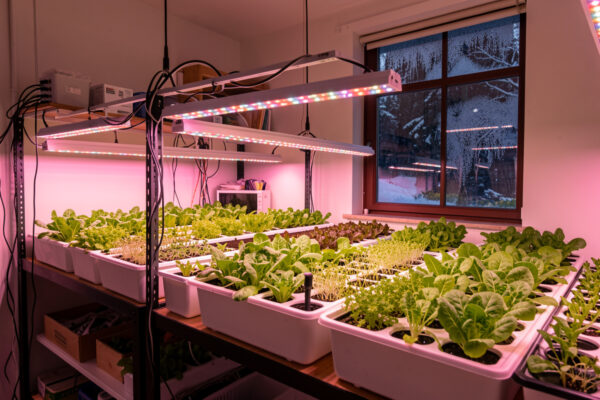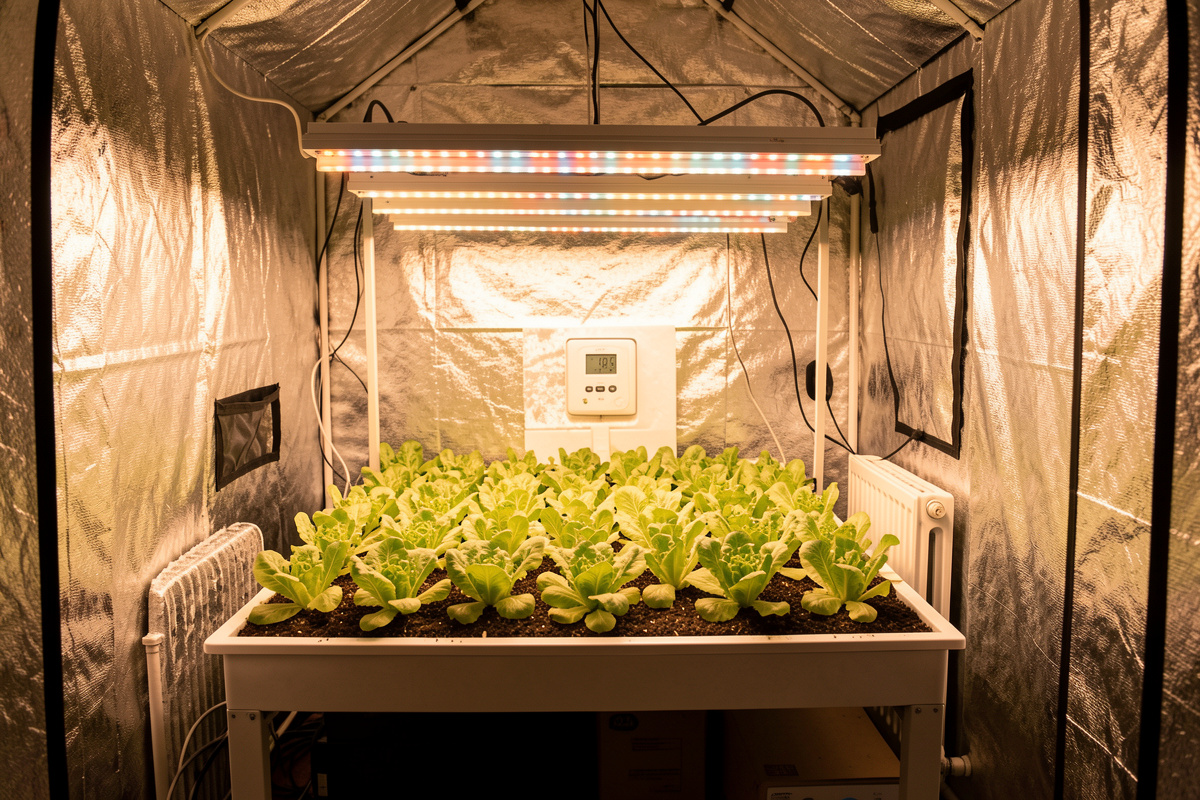
Winter heating turns a grow room into a desert, and that desert quietly throttles your plants through vapour-pressure deficit (VPD). Warm a room from 15°C to 22°C without adding moisture and relative humidity can crash from a comfortable 55% to under 25%, pushing VPD toward 1.8–1.9 kPa — far above the 0.8–1.2 kPa band leafy greens transpire happily in. When VPD runs too high the plant closes its stomata to stop losing water, and the moment stomata shut, photosynthesis and growth slow even if your light and nutrients are perfect. Fixing winter humidity is one of the highest-leverage, least-understood moves in a cold-climate grow.
I ignored this for a full winter and paid in phantom problems. My lettuce showed crispy leaf edges and stalled growth, I chased nutrient tweaks and light changes for weeks, and the whole time the real culprit was a hygrometer reading 22% in a room the radiators had baked dry. Once I put a number on the air, the fix was obvious and cheap. Here’s how VPD actually works and how I hold it in band all winter.
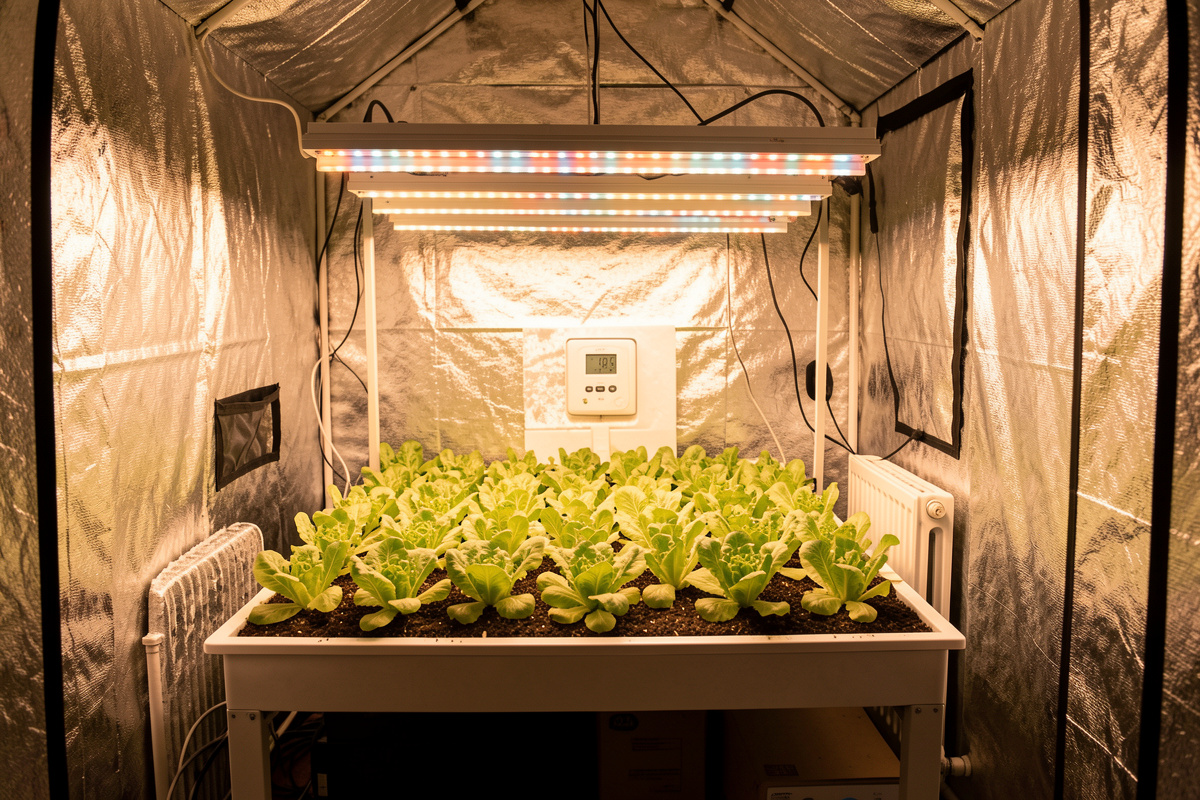
What Is VPD and Why Does It Matter More Than Humidity Alone?
VPD is the difference between how much water vapour the air is currently holding and how much it could hold when saturated, expressed in kilopascals. It’s a better guide than relative humidity alone because it folds temperature and humidity into the single number the plant actually feels — the “pull” the air exerts on the moisture inside a leaf. Warm air can hold far more water than cold air, so the same 40% RH means something completely different at 15°C than at 25°C.
For leafy greens I aim to keep air VPD in the 0.8–1.2 kPa band. Too low (below ~0.5) and transpiration nearly stops, which invites fungal problems and weak, soft growth; too high (above ~1.4) and the plant defends itself by closing stomata and slows down. This is the environmental control loop I treat exactly like temperature and light in the cold-climate indoor hydroponics hub — sensors, a target band, and intervention only when the number drifts out of it.
Why Does Heating Crash the Humidity?
Because heating adds warmth but not water. When your radiator or space heater raises the air temperature, the air’s capacity to hold moisture jumps, but the actual amount of water vapour in the room stays the same — so the relative humidity falls. Go from 15°C to 22°C with no new moisture and you can watch the hygrometer drop 20 or more percentage points over an evening. The driest room in a Swedish house in January is almost always the one with the heater running hardest.
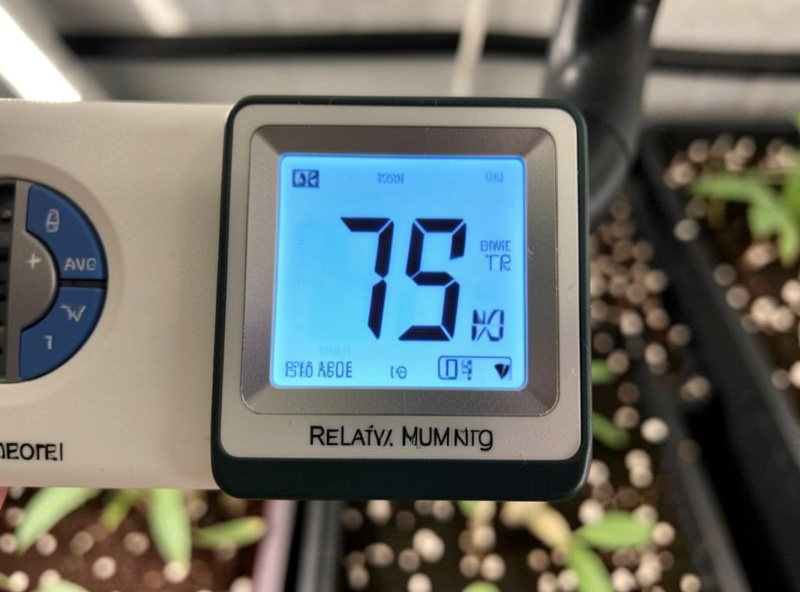
The math is worth internalising. At 22°C the air can hold about 2.64 kPa of water vapour at saturation. At 30% RH it’s holding 0.79 kPa, so the deficit — the VPD — is 1.85 kPa, well into stress territory. Nudge humidity up to 60% and the air is holding 1.58 kPa, dropping the deficit to about 1.06 kPa, right back in the healthy band — without touching the temperature at all. That’s the whole game: in winter you’re not lowering temperature, you’re adding moisture to bring VPD down.
What VPD Do Common Winter Temperatures and Humidities Give?
The table below is the air-VPD grid I keep in mind for a leafy-green grow. Find your room temperature down the side and your hygrometer’s humidity across the top; the cell is the approximate VPD in kPa. The shaded reality of winter is the top-right of dry columns — that’s where a heated, unhumidified room lands, and it’s why growth stalls.
| Air temp | 25% RH | 40% RH | 55% RH | 70% RH |
|---|---|---|---|---|
| 18°C | 1.55 | 1.24 | 0.93 | 0.62 |
| 20°C | 1.75 | 1.40 | 1.05 | 0.70 |
| 22°C | 1.98 | 1.59 | 1.19 | 0.79 |
| 24°C | 2.24 | 1.79 | 1.34 | 0.90 |
Read across the 22°C row and the winter trap is obvious: at 25% RH you’re at a punishing 1.98 kPa, and you don’t get back into the 0.8–1.2 band until humidity climbs to around 55%. That single insight — that a warm dry winter room needs roughly 50–65% RH to sit in band — is what turned my winter lettuce around. The numbers here are air VPD; leaf-surface VPD runs a touch lower when the canopy is cooler than the air, but the air figure is close enough to steer by.
How Do I Raise Humidity in a Winter Grow Room?
The most reliable tool is a small ultrasonic humidifier on a hygrostat set to hold the target band. I run one in the tent on the driest weeks, wired to switch off once humidity hits the top of my range so it never overshoots into swamp territory. It’s the humidity equivalent of the thermostat on my reservoir heater — set the band and let the loop manage it.
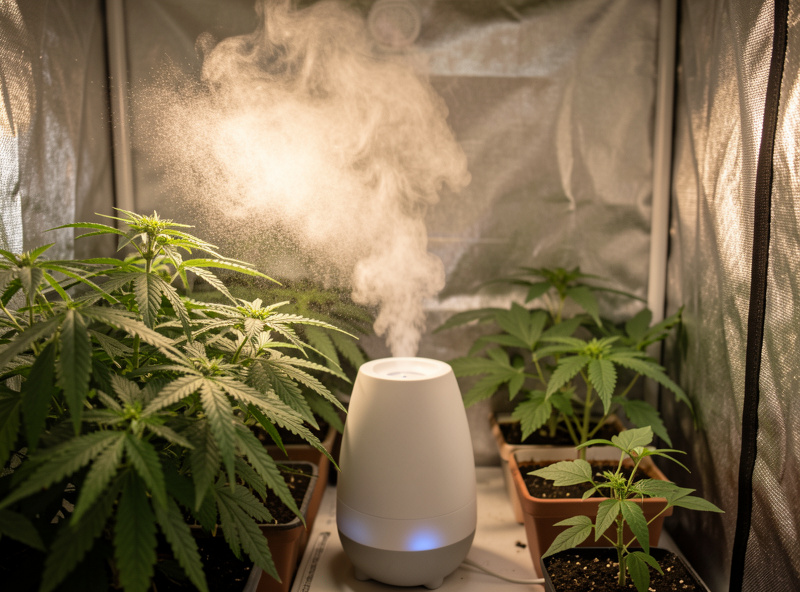
There are cheaper, passive helps too. A full, actively transpiring canopy raises its own local humidity, so a densely planted tent self-buffers better than a sparse one — another reason winter greens like lettuce do well grown close. Trays of water near the airflow, damp media, and simply keeping the grow space enclosed all nudge humidity up. And because a warm reservoir gives off some evaporative moisture, the same heater I use to keep the res warm helps a little on the humidity side as a bonus. I still lean on the humidifier for real control, but stacking the passive wins means it runs less.
Can Winter Humidity Ever Be Too High?
Yes, and it’s the flip side worth watching. If you over-humidify a cold, still corner — VPD dropping below about 0.5 kPa — transpiration nearly stops and you create the damp, stagnant conditions that powdery mildew and other fungal problems love. Cold walls make this worse by causing condensation where the warm humid air meets a cold surface, which is exactly the micro-climate mould wants — another reason I insulate the cold wall before I touch humidity at all, covered in insulating a grow tent against a cold wall.
My guardrails are simple: keep air moving with a small fan so no pocket goes stagnant, aim for the middle of the band rather than the top, and pull the humidifier back on milder days when the room isn’t as dry. If I ever see the telltale dusting of powdery mildew, humidity and airflow are the first things I check, not the nutrients. The goal is boring stability in the 0.8–1.2 band, not maximum moisture. For the underlying plant-science on VPD and transpiration, university controlled-environment resources like University of Minnesota Extension and Penn State Extension are worth a read.
What Does My Winter Humidity Routine Actually Look Like?
It’s mostly reading one number and reacting to it. I keep a combined hygrometer-thermometer at canopy height — not up near the warm light or down by the cold floor, both of which lie — and I glance at it the same way I check the EC pen and the res thermometer. If the humidity’s sitting in the low-to-mid 50s at my grow temperature, I do nothing. If it’s dropped into the 30s after a cold snap kicked the heating harder, the humidifier’s hygrostat is already handling it, and I just confirm the number recovered.
The seasonal pattern is predictable once you’ve lived a winter of it. The coldest, driest weeks — deep January here — are when the heating runs hardest and the room goes driest, so that’s when the humidifier works most. On milder, damper spells I dial it back or switch it off entirely, because the last thing I want is to over-humidify a still corner into mildew territory. I also cluster my tasks: I do res changes and any misting in the morning under the light, so the extra moisture burns off through the day rather than sitting cold and stagnant overnight when VPD naturally drifts low anyway.
The mistake I keep reminding myself not to repeat is trusting how the air feels. A heated room feels “fine” to me at 25% humidity because I’m a mammal, not a leaf. My skin is a useless instrument for this; the hygrometer is the only honest read. That lesson — put a number on the invisible thing before you troubleshoot anything else — is the same one I learned with the reservoir thermometer and the PAR meter, and it’s the whole philosophy behind a cold-climate grow that actually works.
Frequently Asked Questions
What VPD should I target for leafy greens?
Aim to keep air vapour-pressure deficit in the 0.8 to 1.2 kPa band for leafy greens. Below about 0.5 transpiration nearly stops and fungal risk rises, and above about 1.4 the plant closes its stomata and growth slows. In a warm winter room that band usually means holding relative humidity around 50 to 65 percent.
Why does my grow room humidity drop when the heating comes on?
Heating warms the air without adding moisture, so the air’s capacity to hold water rises while the actual water vapour stays the same, and relative humidity falls. Going from 15 to 22 degrees Celsius with no added moisture can drop humidity by 20 or more percentage points in an evening.
How do I raise humidity in a winter grow room?
The most reliable method is a small ultrasonic humidifier on a hygrostat set to hold your target band so it switches off before overshooting. A full transpiring canopy, trays of water near the airflow, damp media, and a warm reservoir all add passive moisture that reduces how hard the humidifier has to work.
Is relative humidity or VPD the better number to watch?
VPD is more useful because it combines temperature and humidity into the single value the plant actually feels. The same relative humidity means very different things at different temperatures, since warm air holds far more moisture than cold air, so steering by VPD keeps you in the right band across temperature changes.
Can humidity be too high in winter?
Yes. Over-humidifying a cold, still space drops VPD below about 0.5 kPa, which nearly stops transpiration and creates the damp, stagnant conditions powdery mildew loves. Cold walls also cause condensation where warm humid air meets a cold surface. Keep air moving and aim for the middle of the band rather than the top.
Further Reading
- Cold-climate indoor hydroponics: my winter system
- Keeping a reservoir warm enough in an unheated room
- Powdery mildew prevention in hydroponics
- Growing lettuce hydroponically: a complete guide
What I’d do starting today: hang a hygrometer in the grow space and read it after the heating’s been on a few hours. If it’s below 40%, you’re stressing your plants through VPD you can’t see — add moisture, watch the number climb into the 50s, and watch the growth follow.