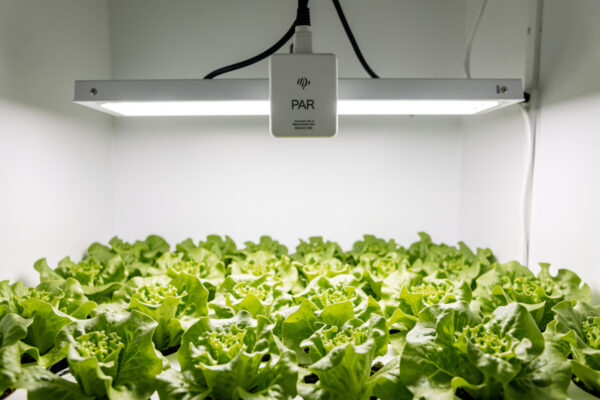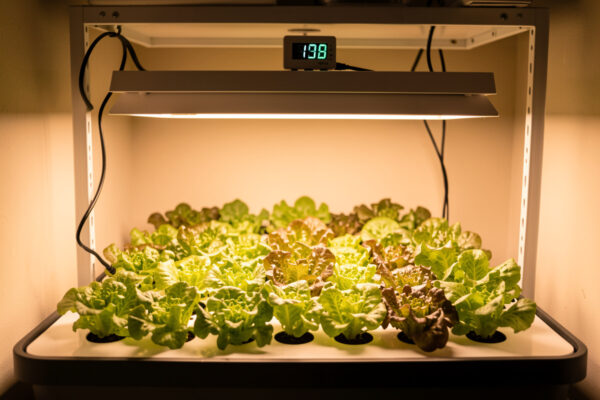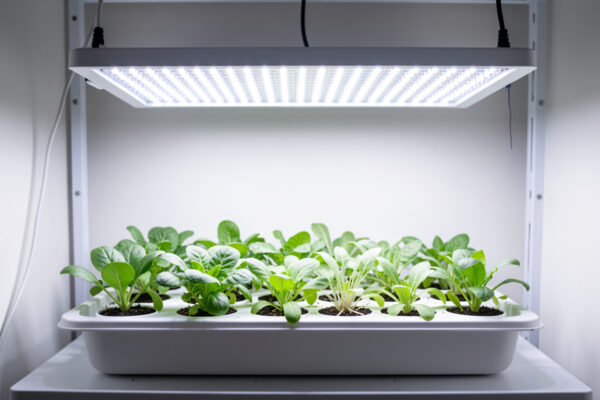
Daily light integral (DLI) is the number that decides whether your winter greens grow or just sit there, and in a dark northern winter almost all of it has to come from your fixture. DLI is simply how many moles of usable light land on a square metre of canopy over a full day — PPFD multiplied by seconds of light, converted to moles. Leafy greens want 12–17 mol/m²/day; at my latitude in December the winter sun delivers a small fraction of that even at a south window, so the supplemental light isn’t a top-up, it’s the entire meal. Get the DLI math right and lettuce that crawled all winter suddenly fills a tote.
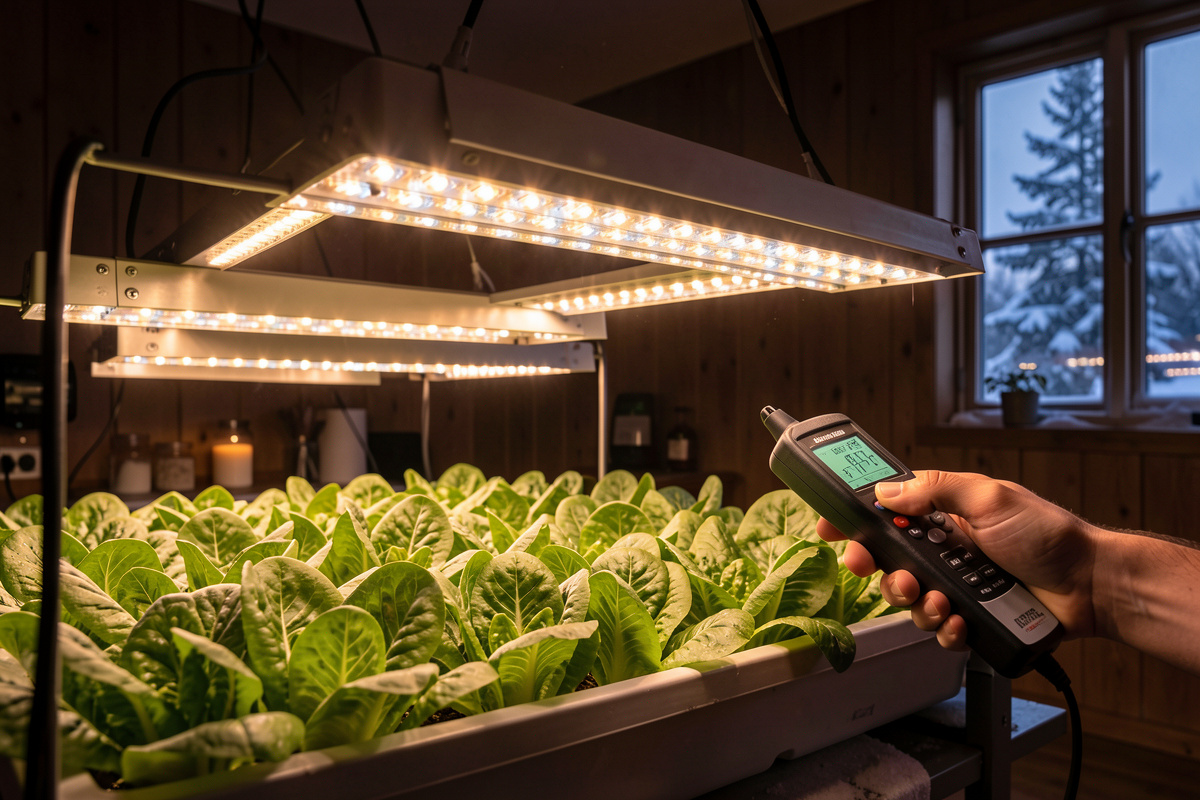
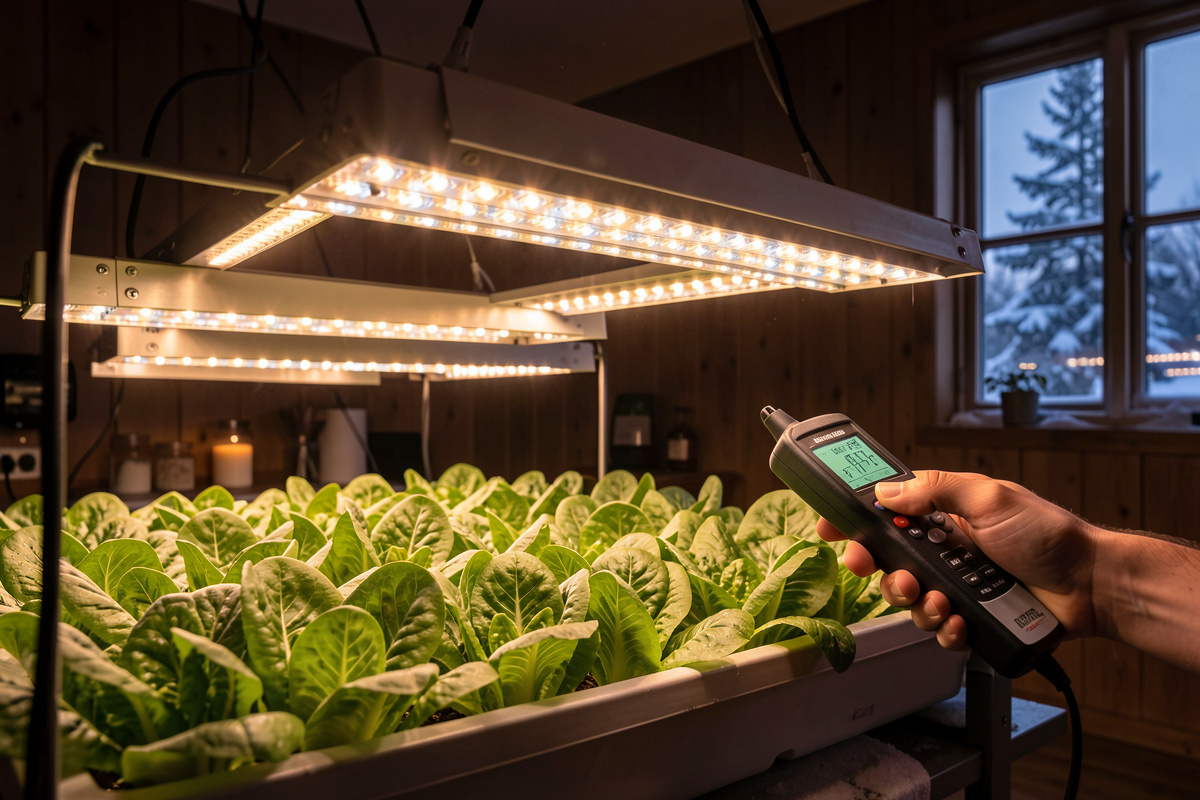
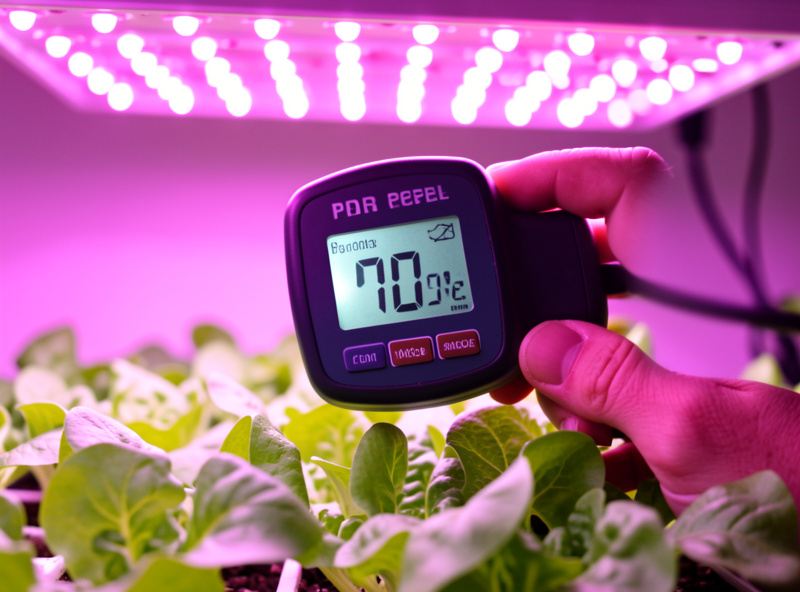
I learned this the expensive way. My first winter I ran a “full spectrum” panel by the wattage on the box, never metered it, and wondered why the lettuce came in thin and slow. When I finally held a PAR meter at canopy the reading told the whole story: I was delivering barely half the DLI I thought I was. This is the arithmetic I run now, with the meter in hand, every time I bring a winter grow online.
What Is DLI and Why Does It Rule Winter Growing?
DLI is the total amount of photosynthetically active light delivered to a canopy over 24 hours, measured in moles per square metre per day. It’s the single most useful lighting number because it combines intensity and duration into one figure a plant actually responds to. A bright light run for a short day and a dim light run long can deliver the same DLI — the plant cares about the total, not either half alone.
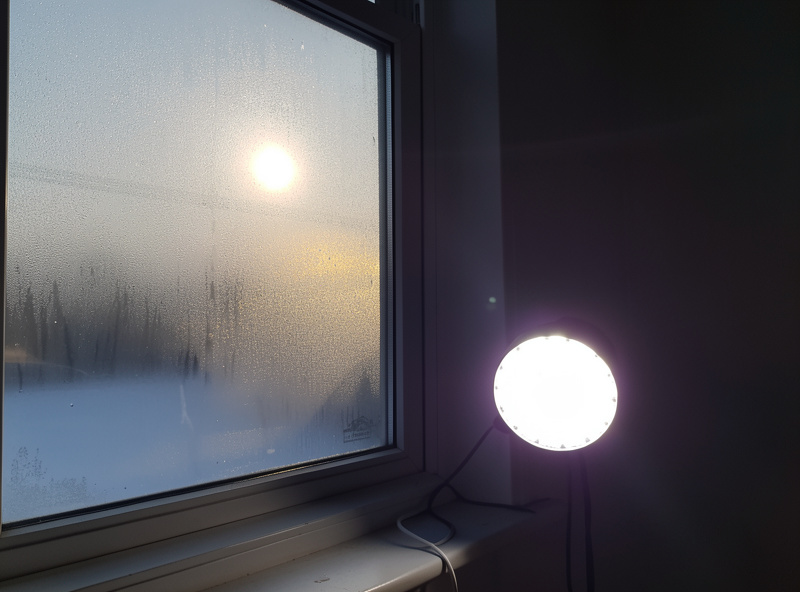
In summer, daylight through a window contributes real DLI and your fixture just fills gaps. In a Nordic winter that contribution collapses. Short days, a low sun angle, and heavy cloud mean the outdoor DLI at my window in December is a rounding error next to what my LED delivers. That’s why cold-climate growers have to do the DLI math warm-climate channels can hand-wave: for us the fixture is the sun, and if the fixture’s numbers are wrong, nothing saves the crop. This is the winter half of the broader lighting picture I cover in the cold-climate indoor hydroponics hub, and it builds directly on the fundamentals in grow light PPFD and DLI for hydroponics.
How Do You Calculate DLI From PPFD and Photoperiod?
The formula is DLI = PPFD × photoperiod-in-seconds ÷ 1,000,000. PPFD is the instantaneous light intensity at your canopy in micromoles per square metre per second; multiply by the number of seconds the light runs, then divide by a million to convert micromoles to moles. It sounds fussy but it’s one line of arithmetic you do once per setup.
Here’s a real example from my bench. My LED bar reads 250 µmol/m²/s at canopy height on the PAR meter. Run it 16 hours — that’s 57,600 seconds — and the math is 250 × 57,600 ÷ 1,000,000 = 14.4 mol/m²/day. That lands squarely in the leafy-green band. Now watch how fast it falls apart: drop the intensity to 150 µmol/m²/s because the light’s hung too high, and at the same 16 hours you get 8.6 DLI — well below target, and exactly the “why won’t my lettuce grow” winter I described above. The photoperiod side matters just as much, which is why I dial the clock deliberately in my winter light schedule.
What PPFD and Photoperiod Combinations Hit Target DLI?
You have two knobs — intensity and hours — and several ways to reach the same DLI. The table below is the grid I keep in my head for leafy greens; every cell is PPFD × hours worked out to a DLI, so you can see the trade-offs at a glance. I aim to land in the 12–17 band without pushing the photoperiod so long it stresses the plants or wastes electricity.
| PPFD at canopy (µmol/m²/s) | 12 h | 14 h | 16 h | 18 h |
|---|---|---|---|---|
| 150 | 6.5 | 7.6 | 8.6 | 9.7 |
| 200 | 8.6 | 10.1 | 11.5 | 13.0 |
| 250 | 10.8 | 12.6 | 14.4 | 16.2 |
| 300 | 13.0 | 15.1 | 17.3 | 19.4 |
| 350 | 15.1 | 17.6 | 20.2 | 22.7 |
Read it and the strategy is obvious: at a weak 150 µmol/m²/s you can’t reach the leafy-green band no matter how long you run — that’s a fixture-too-high or fixture-too-weak problem, not a schedule problem. Around 250–300 at canopy, a 14–16 hour day puts you comfortably in range. For fruiting crops chasing 20–30 DLI you need the 350-plus rows and long days, which is why tomatoes are an electricity decision in winter, not a casual one.
Why You Must Meter PPFD Instead of Trusting Watts
Advertised wattage tells you nothing about the light reaching your canopy. Two 150W fixtures can deliver wildly different PPFD depending on efficiency, beam spread, and hang height, and the marketplace “equivalent to 1000W” claims are pure fiction. The only honest number is what a PAR meter reads at the top of your plants, and a $30 quantum-style meter turns your whole grow from guesswork into arithmetic.
Hang height is the lever most people ignore. PPFD falls off fast with distance — roughly with the inverse square — so raising a bar from 30 cm to 45 cm above the canopy can cut intensity by a third, which is exactly how a fixture that should hit target drifts down to 150. I set hang height first, meter the canopy, then lock it, and I re-check whenever the plants grow up toward the light. The full distance-and-intensity relationship is in grow light distance, and if you’re still choosing a fixture, LED vs HPS and the grow lights guide cover what to buy before you meter it.
If you don’t own a meter yet, that’s the first purchase, ahead of any fixture upgrade. I search for a handheld PAR/PPFD meter and treat it as the most important tool on the bench — it’s the difference between knowing your DLI and hoping.
As an Amazon Associate I earn from qualifying purchases.
How Do I Set Winter DLI on My Own Bench?
My routine is three steps and takes fifteen minutes. First, hang the fixture and meter PPFD at several points across the canopy — the centre always reads higher than the edges, and I care about the average, not the hot spot under the middle of the bar. Second, pick a photoperiod that lands the average PPFD in the 12–17 DLI band using the grid above. Third, log it and re-meter weekly, because the plants grow toward the light and the effective PPFD creeps up as the canopy rises.
The honest confession baked into that routine: I skipped the metering for a full winter and paid for it in slow, pale lettuce. The plants weren’t deficient and the res chemistry was fine — the light was simply out of band and I had no number to prove it. Now the PAR meter comes out before I plant anything, the same way the thermometer goes in the res first. In cold-climate growing the meters aren’t accessories; they’re the only way to know the invisible thing — light — is actually where you think it is. University horticulture programs publish clear DLI targets by crop if you want to sanity-check your numbers: University of Minnesota Extension and Michigan State University Extension both cover controlled-environment lighting in depth.
Does Cold Change How Much Light Your Plants Can Use?
Yes, and it’s the trap that catches careful growers. Light and temperature work together: a plant can only convert the light it receives into growth as fast as its metabolism allows, and metabolism runs on root-zone temperature. Pile on a perfect 15 DLI while the res sits at 13°C and the plant simply can’t use it — you’re paying for electricity the roots can’t cash. That’s why I fix reservoir temperature before I fuss over the last mole of DLI — how I hold the res in band with an unheated room around it is in keeping a reservoir warm enough in winter.
In practice this means my winter light targets assume a warm root zone. Once the res holds 18–20°C the plant responds to the light the way the DLI table predicts; let the res drift cold and the same DLI produces half the growth. I’ve watched this directly on my bench — two identical DWC totes under the same bar, one on a heater and one not, and the cold one lags badly despite reading an identical PPFD at canopy. The lesson: DLI is necessary but not sufficient in a cold room. Nail the light math here, then make sure the res is warm enough to use it, which is the whole point of pairing this with reservoir heat. Get both right and winter greens grow as if it were spring.
Frequently Asked Questions
What DLI do leafy greens need in winter?
Leafy greens want a daily light integral of roughly 12 to 17 mol per square metre per day. In a dark northern winter almost all of that has to come from your grow light, because the short low-angle winter sun contributes very little even at a south-facing window.
How do I calculate DLI from my grow light?
Multiply the PPFD at your canopy in micromoles per square metre per second by the number of seconds the light runs each day, then divide by one million. For example 250 PPFD run for 16 hours is 250 times 57600 divided by 1000000, which equals 14.4 mol per square metre per day.
Can I use wattage instead of a PAR meter?
No. Advertised wattage tells you nothing about the light actually reaching your canopy, and equivalent-wattage marketing claims are unreliable. Only a PAR or PPFD meter reading taken at the top of your plants gives you the real intensity you need to calculate DLI.
Does raising my grow light really cut the DLI that much?
Yes. Light intensity falls off roughly with the inverse square of distance, so raising a bar from 30 to 45 centimetres above the canopy can cut PPFD by about a third. That is often the difference between hitting your target DLI band and falling well short of it.
Is it better to run a brighter light for fewer hours or a dimmer light longer?
Both can reach the same DLI since it is intensity times duration, but there are limits. Very low intensity cannot be rescued by long hours, and extremely long photoperiods stress some crops and waste electricity. Aim for a moderate PPFD around 250 to 300 at canopy with a 14 to 16 hour day for most leafy greens.
Further Reading
- Cold-climate indoor hydroponics: my winter system
- Grow light PPFD and DLI for hydroponics: the numbers explained
- Grow light distance: how far from hydroponic plants
- Hydroponic grow lights: how to choose, hang and schedule
What I’d do starting today: borrow or buy a PAR meter, hold it at canopy, and run one line of arithmetic. If your DLI isn’t in the 12–17 band, no nutrient tweak will fix the slow winter growth — the light is the problem, and now you can prove it.