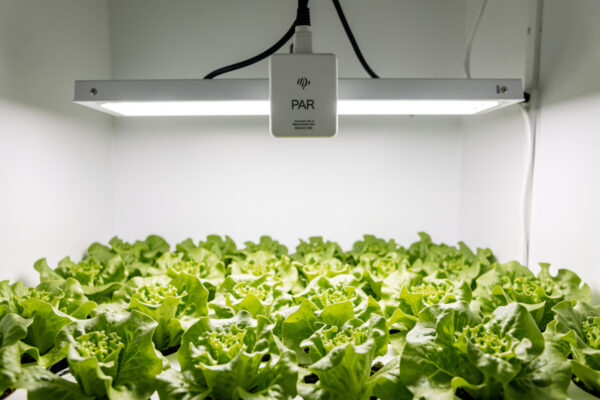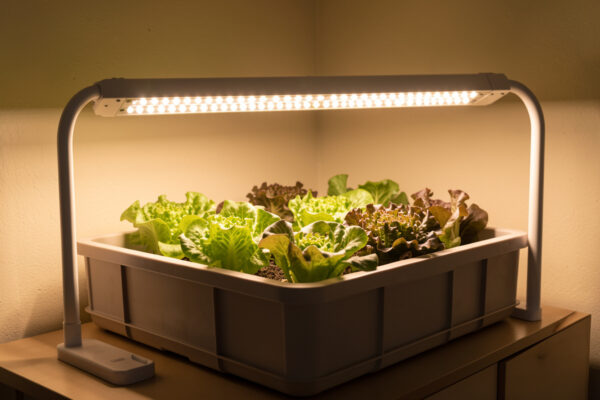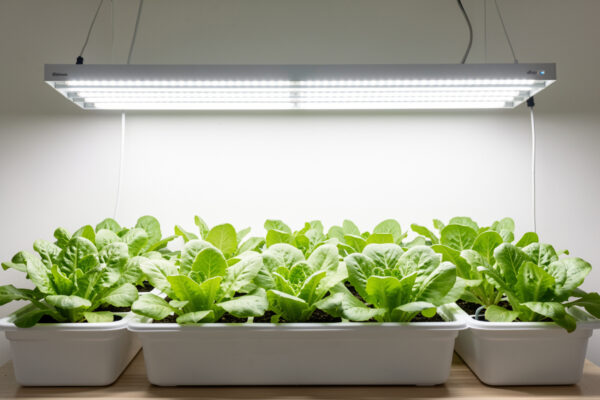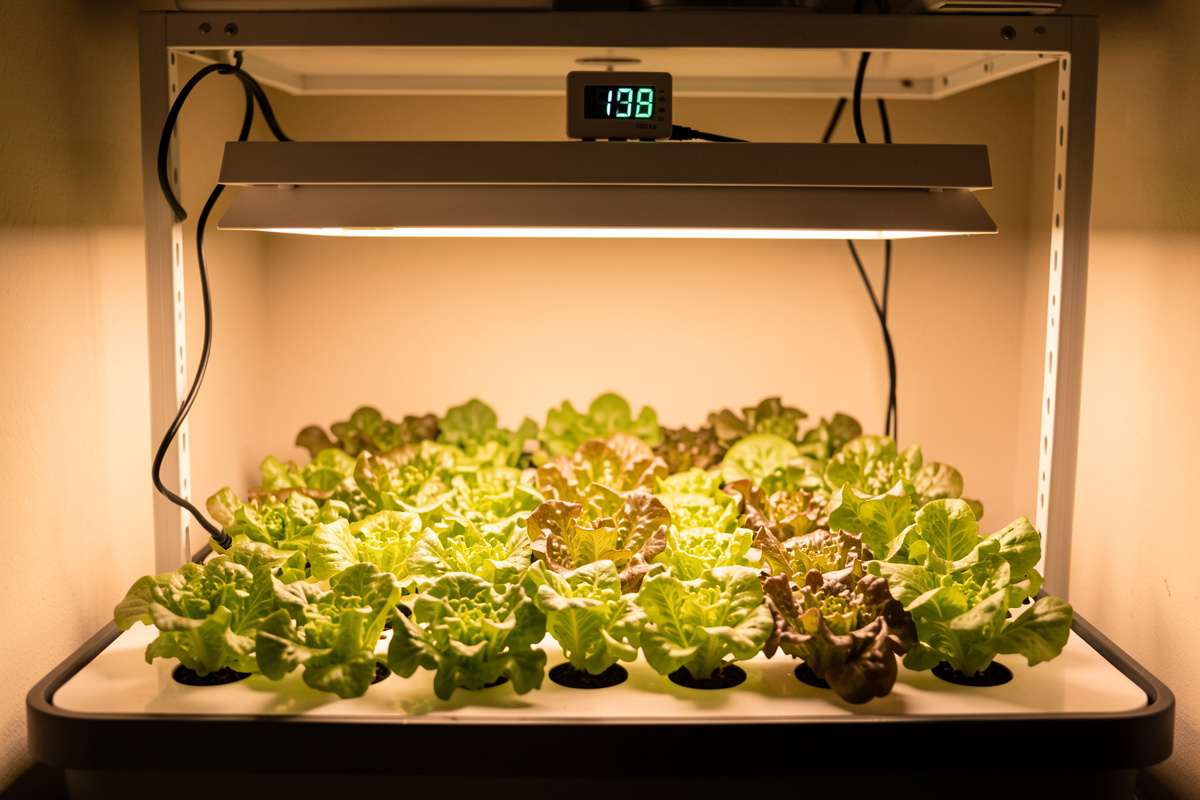
Hydroponics is a control loop, and the photoperiod is the clock that runs it. Of all the lighting decisions a grower makes, the schedule is the one I see treated most casually — flip the lights on in the morning, off at night, roughly. But the on/off cycle isn’t a rough thing to your plants; it’s a signal they read precisely, and getting it consistent does more for steady growth than chasing the perfect spectrum or the last few PPFD. I never run my lights by hand. A cheap timer handles the schedule, and the “smart” in how I grow is exactly this: set the clock, let it run, intervene only when the loop fails.
Growing indoors in Sweden, where the natural day length swings wildly across the year, taught me to ignore the sun entirely and impose my own day on the plants. That turns out to be one of indoor hydroponics’ quiet advantages: you control the photoperiod completely, so you can give a crop the exact light schedule it wants regardless of season. Here’s how I set those schedules, why consistency beats maximum hours, and the timer setup that makes it effortless.
How Many Hours? Start With the Crop
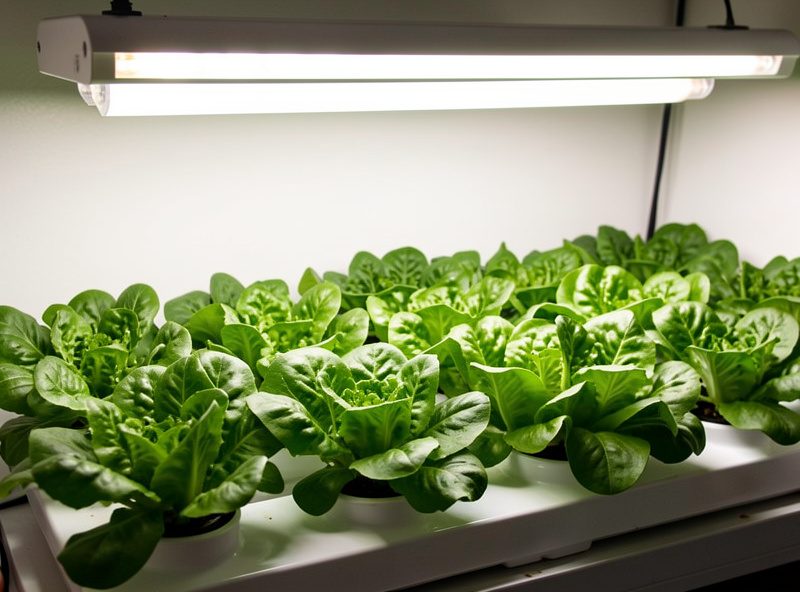
Light schedule is crop-driven, and the first split is between leafy greens and fruiting plants. Leafy greens and herbs — lettuce, basil, kale, spinach — are day-length neutral, meaning they don’t flower in response to light hours, so you can run them long: 14 to 18 hours of light a day is a productive, common range, and many growers settle around 16. More hours mean more total daily light (DLI) and faster growth, up to the point where the plants need some dark to respire and you stop seeing a return.
Fruiting and flowering crops are more particular. Some are photoperiod-sensitive, using the length of the dark period to decide when to flower — give them the wrong day length and you delay or trigger flowering at the wrong time. For the leafy greens and herbs that make up most home hydroponics, you don’t have to worry about that, which is one more reason they’re the forgiving first crops. Match the hours to the crop’s DLI target and you’ve solved most of the puzzle.
Why Plants Need Darkness
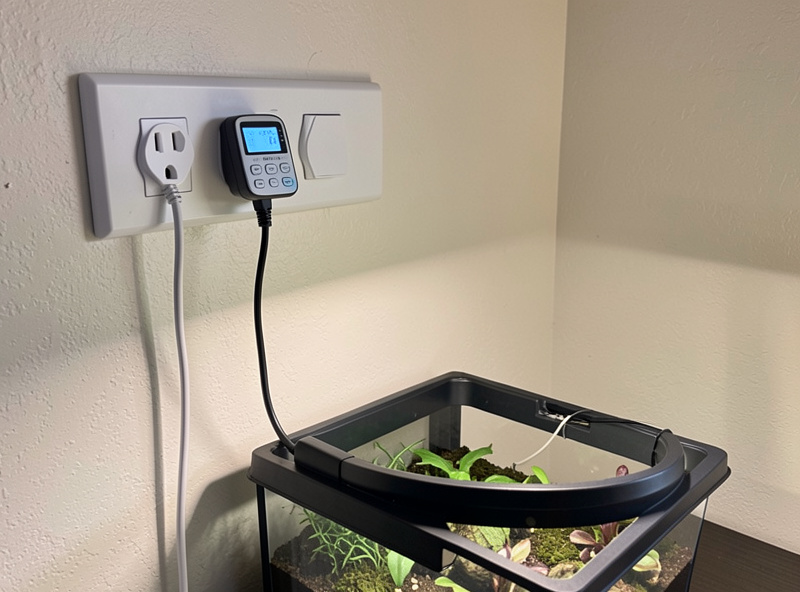
It’s tempting to think more light is always better, so why not run lights 24 hours a day? Don’t. Most plants need a dark period to carry out essential metabolic processes — they respire, move sugars made during the day, and effectively rest. Running lights around the clock denies them that recovery and, in my experience, produces stressed plants rather than faster ones, often with no growth benefit to show for the extra electricity. The dark period isn’t wasted time; it’s part of the cycle the plant evolved to run.
There are growers who run very long or continuous photoperiods on certain leafy crops and report it works for them, but for a reliable home setup I treat a meaningful dark period as the default. Sixteen hours on, eight off, is a schedule that’s hard to beat for leafy greens and gives the plants their rest while still delivering a strong DLI.
The dark period earns its keep in another way that’s easy to overlook: it’s when you should be doing most of your hands-on work. Spraying anything on the leaves, fiddling with the roots, or topping off and adjusting the reservoir is gentler on plants during their dark cycle, and a predictable lights-off window gives you a planned slot to do it. I time my res checks and any foliar work to land in the dark period for exactly this reason — the plant isn’t mid-photosynthesis, and the timer guarantees I know precisely when that window opens every day.
Splitting the Photoperiod: Day-and-Night Tricks
Most growers run a single block of light — sixteen hours on, eight off — and that’s perfectly good. But once you have a digital or smart timer, a couple of split-cycle tricks are worth knowing. Some growers split the dark period or run the lights through the coolest part of the day to manage heat, since even efficient LEDs add a little warmth to a closed space and your choice of fixture determines how much that matters. Running lights overnight, when your room and your electricity may both be cheaper and cooler, is a genuinely useful option a timer makes trivial.
There’s also a practical Nordic angle here: in deep winter, running the photoperiod through the dark evening hours means the grow light is effectively standing in for the sun that never showed up, and in summer I sometimes shift it to avoid stacking grow-light heat on top of a warm afternoon. None of this changes the total hours the crop receives — it just moves them to a clock that suits the room. The plants only care about the cycle being consistent day to day, not whether “day” for them happens to fall at night for you. That flexibility is one of the underrated freedoms of growing under artificial light.
Consistency Beats Everything
If I had to name the single most important thing about a light schedule, it wouldn’t be the number of hours — it would be consistency. Plants entrain to a stable light/dark rhythm the way a sourdough starter entrains to a feeding schedule, and a wandering photoperiod stresses them. Lights that come on at 6 a.m. one day and 9 a.m. the next, or a schedule you keep tweaking, send mixed signals and show up as uneven, sulky growth.
This is precisely why manual switching fails: you forget, you travel, you flip them late, and the inconsistency accumulates. A timer removes the human from the loop entirely. Set it once to a stable cycle and the plants get the same day, every day, whether you’re home or not — the same automation logic I apply across my sensing and monitoring setup. Pick your hours, commit to them, and let the clock be boring.
The Timer: Mechanical, Digital, or Smart
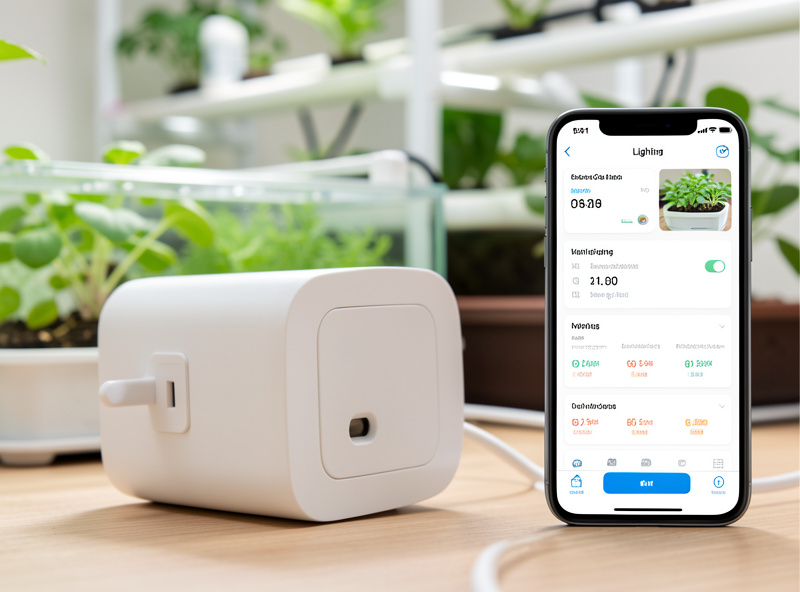
You have three tiers of automation, and all of them beat doing it by hand. A basic mechanical timer with pins is dirt cheap, has no software to glitch, and does the one job perfectly — I’ve run plenty of grows on nothing fancier. A digital timer gives you precise on/off times and multiple cycles, useful if you want to split the photoperiod. A smart Wi-Fi plug adds remote control, scheduling from your phone, and integration with the rest of a smart-home or hydro-automation rig — handy, and the natural choice if you’re already running a connected setup, but not necessary for the core function.
My honest advice: start with a reliable timer of any tier and don’t overthink it. The expensive smart plug doesn’t grow better plants than the cheap mechanical timer; it just adds convenience and remote visibility. What matters is that something other than your memory controls the lights. A solid grow-light timer or smart plug is available on Amazon here. As an Amazon Associate I earn from qualifying purchases.
Light Schedules by Crop Type
| Crop | Light hours | Dark hours | Notes |
|---|---|---|---|
| Lettuce / leafy greens | 14–16 | 8–10 | Day-length neutral; consistency matters most |
| Herbs (basil, etc.) | 14–18 | 6–10 | Tolerate long photoperiods well |
| Seedlings / starts | 16–18 | 6–8 | Long gentle light, lower intensity |
| Fruiting crops | 12–16 | 8–12 | Some are photoperiod-sensitive; research the variety |
What a Failed Schedule Looks Like
It’s worth knowing the symptoms of a photoperiod problem, because they’re easy to misdiagnose as nutrient or light-intensity issues. The classic sign of too few light hours is slow, pale, stretchy growth — the plant simply isn’t accumulating enough daily light, so it reaches and thins. The fix is more hours or more intensity to lift the DLI, not more fertilizer. On the other end, plants run on too long with no real dark period can look stressed, with curling or a tired, off-color cast, and they rarely grow faster to justify it.
The trickiest failure is the inconsistent one, because it doesn’t produce a clean symptom — just generally underwhelming, uneven growth that never quite thrives. I’ve chased that ghost before, checking EC and pH and root health, only to realize the real culprit was a wall switch I wasn’t flipping at the same time each day. The moment everything went onto a timer, the mystery cleared up. If a leafy crop is sulking and your reservoir checks out, audit the schedule before you touch anything else — a wandering or too-short photoperiod is a more common cause of disappointing growth than most growers suspect.
Setting It and Forgetting It
Here’s my whole workflow: pick the crop, choose a photoperiod in its range that delivers the right DLI at your fixture’s intensity, set a timer to that exact cycle, and leave it alone. Re-check only when you change crops or notice a problem. That’s the beauty of imposing your own day on an indoor grow — once the schedule is set and automated, the photoperiod becomes the one variable you never have to think about, freeing your attention for the reservoir and the nutrients, where the real day-to-day management lives. A boring, consistent light schedule is a sign you’ve got this part right. Pair it with the right hanging height and a quality full-spectrum fixture, and your lighting is fully dialed in.