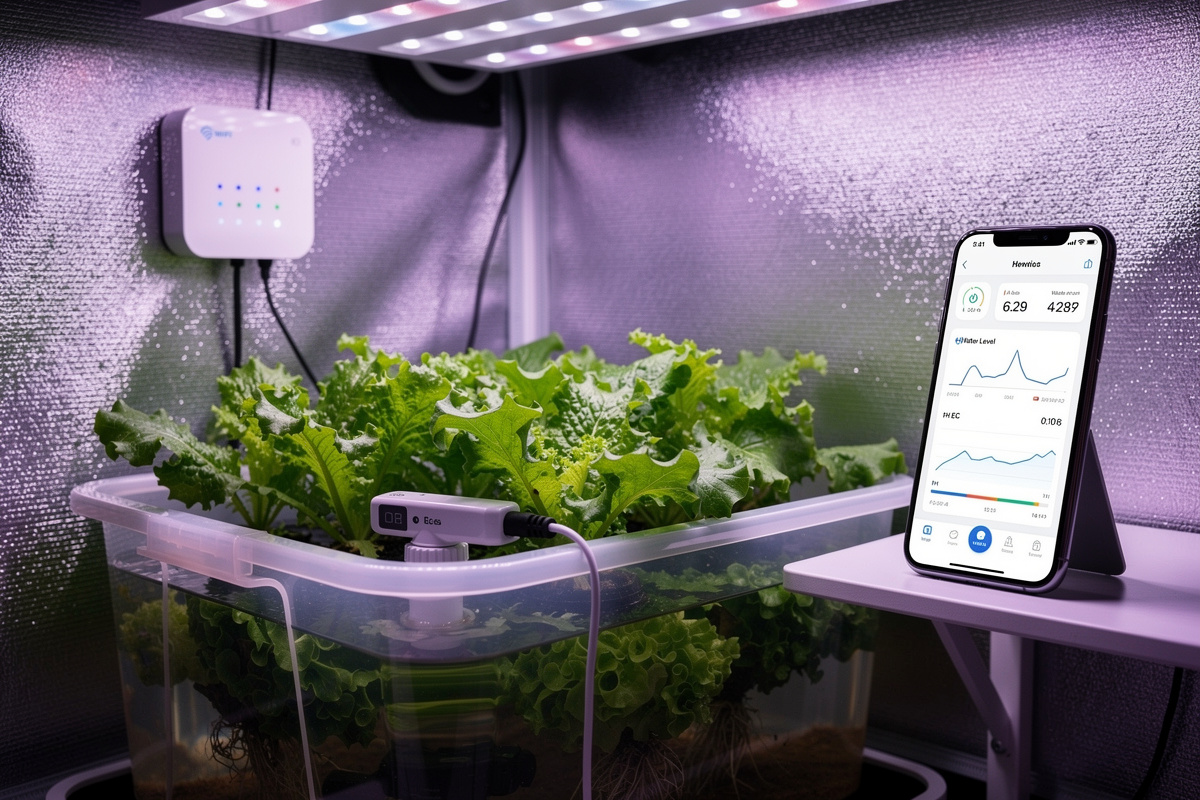
Manual hydroponic monitoring works — it’s what I run on every one of my own reservoirs, pH pen and EC pen logged by hand across DWC, NFT, Kratky, and ebb-flow. It works until it doesn’t — until you skip a day, take a weekend trip, or one of the three drift events that wipe a crop hits while you weren’t looking. Smart sensors close that gap by sampling continuously and pushing alerts to your phone before pH drift, EC creep, or a pump failure becomes a dead reservoir.
This guide covers the five parameters worth automating, which sensor protocols actually work in a residential hydroponic setup, and how to wire the data into a home automation system so the sensors trigger alerts and corrective actions without you watching a dashboard.
Why Smart Sensors Matter for Hydroponic Systems
Smart hydroponic sensors continuously measure and log conditions that drift faster than weekly check-ins can catch. A typical recirculating system loses 0.1–0.3 pH units per day from plant uptake; a manual measurement schedule of every 3 days can miss a drift to 7.0 (where iron and phosphorus precipitate out) before you correct.
The economic case is straightforward. A standard Bluelab pH Controller Wi-Fi runs around $629 per Bluelab’s own product page. A weekend pH crash that kills 10 lettuce heads costs the same in time and seed cost. After 1–2 prevented incidents, the controller pays for itself. For commercial-scale or kitchen-production setups, that math collapses to weeks.
The home grower running 1–2 small systems faces a different math: smart sensors are not strictly necessary, but they reduce daily attention from “five-minute check, twice daily” to “one alert per week, when something needs you.” That’s the value proposition — not catastrophic prevention, but ambient peace of mind.
The Five Parameters Worth Automating
Not every hydroponic measurement deserves a sensor. The five that pay back the wiring effort:
1. pH. The single most volatile parameter in hydroponics. Plants prefer 5.5–6.5 for most crops; outside that band nutrients lock out even at correct concentrations. Drift speed depends on plant size and crop type — a 6-plant lettuce DWC drifts slower than a 12-plant tomato bucket. Both benefit from continuous monitoring.
2. EC / TDS / PPM. The strength of the nutrient solution. Drifts up as water evaporates (concentration increases) or down as plants consume nutrients faster than water. The manual EC meter article covers the parameter in depth; the smart version automates the same measurement with logging.
3. Water level / reservoir volume. The single most catastrophic failure mode. A pump running dry kills root systems within 4–6 hours. Float switches and ultrasonic sensors both work; the smart version pings your phone instead of (or before) shutting off the pump.
4. Water temperature. Above 75°F, dissolved oxygen drops and root rot pathogens accelerate. Below 60°F, nutrient uptake slows. Indoor systems usually stay in range, but a malfunctioning chiller or a hot summer week can push outdoor systems out fast.
5. Air temperature and humidity. Less critical for the hydroponic system itself but linked to plant transpiration and powdery-mildew risk. A single sensor in the grow tent covers both.
Two parameters that look like good candidates but rarely justify the sensor: dissolved oxygen (DO meters cost $300+ and only matter in deep water culture with weak air pumps) and CO2 (only matters in sealed grow tents with gas dosing). Skip both for typical home setups.
Smart Sensor Hardware: Wi-Fi vs Zigbee vs Z-Wave
For hydroponic sensors specifically, Zigbee or Z-Wave outperform Wi-Fi on every metric except initial setup ease. Battery life is 6–18 months on Zigbee versus 1–4 months on Wi-Fi for equivalent sensors, and Zigbee’s mesh network handles the basement/garage placement most growers actually use.
The protocol comparison:
| Aspect | Wi-Fi | Zigbee | Z-Wave | Bluetooth LE |
|---|---|---|---|---|
| Battery life (sensor) | 1–4 months | 6–18 months | 6–24 months | 3–6 months |
| Range | 30–100 ft | 30 ft + mesh | 50 ft + mesh | 15–30 ft |
| Hub required | No (router only) | Yes (Zigbee hub) | Yes (Z-Wave hub) | Phone or hub |
| Setup complexity | Low | Medium | Medium | Low |
| Best for hydro | Powered controllers | Battery sensors | Battery sensors | Manual readouts |
Practical pattern that works: a Zigbee or Z-Wave hub (Aqara M3, Hubitat C-8, Home Assistant + SkyConnect) handles the battery-powered sensors. Wi-Fi handles powered devices like the doser pumps, EC controllers, and the smart plug controlling the main pump. Bluetooth handles the occasional handheld pH pen for spot-checking.
Best Smart pH Sensors for Home Hydroponics
Three categories deliver actually-useful continuous pH:
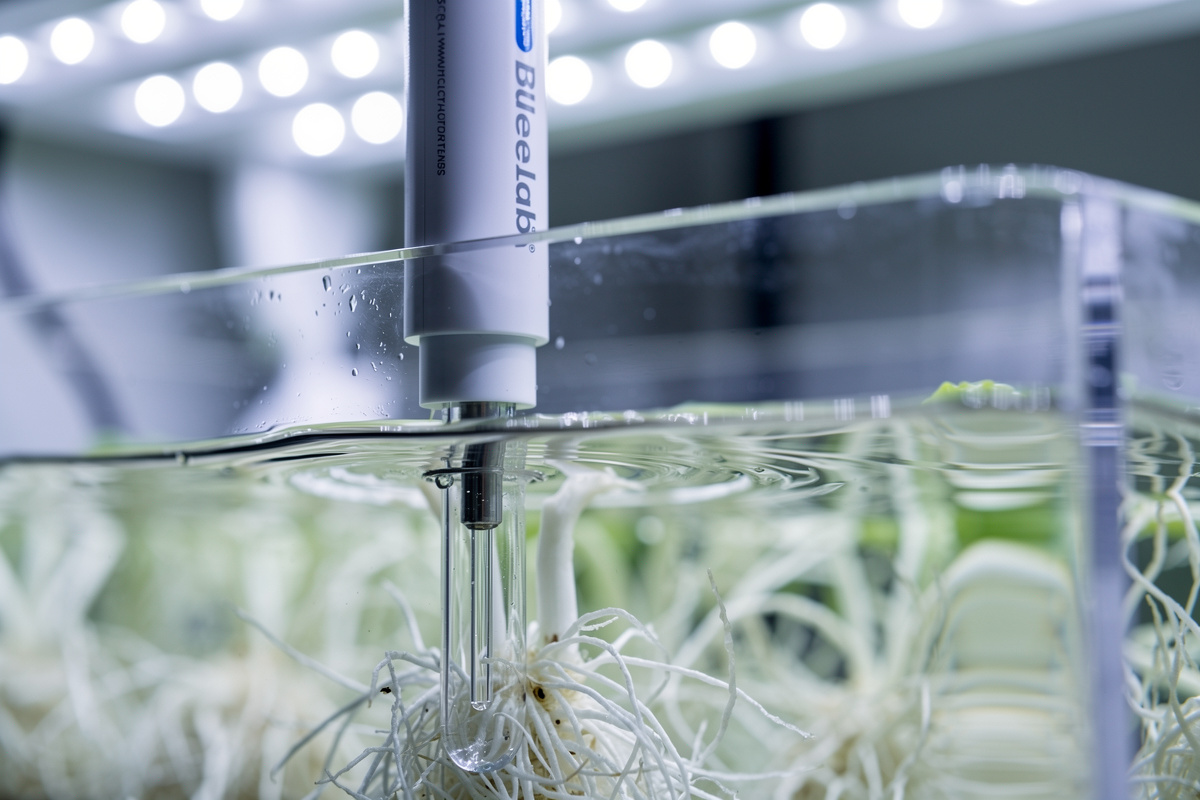
1. Continuous immersion probes (Bluelab Connect, Atlas Scientific EZO). Industrial-grade probes that sit in the reservoir permanently. Wired to a controller that exposes data over USB, Wi-Fi, or MQTT. Bluelab’s Connect line is the home-grower standard, running roughly $300–650 depending on configuration. Atlas Scientific is the DIY/hacker route — the same pH electrode tech via their EZO Complete-pH Kit, which starts at $174.99 for the base probe and climbs toward $400+ with a premium probe, plus a Raspberry Pi to run it. Both deliver lab-grade readings (±0.05 pH) and last 12–24 months before electrode replacement.
2. Multi-parameter pucks (HOBOlink, ECsense, Mi Flora-style for hydro). Single device that reads pH, EC, and temperature. Convenience win, accuracy compromise — most multi-parameter consumer pucks read pH at ±0.2, fine for hobbyist DWC but loose for finicky tomato or strawberry crops.
3. Auto-dosing pH controllers (Bluelab Pro Controller, BlueOX, AutoPilot). Sensor + dosing pump in one. Reads pH, automatically doses pH-up or pH-down to hold setpoint. The most hands-off option, and also the most expensive — Bluelab’s own Pro Controller Wi-Fi lists at $1,499, meaningfully more than the “$700+” ballpark you’ll see quoted for this category elsewhere; BlueOX and AutoPilot land somewhat lower but still solidly four figures once you add dosing pumps. Worth it for absent-owner setups (vacation home, rental property hydroponics) and for kitchen-production growers running 5+ systems — not a casual home-grower purchase. The pH adjustment guide covers the chemistry these auto-dosers automate.
Skip: any “pH stick” that claims continuous monitoring without immersion-rated electrodes. They drift within days.
Best Smart EC/PPM Sensors
EC sensors are mechanically simpler than pH (no glass membrane, no junction to clog) and last longer. The market splits cleanly:
Inline sensors (Bluelab Connect, Hanna HI98129) read the recirculating solution directly. Most reliable; require pump-driven flow past the probe. Best for NFT, ebb-and-flow, and DWC with circulation pumps.
Wand-style sensors dip into the reservoir on a schedule (manually or via servo). Good enough for DWC and Kratky; less convenient than inline.
Combined pH+EC controllers like Bluelab Pro and TrolMaster Aqua-X are the kitchen-production standard. One device, both readings, with controller-side logic for nutrient balance. The two aren’t close on price, though — Bluelab’s Pro Controller runs $1,499, while a TrolMaster Aqua-X system (base controller plus pH/EC sensor modules) typically lands more in the $400–700 range. Worth either for setups running 6+ buckets; which one depends on your budget and how much you value Bluelab’s ecosystem polish.
For DIY: Atlas Scientific EZO-EC + a Raspberry Pi hits ±2% accuracy for under $250 total. The community calibration scripts are mature; integration with Home Assistant is one Python script away.
Smart Water Level and Flow Sensors
The cheapest sensor in the stack and the one that prevents the most catastrophic failure.
Float switches ($5–25) trigger when water drops below a threshold. Wire to a Sonoff Mini or Shelly 1 to expose the trigger to your home automation system. Total cost under $30 per reservoir.
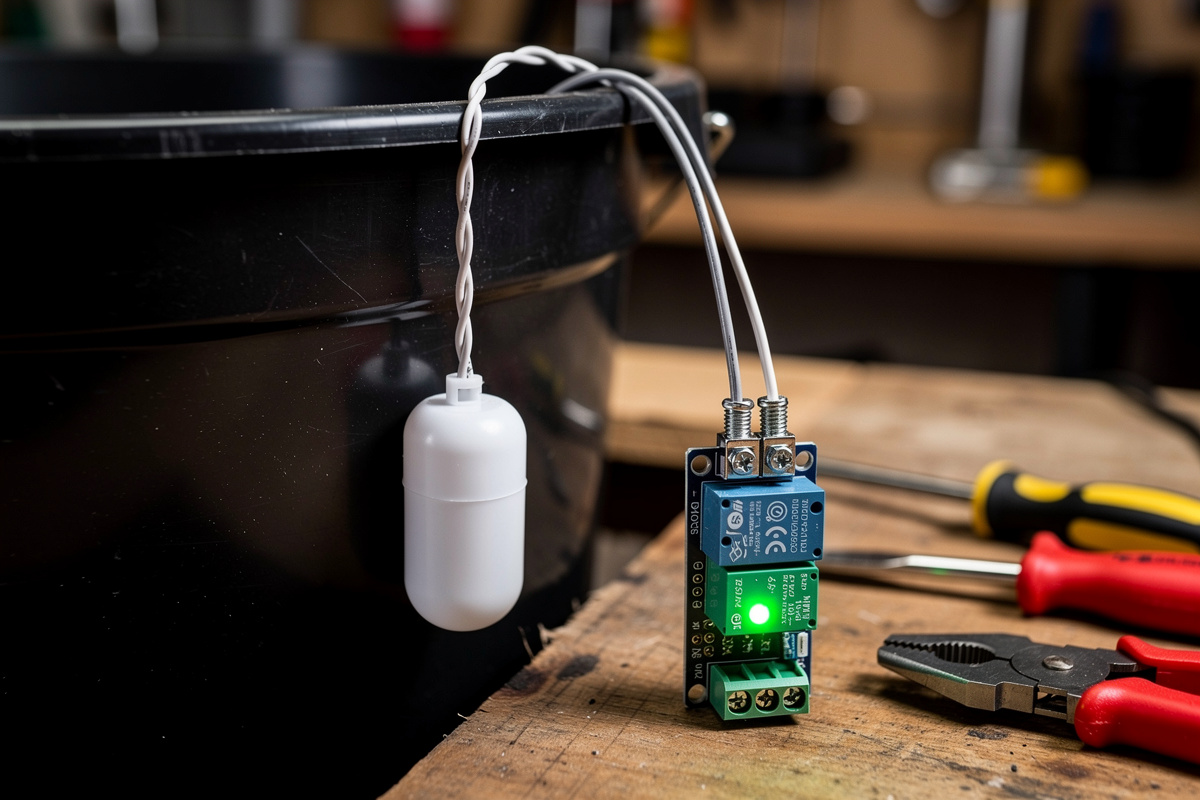
Ultrasonic sensors ($25–60) measure continuous depth without contact. More accurate, more failure modes (foam interferes, condensation interferes). Best for closed reservoirs; questionable for open buckets.
Flow sensors on the pump output line confirm the pump is actually moving water, not just running. The HFS-21 hall-effect flow meter ($15) wired to a NodeMCU is the DIY-darling solution. Commercial: TrolMaster’s flow station.
The combination that prevents 95% of failures: float switch low + flow sensor on pump output + Wi-Fi smart plug controlling the pump. Under $80 in parts; alerts you AND auto-shuts the pump on flow loss. I run smart plugs on my own light and pump timers already — this is the same automation logic extended one step further, and it’s the cheapest insurance in this entire guide against the one failure mode (a pump running dry) I’ve actually lost a root system to.
Connecting Hydroponic Sensors to a Home Automation Hub
The ideal stack uses Home Assistant or Hubitat as the central brain, with sensors reporting via Zigbee or Wi-Fi/MQTT. All sensor brands worth buying expose data via at least one of these protocols.
Home Assistant is the home-grower default — open source, runs on a Raspberry Pi, integrates with every sensor brand mentioned in this article. The setup pattern is identical across them: install the integration, point it at the device, sensors appear as entities. From there, dashboards, alerts, and automations are point-and-click.
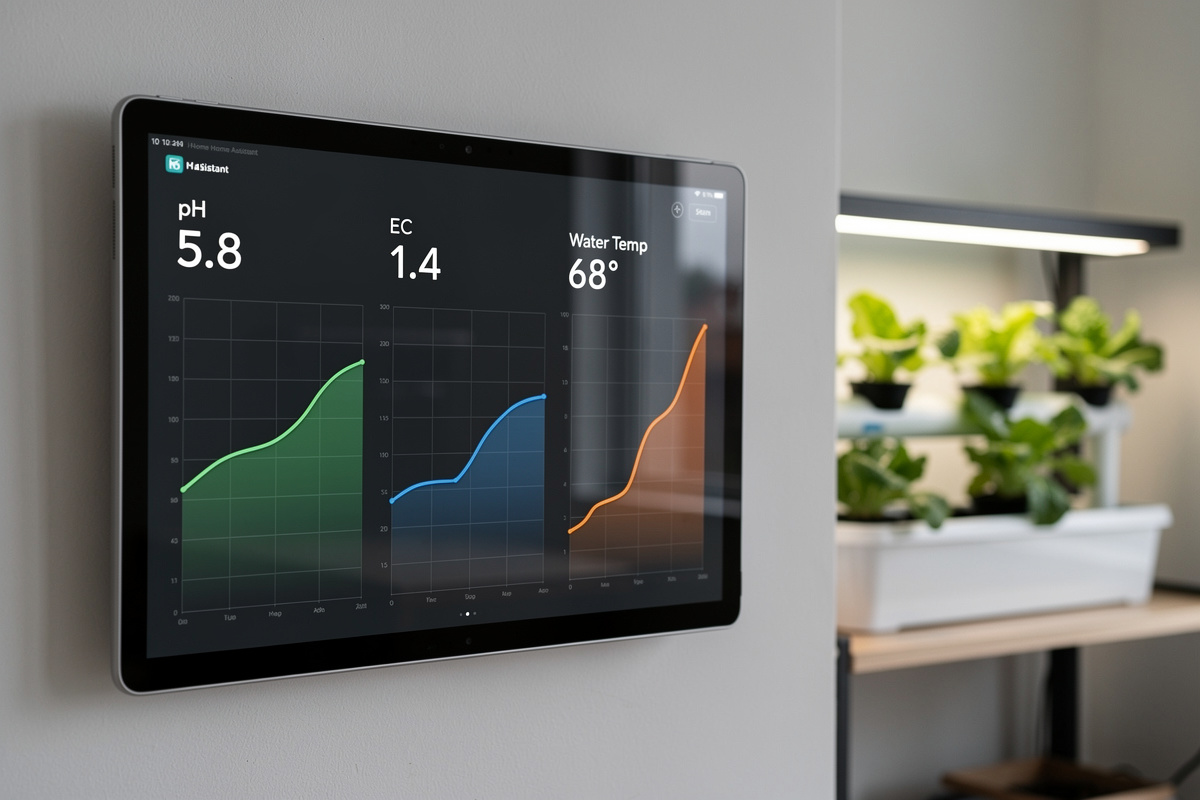
For sensor selection beyond hydroponics — door, window, motion, leak, smoke, temperature — the complete smart sensor buyer’s guide covers the full range with protocol comparisons that apply equally to grow-room sensors. Hydroponic sensors share the same hub, the same automations, and the same notification stack as the rest of the smart home; treating them as a separate system is what makes hydroponic monitoring overcomplicated.
For users not running Home Assistant, Hubitat is the closest commercial alternative with similar protocol breadth. Apple HomeKit, Amazon Alexa, and Google Home all work but lag on Zigbee/Z-Wave coverage and have weaker automation logic for the conditional rules hydroponics needs (“if pH > 6.5 AND EC > 1.6 then alert me but don’t dose”).
Setting Up Alerts and Automated Responses
The best automation rules for hydroponic sensors are alert-first, action-second. Bad automations drain reservoirs into bathrooms; thoughtful ones save crops.
Recommended starting alert rules:
- pH out of range: Alert if pH stays outside 5.5–6.5 for more than 30 minutes. The buffer prevents alert spam during normal post-water-change spikes.
- EC drift: Alert if EC moves more than 0.4 from setpoint within 12 hours. Faster movement than that means a system failure (leak, pump dead, plant stress).
- Water level low: Alert at 20% of reservoir capacity. Auto-shutoff pump at 5%.
- Water temperature high: Alert at 75°F. Trigger chiller (if installed) at 73°F.
- Air temperature outside grow range: Alert at 60°F low and 85°F high.
Active interventions to consider, in order of safety: switching off lights on heat, switching on a fan, switching off the pump on flow loss. Active interventions to AVOID until you have logged 30+ days of data: auto pH dosing (a stuck dosing pump can crash pH within an hour), auto nutrient top-off (concentration errors compound), and any rule that changes more than one variable simultaneously.
Common Sensor Problems and Calibration
Three issues account for 80% of smart-sensor failures.
pH probe drift. Even immersion-grade probes drift 0.1–0.2 pH per month. Calibrate against pH 4.0 and pH 7.0 buffer solutions every 30 days — the same calibration cadence I keep on my own handheld pH pens, just automated. Replace electrodes every 12–24 months. Symptom: readings stop tracking your handheld meter after a few weeks; if a smart probe and a fresh handheld cross-check disagree by more than 0.1-0.2 pH, trust the freshly calibrated handheld and recalibrate the probe.
EC probe fouling. Mineral and biofilm coat the electrodes, lowering apparent EC. Wipe with a soft cloth weekly; soak in 5% white vinegar for 10 minutes monthly. Symptom: EC readings stay flat while plants visibly grow (consumption should be drawing the number down).
Wi-Fi sensor disconnects. Battery-powered Wi-Fi sensors drop off when the router restarts; Zigbee sensors recover faster because the mesh handles re-association. Symptom: gaps in the data log every few days. Fix: switch to Zigbee for battery-powered sensors. The hydroponic equipment buying guide covers the broader equipment recommendations these sensors plug into.
For systems that are working well, a quarterly calibration check and annual electrode replacement keeps the data trustworthy. The point of smart sensors is to remove daily attention; spending an hour every quarter on calibration is a fair trade.
Can smart sensors replace daily hydroponic check-ins?
For mature, stable systems, yes. For new systems or major changes (new crop, new nutrient brand, system rebuild), keep the daily manual check for the first two weeks until you confirm the sensors are tracking reality. Sensors fail silently more than catastrophically.
Do smart hydroponic sensors work without internet?
Yes if the sensors and hub run locally. Home Assistant, Hubitat, and Bluelab Connect all support fully local operation. Cloud-only sensors (some Wi-Fi brands) stop working when the internet drops. Choose local-first protocols for grow rooms.
What is the cheapest viable smart sensor setup?
A float switch ($10), a Sonoff TH16 with DS18B20 temperature probe ($25), and a manual EC pen for weekly checks ($30) covers the catastrophic failure modes for under $70. Add a Bluelab pH Pen (roughly $95-125) for accurate handheld spot-checks – note that’s spot-checking, not true continuous monitoring; for genuinely continuous immersion pH at the budget end, the Atlas Scientific EZO kit (starts at $174.99) plus a Raspberry Pi is the real cheap entry point. Either way, total lands around $270-350.
Are Wi-Fi pH sensors accurate enough for hydroponics?
Wi-Fi affects connectivity, not accuracy — sensor accuracy depends on the electrode and ADC, not the radio. The Wi-Fi pH sensors that perform well (Bluelab Connect, Atlas EZO with ESP32) read at ±0.05 pH. Cheap sub-$50 Wi-Fi pens drift quickly regardless of connectivity.
How often do smart sensors need calibration?
pH probes need 2-point calibration monthly with pH 4.0 and pH 7.0 buffers. EC probes need single-point calibration quarterly with 1413 µS or 1500 ppm standard. Temperature and water-level sensors are factory-calibrated and rarely need adjustment.
Can I use a Mi Flora plant sensor for hydroponics?
No. Mi Flora and similar capacitive soil sensors measure soil moisture and EC of soil — they read incorrectly when fully submerged in water. Use purpose-built hydroponic immersion probes. The form factor difference is the giveaway.
Related Articles
- EC Meter for Hydroponics: How to Read and Calibrate — manual EC monitoring foundation
- pH Down for Plants: Safe Use, Dosing, and Alternatives — pH chemistry these sensors monitor
- Essential Hydroponic Equipment — what the sensors connect into
- Hydroponic Nutrients Complete Guide — the EC targets these sensors are reading against
- Hydroponic Systems: Complete Guide to All Methods — system types these sensors monitor