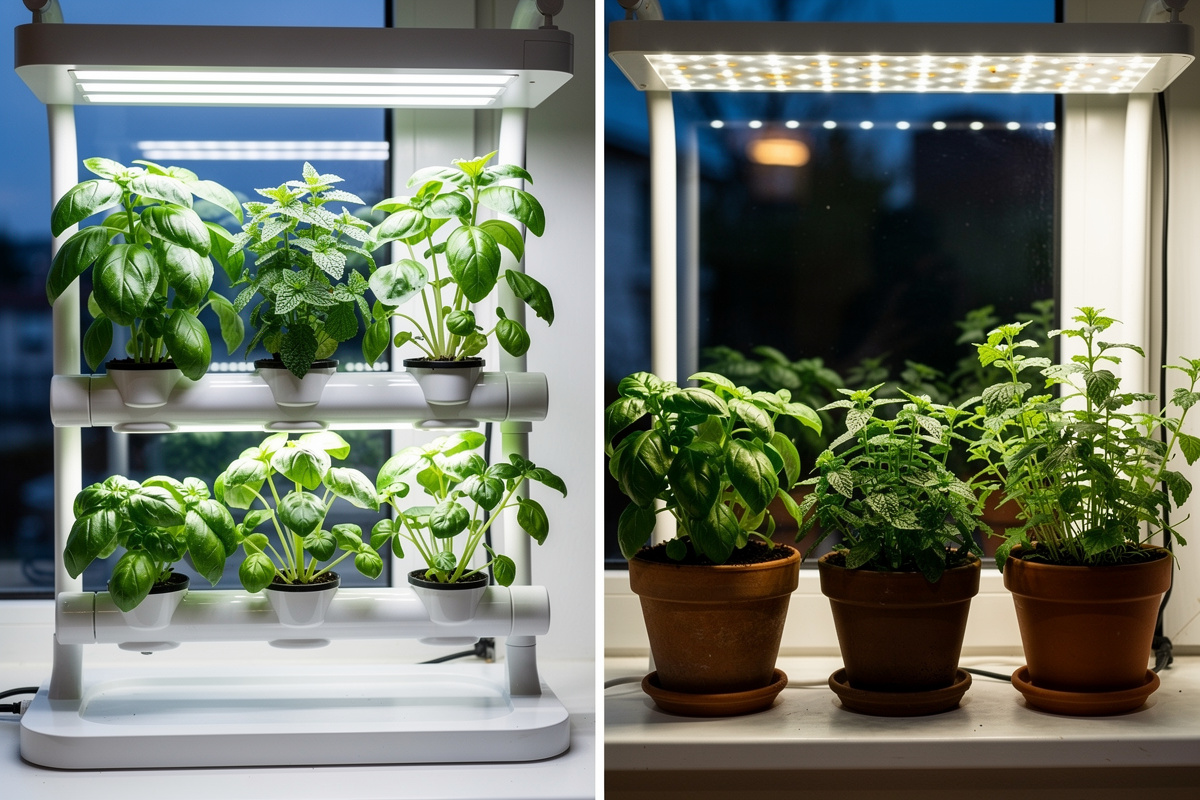
Herbs are one of the most popular crops for indoor growing — and the debate between hydroponics and soil is especially heated. On my own bench, hydroponic herbs are the fastest-growing thing I run, full stop, and Kratky jars in particular make the case louder than any other crop I grow. Soil growers point to richer flavor, lower cost, and simpler maintenance. This guide compares both methods across every factor that matters so you can choose the approach that fits your kitchen, budget, and growing style.
As an Amazon Associate I earn from qualifying purchases.
Hydroponic Herbs vs Soil Grown: Key Differences at a Glance
| Factor | Hydroponic Herbs | Soil-Grown Herbs |
|---|---|---|
| Growth speed | 30–50% faster to first harvest | Standard growth rate |
| Yield per plant | 25–40% higher with optimized nutrients | Good — depends on soil quality |
| Setup cost | $40–$150 depending on system | $10–$25 for containers and soil |
| Ongoing cost | Nutrient solution, pH supplies | Fertilizer, potting mix replacement |
| Difficulty | Easy to moderate — basic pH monitoring | Very easy — forgiving of mistakes |
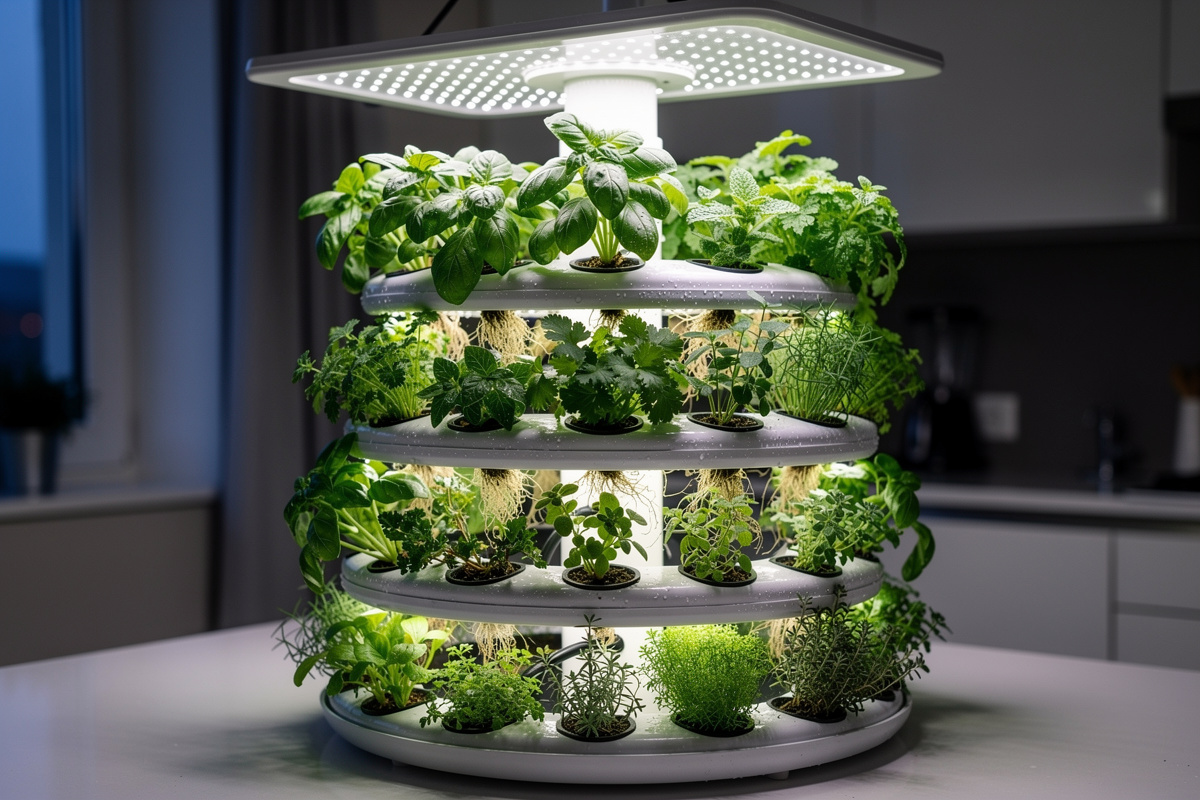
| Space needed | Compact — vertical towers and NFT channels | More counter or windowsill space |
| Pest risk | Very low — no soil-borne pests or fungus gnats | Moderate — fungus gnats, soil mites possible |
| Flavor | Excellent — clean, consistent taste | Excellent — complex, traditional flavor |
| Water usage | 80–90% less than soil | Standard — frequent watering needed |
How Hydroponic Herb Growing Works
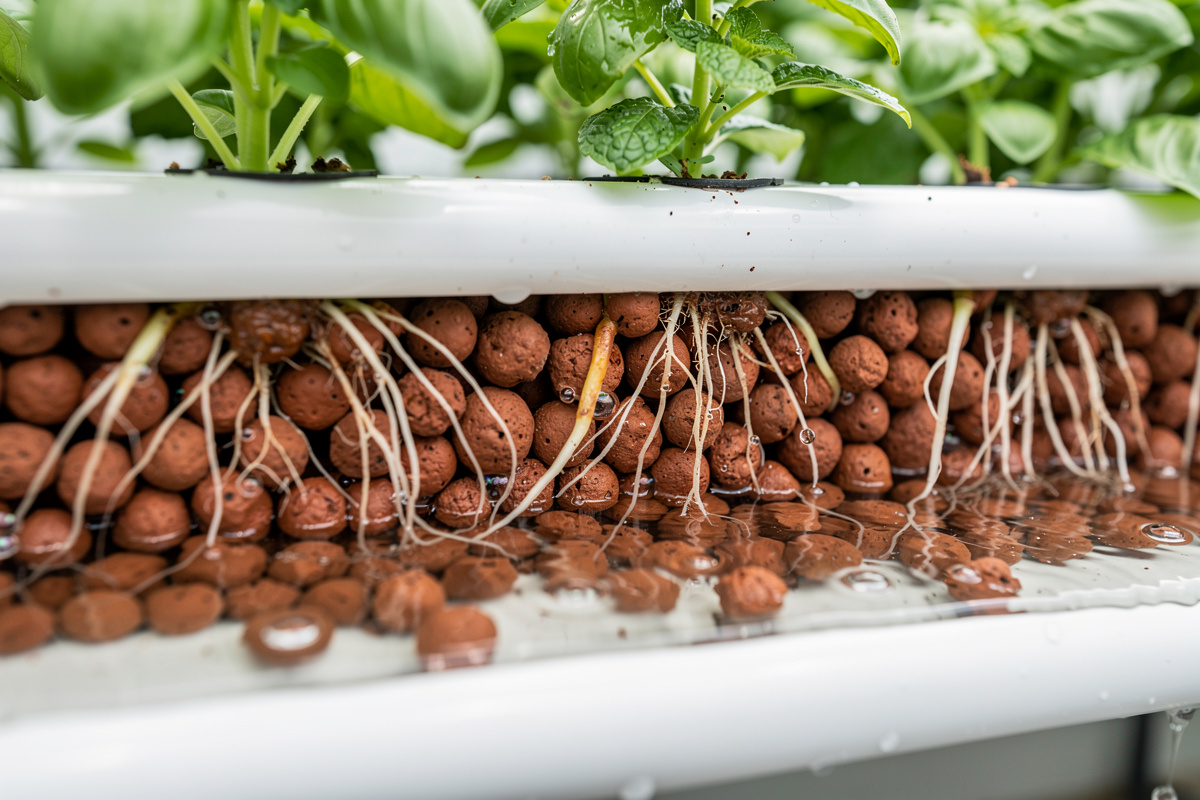
In hydroponic systems, herb roots grow in an inert medium — clay pebbles, rockwool, or sponge cubes — and receive water and dissolved nutrients directly through a circulating or passive solution. The plant never searches for food or pushes roots through dense soil. Everything it needs is delivered to the root zone in precise concentrations.
This direct delivery is why hydroponic herbs grow faster and produce more leaves. In soil, roots expend energy expanding through the medium and competing with microorganisms for nutrients. In hydroponics, that energy goes directly into leaf and stem production — which is exactly what you want from herbs.
Best Hydroponic Systems for Herbs
Herbs are among the easiest crops to grow hydroponically. Their shallow root systems, low nutrient demands, and compact size make them ideal for almost any hydroponic method — from simple passive systems to commercial-scale setups.
| System Type | Herb Suitability | Pros | Cons |
|---|---|---|---|
| Kratky (Passive) | Excellent | No pumps, no electricity, zero noise, cheapest option | Limited to small setups, reservoir needs refilling |
| NFT (Nutrient Film) | Excellent | Perfect for shallow herb roots, space-efficient, scales to 20+ plants | Pump-dependent, power outage kills plants quickly |
| Deep Water Culture (DWC) | Excellent | Simple setup, affordable, great oxygenation | Reservoir temperature control important, limited scalability |
| Ebb and Flow | Good | Reliable, periodic flooding promotes strong roots | Heavier setup, flood table needed |
| Drip System | Good | Precise nutrient delivery, scalable | Emitters can clog with organic matter |
| Aeroponics | Excellent but complex | Fastest growth possible, maximum oxygenation | Expensive, mist nozzles clog, less forgiving |
For most home growers, Kratky or NFT systems offer the best balance of performance and simplicity for herbs. Kratky is the absolute easiest — just jars with nutrient water and no electricity. NFT channels are the step up, holding 20 to 40 herb plants in a compact countertop footprint. Kratky is the method I reach for when I want a zero-pump control to compare against whatever else is running on my bench, and herbs are exactly the low-maintenance crop it’s built for.
Nutrient Requirements for Hydroponic Herbs
Herbs are light feeders compared to fruiting crops like tomatoes and peppers. They need moderate nitrogen for leaf production and minimal phosphorus and potassium since they are not producing fruit. A balanced hydroponic nutrient solution at half to three-quarter strength is ideal.
Seedling/cutting stage (weeks 1–2): Quarter-strength balanced nutrients. EC 0.4–0.6, pH 5.5–6.5. Young herb cuttings and seedlings are sensitive to nutrient burn. Plain water is often sufficient for the first week.
Vegetative growth (weeks 2+): Half to three-quarter strength balanced nutrients. EC 0.8–1.2, pH 5.5–6.5. Herbs need consistent nitrogen for leaf production but do not require the high nutrient concentrations that fruiting crops demand.
Harvesting stage: Maintain the same nutrient level. Herbs produce continuously, so there is no “bloom” phase to switch to. Simply top off the reservoir with fresh nutrient solution as the plants consume water.
If you are new to managing nutrient solutions, the essential equipment guide covers the pH meters, EC meters, and mixing tools you need.
How Soil-Grown Herb Growing Works
Soil growing is the traditional method: fill a container with quality potting mix, plant the herb, water regularly, and fertilize occasionally. The soil acts as both the growing medium and the nutrient reservoir. Beneficial microorganisms in the soil break down organic matter and fertilizer into forms the plant can absorb.
The simplicity of soil growing makes it the natural starting point for most herb growers. There is no pH meter to calibrate, no EC meter to read, no nutrient mixing ratios to calculate, and no pump to maintain. You water when the soil feels dry, feed with a diluted liquid fertilizer every 3 to 4 weeks, and the soil buffers minor mistakes.
If you prefer the container approach and want a comprehensive walkthrough from planting to harvest, CityRooted has a complete guide to growing herbs indoors in containers that covers variety selection, container sizing, soil mix, watering, harvesting techniques, and preservation methods using traditional soil-based growing.
Best Soil Setup for Container Herbs
Container herbs need well-draining potting mix — never garden soil, which compacts in containers and suffocates roots. A standard recipe is 70% quality potting mix and 30% perlite for drainage. Mediterranean herbs like rosemary, thyme, and oregano need even more drainage: 50% potting mix, 30% perlite, and 20% coarse sand.
Container size: 12 to 20 cm diameter per herb, depending on the variety. Mint and chives can thrive in 12 cm pots. Basil, parsley, and rosemary need 15 to 20 cm for full production. Each herb should have its own container — combining herbs with different water needs in one pot means some will always be unhappy.
Head-to-Head Comparison: Growth Speed and Yield
Establishment (Weeks 1–2)
Both methods start the same way: cuttings root in water or rockwool cubes, and seedlings germinate in moist starter medium. There is no speed difference during initial rooting or germination — the cutting does not know what system it will eventually grow in.
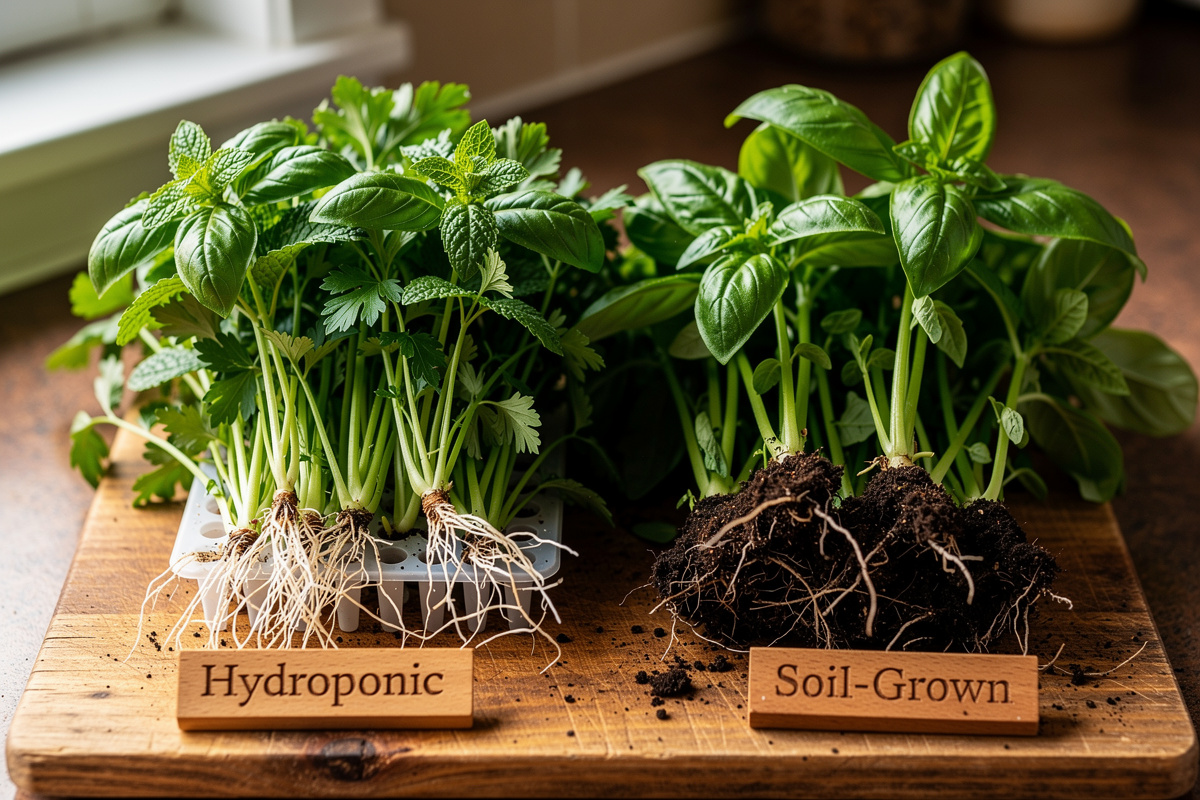
The divergence begins once roots establish in the final system. Hydroponic herb roots typically establish within 3 to 5 days and show visible new leaf growth within a week. Soil-grown cuttings need 7 to 10 days for roots to colonize the new potting mix before growth accelerates.
Vegetative Growth (Weeks 2–6)
This is where hydroponics pulls ahead significantly. With optimized nutrient delivery and constant access to water, hydroponic herbs grow noticeably faster than soil-grown equivalents — in the 30 to 50 percent range in my own side-by-side jars. A peer-reviewed comparison of NFT, ebb-and-flow, and soil basil found the NFT plants reached about 40 cm versus 28.5 cm for soil at the 45-day mark, a similar-sized gap (Plant Science Archives, 2024). A Kratky basil jar at peak growth is the one thing on my bench I have to keep ahead of with the scissors or it gets leggy fast. Soil-grown basil grows at a respectable pace but is more dependent on watering consistency and fertilizer timing.
Herbs like mint and parsley show particularly dramatic differences on my bench too — hydroponic mint fills out its net pot and reservoir roots noticeably faster than a soil-grown mint plant reaches comparable size, though exactly how much faster varies with light and season.
Harvesting (Weeks 4+)
Hydroponic herbs are typically ready for first harvest 1 to 2 weeks earlier than soil-grown equivalents. Extension-adjacent research comparing soilless and soil yields puts the general advantage in a similar band, and what I get off repeat harvests on my own bench lands in the 25 to 40 percent range, though real-world results depend heavily on light quality, temperature, and harvesting technique.
Soil-grown herbs often produce leaves with slightly more complex flavor — likely due to the diverse microbial activity in soil that produces trace organic compounds absent in sterile hydroponic solutions. The difference is subtle but noticeable in side-by-side taste tests, particularly with Mediterranean herbs like rosemary and thyme.
Cost Comparison: First Year and Ongoing
| Expense | Hydroponic Setup | Soil Container Setup |
|---|---|---|
| Growing system | $40–$100 (Kratky jars or NFT channel) | $10–$20 (pots or window box) |
| Growing medium | $10–$20 (clay pebbles or rockwool) | $10–$15 (potting mix, perlite) |
| Nutrients | $15–$25 (hydroponic nutrient concentrate) | $8–$12 (liquid fertilizer) |
| pH test kit | $8–$15 | $0 (not needed) |
| Grow light | $20–$60 (LED panel for herbs) | $20–$60 (same light requirement) |
| Year 1 Total | $93–$220 | $48–$107 |
| Annual ongoing | $25–$45 (nutrients, pH supplies) | $15–$25 (soil, fertilizer) |
Hydroponics costs roughly twice as much in the first year but the gap narrows significantly after that. If you are growing 6 or more herbs and value faster harvests, the per-herb cost of hydroponics drops below soil growing within a single growing season. For a budget Kratky build under $20, the breakeven point comes almost immediately.
Herb Varieties That Perform Best in Each System
Most herbs perform well in both systems, but some varieties have clear preferences based on their natural growing conditions.
Best for hydroponics: Basil, mint, cilantro, dill, and parsley. These fast-growing, leafy herbs respond dramatically to the consistent nutrient delivery of hydroponic systems. Basil is the standout performer — hydroponic basil grows so fast that many commercial herb growers use hydroponics exclusively for it.
Best for soil containers: Rosemary, thyme, oregano, sage, and lavender. These Mediterranean herbs evolved in dry, rocky conditions and prefer the slower, drier growing cycle that soil provides. They can grow hydroponically but are more prone to root rot in constantly wet systems — I lost a rosemary cutting to a soggy net pot early on before moving it to soil permanently, where it’s been trouble-free since.
Excellent in both: Chives, lemon balm, marjoram, and tarragon. These adaptable herbs perform well regardless of growing method when given adequate light and appropriate care.
Light Requirements: Same for Both Methods
Whether you grow in hydroponics or soil, herbs need 4 to 8 hours of direct light per day depending on the variety. Under grow lights, 12 to 14 hours of full-spectrum LED light produces excellent results for all herb types. Light is the one variable that does not change between methods.
A minimum of 100 PPFD (photosynthetic photon flux density) at the canopy is sufficient for most herbs. Basil and Mediterranean herbs benefit from 200 to 300 PPFD for maximum leaf production and essential oil content. A modest 20 to 40 watt LED panel covers a full windowsill herb garden adequately.
Common Problems: Hydroponic vs Soil
| Problem | Hydroponic Cause | Soil Cause |
|---|---|---|
| Yellowing leaves | pH drift locking out nutrients, or nitrogen deficiency | Overwatering or nitrogen deficiency |
| Leggy, stretched growth | Insufficient light (same in both systems) | Insufficient light |
| Root rot | Warm reservoir (keep at or below 20°C/68°F), Pythium | Overwatering, poor drainage, soil pathogens |
| Slow growth | Low EC, pH out of range | Compacted soil, insufficient fertilizer, root-bound |
| Bolting (premature flowering) | Heat stress, mature plant (same in both) | Heat stress, mature plant |
| Pest issues | Aphids, whiteflies (no soil pests) | Fungus gnats, soil mites, plus aphids and whiteflies |
Hydroponic problems tend to be nutrient or pH-related and are fixable by adjusting solution parameters. Soil problems tend to be moisture-related and are fixable by adjusting watering frequency. Both systems share above-ground pest issues (aphids, whiteflies) that require identical treatment regardless of growing method. For troubleshooting hydroponic-specific issues, see the common mistakes guide.
Which Method Should You Choose?
Choose hydroponics if: You want the fastest possible herb harvests, enjoy the technical side of growing, plan to grow herbs year-round, have limited counter or windowsill space (vertical towers are very space-efficient), or want to eliminate fungus gnats entirely. Hydroponic herbs reward minimal extra attention with significantly faster growth.
Choose soil if: You are a beginner who wants the simplest path to growing herbs, prefer lower startup costs, do not want to manage pH or nutrient solutions, or value the hands-off simplicity of traditional container gardening. Soil is forgiving, intuitive, and produces excellent herbs with minimal technical knowledge.
Choose both: Many experienced herb growers run both methods simultaneously. Grow fast-producing leafy herbs like basil, mint, and cilantro hydroponically for maximum speed, while keeping Mediterranean herbs like rosemary, thyme, and oregano in soil containers where they naturally thrive. This hybrid approach gives you the best of both worlds.
Growing Hydroponic Herbs: Quick Start Checklist
1. System: Start with Kratky — it is the simplest hydroponic method. Mason jars, net pots, clay pebbles, and nutrient water. Total cost: $15–$25 for 4 herbs.
2. Medium: Clay pebbles (hydroton) or rockwool cubes for starting cuttings. Both provide excellent root support and aeration.
3. Nutrients: Balanced hydroponic nutrient solution at half strength. General Hydroponics Flora series or similar. Herbs need less nutrient concentration than fruiting crops.
4. Monitoring: pH test strips or digital meter. Check pH every 3 to 5 days (target 5.5–6.5). EC meter optional for herbs — they are forgiving of nutrient variations.
5. Light: Full-spectrum LED, 12 to 14 hours daily, 100 to 300 PPFD at the canopy. A south-facing windowsill works for most herbs without supplemental light.
6. Environment: Temperature 18 to 24°C (65 to 75°F). Reservoir temperature at or below 20°C (68°F) for Kratky and DWC — treat 22°C (72°F) and up as the danger zone for root rot. Humidity 40 to 60 percent. Gentle air circulation prevents mold and strengthens stems.
The indoor garden setup guide covers the full installation process if you are building your first hydroponic system from scratch.
Are hydroponic herbs better than soil-grown herbs?
Hydroponic herbs typically grow 30-50% faster and produce 25-40% higher yields per plant compared to soil-grown herbs. However, soil-grown herbs are simpler to manage and many cooks find they have more complex, nuanced flavor — especially Mediterranean herbs like rosemary and thyme. Neither method is objectively better — leafy herbs like basil and mint excel in hydroponics, while woody herbs prefer soil.
What is the easiest hydroponic system for growing herbs?
The Kratky method is the easiest hydroponic system for growing herbs. It requires no pumps, no electricity, and no moving parts — just jars filled with nutrient solution, net pots, and clay pebbles. Basil, mint, and cilantro thrive in Kratky setups. For larger herb gardens, NFT channels scale to 20-40 plants in a compact countertop footprint.
What pH do hydroponic herbs need?
Hydroponic herbs grow best at a pH of 5.5 to 6.5. This range allows optimal uptake of all essential nutrients. Check pH every 3-5 days with test strips or a digital meter and adjust using pH up or pH down solutions. Herbs are more forgiving of pH variation than fruiting crops, so minor drift is not usually a problem.
How long does it take to grow herbs hydroponically?
From cutting to first harvest, hydroponic herbs take approximately 2-4 weeks for fast growers like basil and mint, and 4-6 weeks for slower varieties like rosemary and thyme. This is roughly 1-2 weeks faster than soil-grown herbs of the same variety. Once established, herbs can be harvested continuously for months under indoor grow lights.
Can you grow all herbs hydroponically?
Most herbs grow well hydroponically, but Mediterranean herbs like rosemary, thyme, oregano, sage, and lavender prefer drier conditions and are more prone to root rot in constantly wet hydroponic systems. These herbs perform better in soil containers with excellent drainage. Leafy herbs like basil, mint, cilantro, parsley, and dill are excellent hydroponic candidates.
Related Articles
- Complete Guide to Hydroponic Plant Growing — Master plant selection, nutrient schedules, and harvest timing for all hydroponic crops
- Hydroponic Systems Explained: DWC, NFT, Ebb and Flow — Understand which system matches your growing goals
- Essential Hydroponic Equipment Guide — pH meters, EC meters, lights, and everything you need
- DIY Hydroponics on a Budget — Build a Kratky system for under $20
- 7 Common Hydroponic Mistakes — Avoid the pitfalls that kill herb plants
- Growing Herbs Indoors: Complete Container Guide — The soil-based alternative on our sister site CityRooted