Chlorine and chloramine are the two disinfectants municipalities add to tap water, and the EPA allows up to 4.0 mg/L of either as a residual at your tap — but only one of them leaves when you let the water sit. Free chlorine dissipates overnight; chloramine does not, and that single difference is why I once killed a freshly dosed beneficial bacteria res without realizing it. Knowing which one your utility uses decides everything about treatment.
This is the question I get more than any other about source water, and the answer is always the same boring one: test, do not assume. The two chemicals behave so differently that the standard hobby advice (“just leave it out overnight”) is correct for roughly half the country and useless for the other half. I treat the chlorine-versus-chloramine question as the very first branch in the source-water decision tree, before EC or alkalinity, because it changes whether any of the rest of your treatment is even necessary. The full upstream picture is in the hydroponic water source and treatment guide; this piece goes deep on the disinfectant branch alone.
What Is the Difference Between Chlorine and Chloramine in Tap Water?
Free chlorine is dissolved chlorine gas or hypochlorite, the same chemistry as bleach, added to kill pathogens in the distribution system. It is effective, cheap, and volatile — it reacts with organics, it decomposes in sunlight, and it escapes from water left open to the air. Chloramine is a different animal: it is formed by combining chlorine with ammonia, which produces a more stable molecule that persists much longer in pipes. Utilities switch to chloramine specifically because it holds a residual all the way to the far ends of the distribution network, where free chlorine would have decayed away.
The chemistry difference maps directly onto a hydroponic difference. Free chlorine is reactive and short-lived, so it tends to do its damage fast and then disappear — meaning low-level residuals are often gone by the time the water reaches your res, or within a day of sitting. Chloramine is deliberately designed to refuse to disappear. It keeps reacting slowly, with organic matter, with biofilms, and with any beneficial biology you introduce, for as long as the water sits. The EPA regulates both under the same Maximum Residual Disinfectant Level of 4.0 mg/L expressed as chlorine, and the framework for those limits lives in the agency’s Ground Water and Drinking Water resource. The World Health Organization covers the international disinfectant guidelines in its drinking-water quality pages. Same legal limit on paper, very different consequences at the reservoir.
Which One Does My Utility Actually Use?
This is the single most important question, and the answer is free if you know where to look. In the United States, every community water system publishes an annual Consumer Confidence Report (the water quality report) that states the disinfectant used and the residual range measured through the year. Search your utility name plus “water quality report” and you will usually find a PDF. Some utilities switch seasonally — free chlorine in the cooler months, chloramine in summer, or a periodic “chlorine burn” where they temporarily drop the ammonia and run free chlorine to clean the pipes. That last detail matters: if your utility does a chlorine burn once a year, your treatment routine has to change for that window.
Outside the U.S., or if your utility is opaque about it, the report route may not exist and you fall back to the bench test. Roughly a quarter of the U.S. population is served by systems using chloramine, concentrated in larger cities and warmer regions, but the only way to be sure for your tap is to test it yourself. I check mine every few months because my utility has changed disinfection strategy twice in the years I have lived here, and each time the change showed up in my res before I caught it at the tap.
How I Tell Them Apart at the Bench
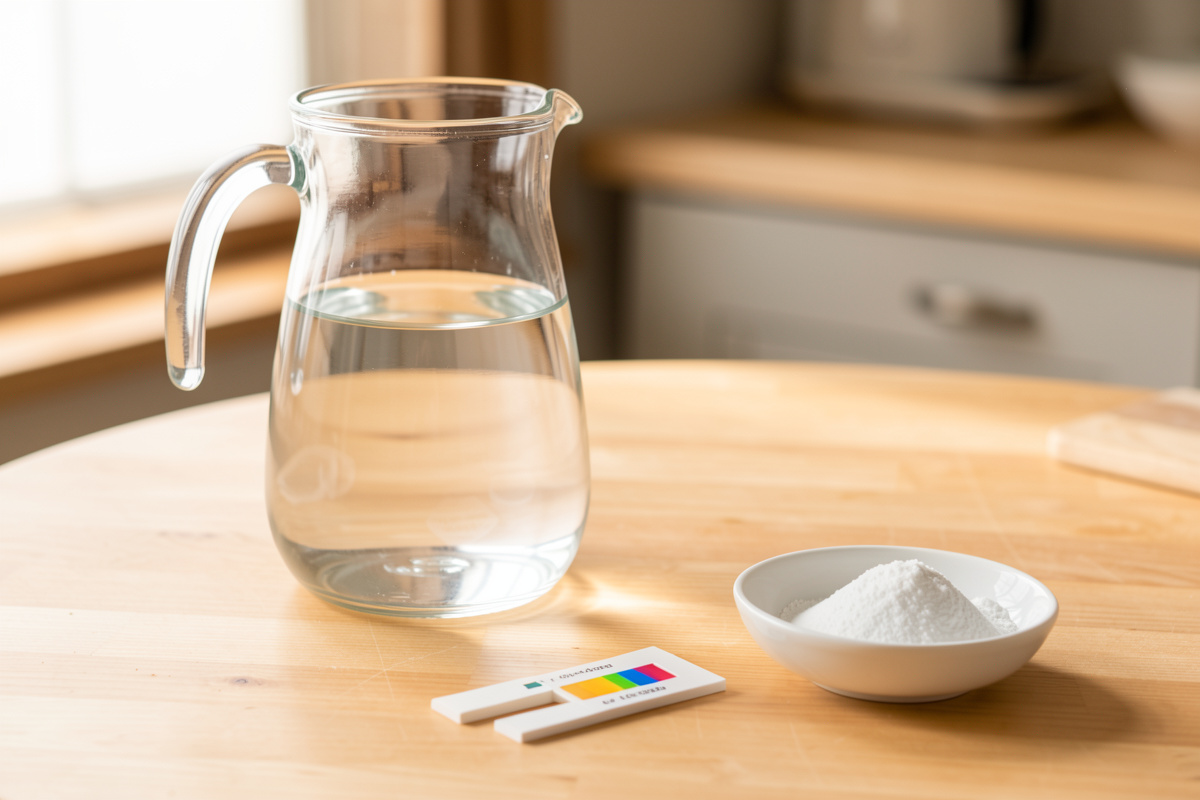
The test is cheap and takes ten seconds. You need a pool or aquarium test strip that reports both free chlorine and total chlorine — the same strips pool owners use read both pads. Dip the strip in a fresh sample of your tap water and compare the two pads. The free-chlorine pad measures free chlorine only. The total-chlorine pad measures free chlorine plus chloramine plus any combined chlorine. The arithmetic is the tell: if total reads the same as free, you have free chlorine. If total reads higher than free, the difference is combined chlorine — and in tap water that is almost always chloramine.
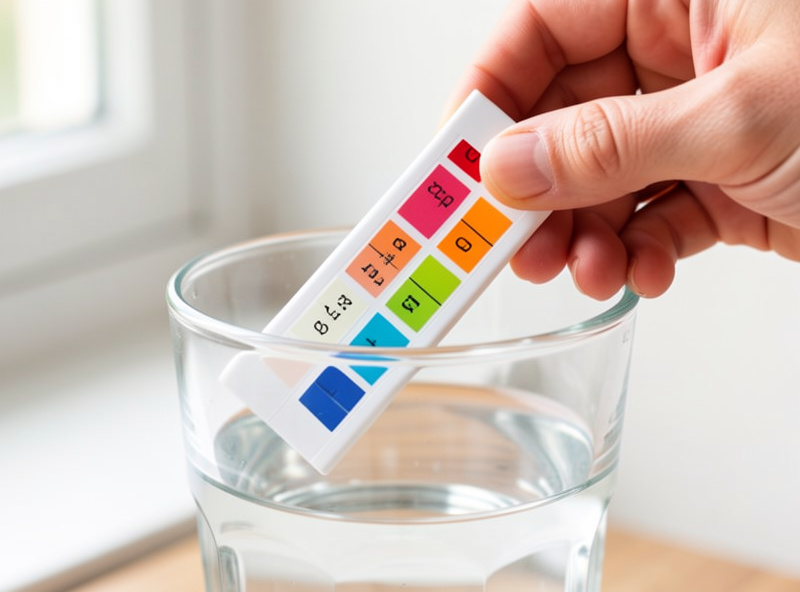
My own tap reads roughly 1 to 2 mg/L total chlorine with a near-zero free-chlorine pad, which tells me I am on chloramine and that off-gassing will not fix it. A neighbor two towns over reads the same total number but with matching free and total pads — free chlorine — and his overnight-aging routine works fine. Same region, same general water chemistry, completely different treatment requirement. This is why copy-pasting another grower’s water routine is a gamble.
Does Chlorine or Chloramine Actually Hurt a Hydroponic Res?
The honest, qualified answer: at the residuals that come out of a typical tap, neither disinfectant is going to instantly kill established plants in a large res, because the dilution and the organic load in a working reservoir consume it. The damage is subtler and it falls hardest on the things you cannot see. Both disinfectants are biocides by design; their entire job is to kill microbes. In a hydroponic res that matters in two places — on roots that rely on a healthy rhizosphere, and on any beneficial inoculant you add deliberately.
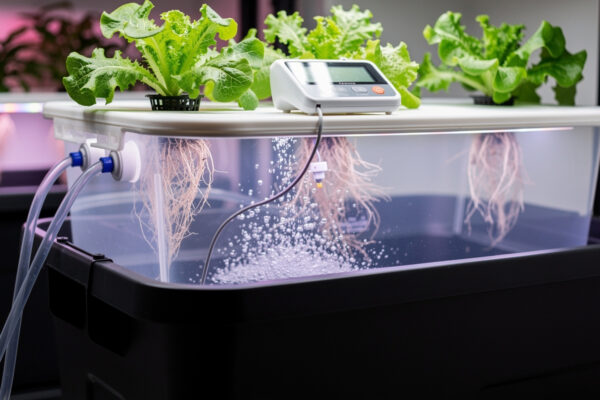
I run a beneficial bacillus inoculant in every res to keep Pythium in check, the same routine I describe in the root-rot prevention piece. The week my utility apparently switched to chloramine without me noticing, I dosed the bacillus into a freshly filled res as usual, and the biology never took. The res stayed oddly clean — that sterile, almost-too-clean look, with a faint swimming-pool smell at the lid — and within days the root tips browned because the protective biology I had paid for was dead on arrival. The chloramine residual had done to my bacillus exactly what the utility put it there to do to pipe biofilm. The plants survived because the res was large and the residual low, but the biological layer I rely on was a write-off.
That is the real risk for a hydro grower. Plants in a big DWC tote will mostly shrug at 1 to 2 mg/L disinfectant. Your microbial inoculants, your compost-tea additions, your mycorrhizae — those will not. If you run sterile or mineral-only with no beneficial biology, disinfectant residual is a minor concern. If, like me, you lean on beneficial microbes as your disease strategy, removing the disinfectant before the biology goes in is non-negotiable.
Why Chloramine Survives the Overnight Trick
Every beginner guide repeats the advice to leave tap water out for 24 hours so the chlorine evaporates. That advice is correct for free chlorine and useless for chloramine, and the reason is the same stability the utility chose chloramine for in the first place. Free chlorine is volatile; it partitions into the air and leaves the water, faster if you bubble an air stone through it because the aeration strips the gas. Chloramine is far less volatile and does not partition out the same way, so it sits in the water for days to weeks depending on temperature and organic load.
The practical consequence is that if you are on chloramine, the overnight-aging routine that half the internet swears by does nothing measurable to your disinfectant level. I tested this directly: I aged a chloramine sample for 48 hours with an air stone running, and the total-chlorine strip read the same as the day I drew it. The same sample aged identically but starting from free-chlorine tap dropped to zero in under a day. So the aging trick is not wrong — it is just specific to one of the two chemicals, and most of the people giving the advice do not know which one they have.
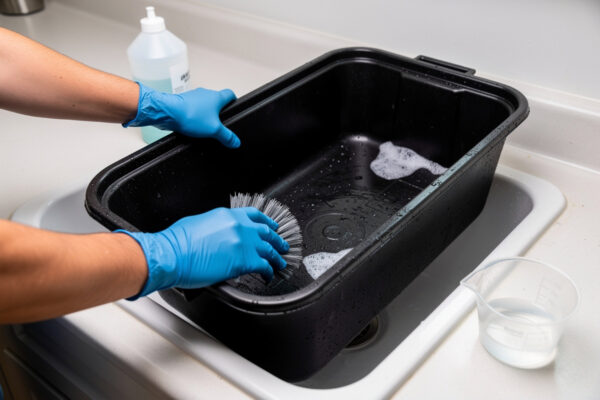
This is also the reason I no longer trust “let it sit” as a default. It works until the utility switches your disinfectant, and then it silently stops working. A test strip costs pennies and removes the guesswork. I keep a bottle next to the EC and pH pens, and a disinfectant check is now part of every res fill, alongside the routines in the reservoir setup and the reservoir cleaning guide.
The Methods That Remove Each One
Because the two chemicals behave differently, removal differs too. Free chlorine yields to three passive or cheap approaches: time (24 hours uncovered), aeration (faster off-gas), or a plain activated-carbon filter (chlorine reacts with carbon and is destroyed on contact). None of these is expensive or complicated, and for a free-chlorine tap, any one of them is enough.
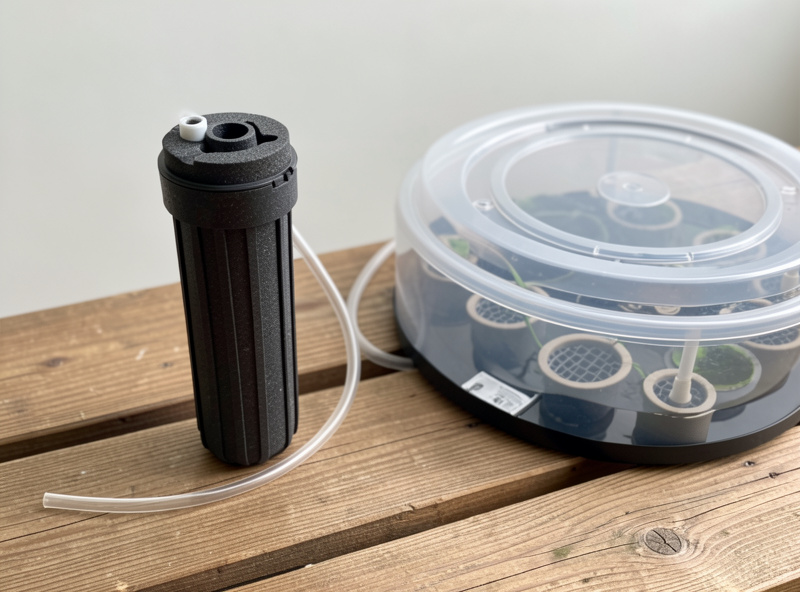
Chloramine needs more. Plain activated carbon removes chloramine slowly and inefficiently because the carbon has to first break the chlorine-ammonia bond; the proper media is catalytic carbon, which is engineered to drive that reaction, and it needs adequate contact time — water should not just splash past it. The chemical route also works and is faster for batching: ascorbic acid (vitamin C) neutralizes chloramine rapidly at roughly 1 gram per 40 liters, and Campden tablets (potassium metabisulfite), the same tablets winemakers use, take out both chlorine and chloramine at about a quarter tablet per 80 liters. The vitamin C route has the nice property of leaving nothing harmful behind — the reaction products are dehydroascorbate and a trace of chloride and ammonium, all fine at these doses. The full step-by-step on each method — doses, contact times, and how I plumbed a carbon stage into my fill line — deserves its own treatment, and I cover all of it in the companion dechlorination guide on this site.
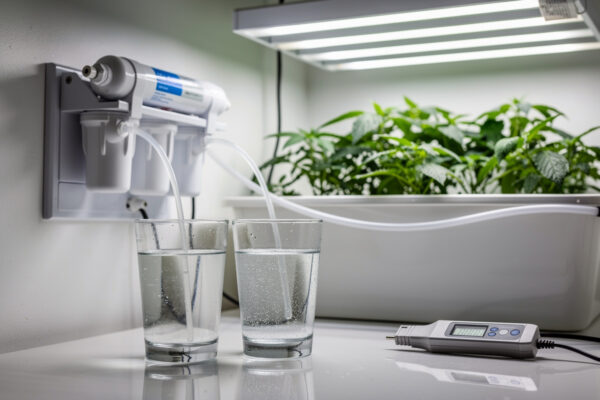
If you are choosing one permanent install, a catalytic carbon filter plumbed inline before your res handles both chlorine and chloramine in a single pass and you never think about it again. That is what I run, and it is the one upgrade I recommend without reservation to anyone on municipal water. It also strips organics and odors as a bonus, which keeps the res smelling like a healthy system instead of a swimming pool.
What I Would Do Starting Today
If I were starting fresh on a municipal supply, here is the exact sequence. Pull the utility water quality report and confirm the disinfectant. Buy a free-and-total-chlorine test strip and confirm the report at the tap — reports describe the system average, and your kitchen tap can differ. If you are on free chlorine, aging overnight or a cheap carbon filter is plenty. If you are on chloramine, budget for a catalytic carbon stage or get comfortable with vitamin C dosing, because the overnight trick will betray you. Re-test any time the utility does maintenance or a seasonal switch, and treat a sudden change in res smell or behavior as a reason to re-test the disinfectant first, before you blame your nutrients.
The short version: chlorine leaves, chloramine stays. Find out which one you have before you decide how hard to work at removing it. Everything downstream — your beneficial biology, your root health, your disease strategy — assumes the disinfectant is gone, and on a chloramine tap that only happens if you make it happen.
As an Amazon Associate I earn from qualifying purchases.
Does letting tap water sit overnight remove chlorine?
Free chlorine yes, chloramine no. Free chlorine off-gasses from open water in about 24 hours, faster with an air stone. Chloramine is far more stable and stays in the water for days to weeks, so aging does not remove it. Test with a free-and-total-chlorine strip to know which you have.
How do I know if my tap water has chlorine or chloramine?
Check your utility’s annual water quality report first, which lists the disinfectant used. At the bench, a pool test strip that reads both free and total chlorine tells you directly: if total is higher than free, the difference is chloramine.
Is chloramine dangerous in a hydroponic reservoir?
At typical tap residuals of 1 to 2 mg/L it will not instantly kill established plants in a large res. The real damage is to beneficial microbes and inoculants, which the disinfectant kills by design. If you run beneficial biology, remove chloramine before dosing it.
What removes chloramine from tap water?
Catalytic carbon with adequate contact time, ascorbic acid (vitamin C) at about 1 gram per 40 liters, or Campden tablets (potassium metabisulfite) at about a quarter tablet per 80 liters. Plain activated carbon and overnight aging do not reliably remove chloramine.
Do I need to dechlorinate if I grow without beneficial microbes?
It is less critical but still worth doing. A sterile or mineral-only res tolerates low disinfectant residuals better than a biological one, but carbon filtration also removes organics and odors and costs little, so most growers on municipal water benefit from a filter stage regardless.