A hydroponic fodder system for chickens turns 1 lb of dry grain into 6-7 lb of fresh sprouted greens in 7 days, cutting feed costs by 40-60% during peak fodder season. Wheat, barley, and oats are the practical inputs; the output is a dense root-and-shoot mat your hens devour in minutes. With a 5-tray rotating rack, a flock of 6 hens gets 1 fresh tray per day and you cycle one tray of seed soak, six tray-days of growth.
This guide covers tray geometry, water cycling, drainage gradient, mold prevention, and the specific seed-to-flock-size math that keeps your fodder lab in balance with how much your chickens actually eat. The tray design and sprouting schedule below is the same rig I run for my own flock; the feeding ratios are cross-checked against published poultry-nutrition research rather than a single backyard trial.
What Hydroponic Fodder Actually Is (and Why It Matters for Chicken Feed)
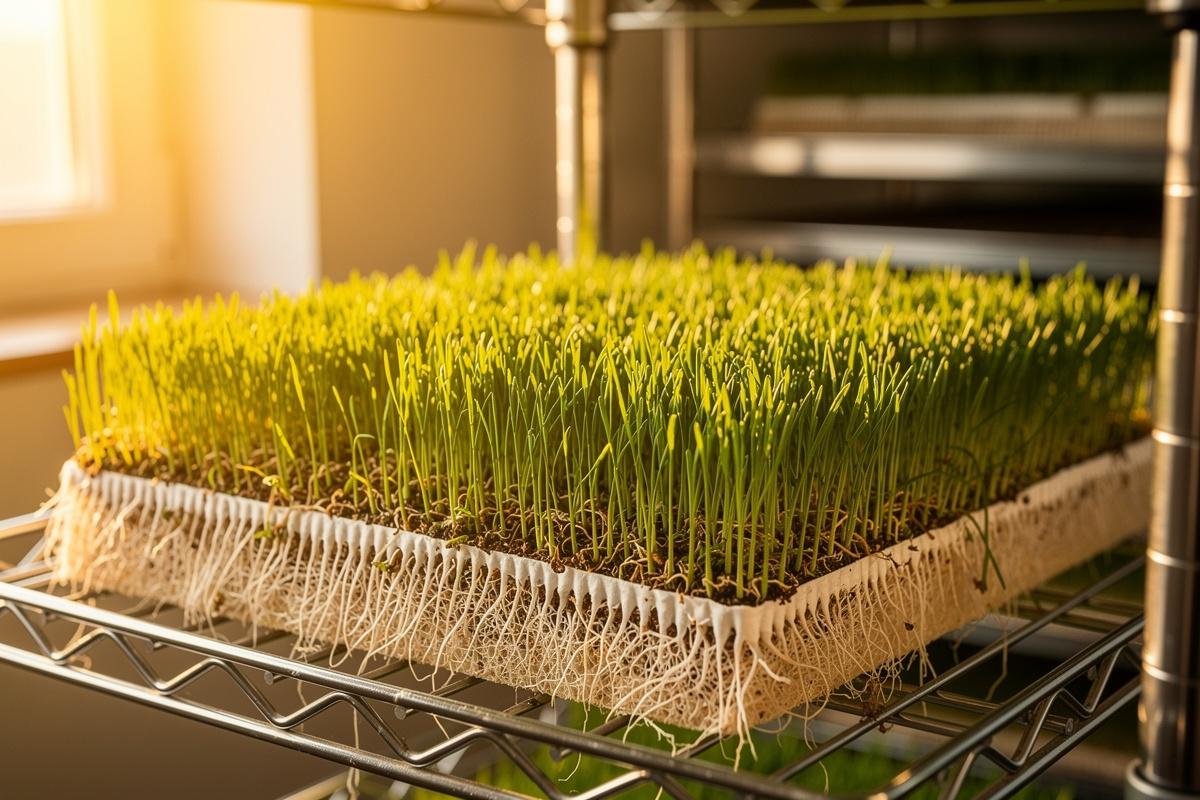
Hydroponic fodder for chickens is wet-sprouted whole grain harvested at day 6-8, when shoots reach 4-6 inches and root mats fully bind the tray. The chickens eat the whole mat — shoots, roots, and any unsprouted hulls — in one feeding. Compared to dry grain, sprouting measurably raises crude protein and vitamin C content in cereals like wheat and barley — vitamin C in particular goes from essentially undetectable in the dry seed to a real presence after germination — and shifts the carbohydrate profile from starches into more bioavailable simple sugars, as documented in the peer-reviewed literature on sprouted cereal grains (Benincasa et al., Sprouted Grains: A Comprehensive Review). The exact multiplier varies by grain type and germination time, so I don’t put a hard percentage on it.
The economic case is straightforward. Hard red winter wheat in 50 lb sacks runs $0.40-0.60 per pound depending on region. After sprouting, that pound becomes roughly 6.5 lb of edible biomass — effectively $0.07-0.10 per pound of fresh feed. Layer pellets run $0.65-0.85 per pound. For a 6-hen flock eating about 24 oz total per day with 30% replaced by fodder, the savings come to roughly $14 per month — not transformative, but the egg quality bump (yolk color, shell thickness, omega-3 ratio) is what most fodder-lab keepers stay for.
The Five-Tray System Design
The 5-tray rolling system is the workhorse design because it matches the 7-day sprout cycle perfectly with one daily feed. Each day you harvest tray 1 (the oldest) for the chickens, advance trays 2-5 forward, and start a new soak as tray 5. This rotation means you always have one tray ready and never run out — the most common failure mode in DIY fodder setups.
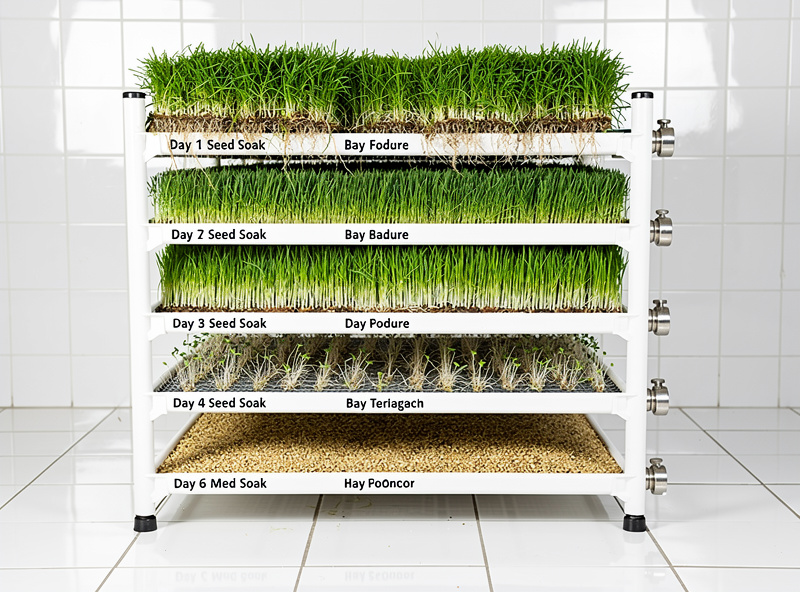
Tray dimensions. A 10×20-inch standard nursery flat (1020 tray) holds 1 lb of dry seed and produces 6-7 lb of fresh fodder — the right portion for a 6-hen flock for one day. Scale up: 8×10 trays for 2-3 hens, 1020s for 4-7 hens, twin 1020s side-by-side for 8-14 hens.
Drainage. Drill 1.5mm holes every 2cm across the bottom of each tray, with the holes weighted toward the front edge so trays drain to a downstream catch tray when angled at 5 degrees. Avoid holes larger than 2mm — seeds wash through during the first 24 hours of root development.
Water cycling. Sprouting fodder needs moisture every 4-6 hours during the day for the first 4 days, then every 8-12 hours for days 5-7. The simplest approach is hand-flooding from a watering can three times a day. The technical approach: a $40 outlet timer on a small submersible pump pulling from a reservoir, top-flooding all five trays in series with a 4-minute irrigation cycle. The pump and timer run 12 minutes per day total — minimal power draw.
Light. Sprouting fodder does NOT need grow lights for the first 5 days — endosperm provides all needed energy. Days 6-7 benefit from 6-8 hours of indirect daylight or a single 24W LED strip overhead at 6500K to deepen green color. More light does not increase mass; it just chlorophyllates the existing biomass. The same lighting principle applies to other shallow-rooted hydroponic systems described in my hydroponic systems reference.
Seed Selection and Cost Math
Not every grain works. The seed must be whole, unhulled, and fresh enough to germinate above 90%. Seed older than 18 months drops below 80% germination, which leaves enough ungerminated grain to mold quickly under fodder-system humidity.
| Grain | Sprouting yield | Days to harvest | Best for |
|---|---|---|---|
| Hard red winter wheat | 1:6.5 | 7 | Default — best balance of yield, taste, hen acceptance |
| Barley (whole, hull-on) | 1:7.0 | 7-8 | Best protein gain; chickens slightly slower to switch |
| Oats (whole groats) | 1:5.5 | 6-7 | Higher fat content; useful in cold weather |
| Rye (food-grade) | 1:6.0 | 7 | Cold-tolerant sprouting; thrives below 65F room temp |
| Field peas (sprouted) | 1:3.5 | 5-6 | Protein boost; rotate in 1 day per week not daily |
For a 6-hen flock running 1 lb daily, monthly seed consumption is 30 lb. A 50 lb sack of feed-grade wheat at $25-35 covers 50 days of fodder — about $0.55-0.70 per day of fresh feed for the entire flock. Layer pellets to deliver the same protein and volume run $1.40-1.80 per day. Net savings: roughly $25 per month. Factor in the yolk-color and shell-quality bump keepers commonly report once fodder is in regular rotation, and the system pays its $80-120 build cost in 3-5 months.
The 7-Day Growing Schedule
Each tray follows the same 7-day cycle. Run them on a rolling start so you harvest one tray per day:
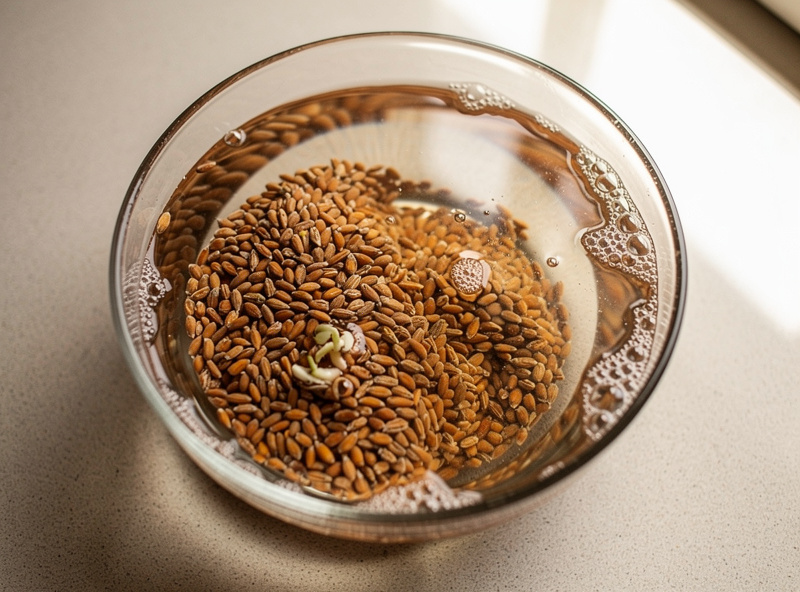
- Day 0 (evening): Rinse 1 lb seed under cool water until water runs clear. Soak in 3x volume of cool water for 12-14 hours. Optional: add 1 tablespoon of food-grade hydrogen peroxide per gallon during soak to suppress fungal spores.
- Day 1: Drain seed thoroughly. Spread evenly in tray to about 1/2 inch depth. Spray-mist 4 times today.
- Day 2: Roots visible. Maintain 3-4 mistings. Tray will smell sweet — like fresh-cut grass — at this stage. A sour or musty smell signals contamination; rinse the tray and continue or restart.
- Day 3-4: Root mat binds the tray. Shoots reach 1-2 inches. Reduce to 2-3 waterings per day.
- Day 5: Shoots green up. Bring under indirect daylight or a single LED strip if growing in a dark corner.
- Day 6-7: Shoots reach 4-6 inches. Mat is dense enough to lift as a single sheet. Harvest by inverting the tray and slicing into thirds for a 6-hen flock.
Total water use: about 6-8 gallons per tray over 7 days — most of it captured back into the recirculation reservoir if you build the gravity-drain version. Compare to growing the same protein equivalent in soil-based field grain: roughly 90-110 gallons per pound of equivalent finished feed. The 12-15x water-efficiency gap is one reason fodder systems show up in arid-region poultry literature.
Feeding Out: How Chickens Actually Eat It
Hens take 5-10 minutes to flatten a 1-square-foot section of fodder mat, eating shoots first then turning over the root mat for the unsprouted hulls and tender root mass. Feed it whole — do not chop; the first time I tried pre-cutting a mat to “help,” my flock ignored the chopped pile and went straight for an untouched section instead. The mat structure encourages natural foraging behavior, which improves flock psychology and reduces feather pecking in confined runs — noticeable on my own birds during the darkest stretch of a Swedish winter when run time is short.
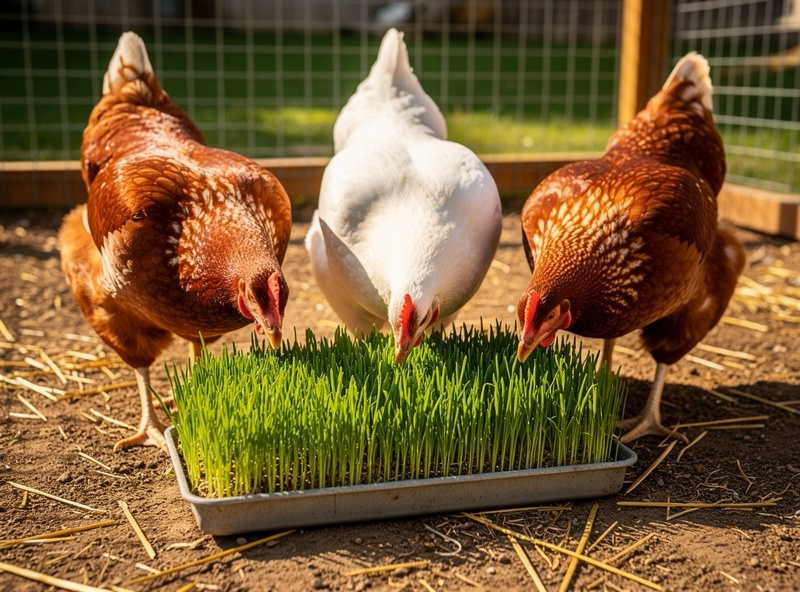
Fodder is supplemental, not a complete diet. Layer hens still need 16% protein and the calcium-phosphorus balance of formulated layer feed for shell quality. I keep fodder around 30-35% of total intake by weight and hold the rest as complete layer feed. A six-week feeding trial on sprouted barley found eggshell strength held up fine at lower inclusion but weakened measurably at the highest tested level over time (Research note: sprouted barley supplement effects on laying hens) — still within commercial-acceptable ranges in that study, but the direction is clear enough that I don’t push fodder past a third of intake on my own flock, since the layer feed it displaces is what’s actually carrying the calcium.
For the dispensing side — getting fresh fodder into your chickens reliably without you being there every morning — my sister site SmartCoopHQ has a complete automatic chicken feeder buyer guide that covers gravity-fed treadle feeders, bucket-and-spring designs, and computerized scheduled dispensers. I run a treadle-style feeder with a flat tray wired into it for exactly this reason — it keeps the fodder mat accessible without letting the flock trample it before it’s fully consumed.
Mold Prevention (the One Failure Mode That Will End Your Run)
Mold is the single largest reason fodder systems get abandoned. Aspergillus and Fusarium grow at the same temperature and humidity that wheat sprouts at, and a single contaminated tray can kill chickens. Three rules eliminate 95% of mold risk:
Rinse seeds thoroughly before soak. The dust and broken kernels carry the spores. Rinse until water runs clear — usually 4-6 rinses for feed-grade wheat.
Drain trays completely between waterings. Standing water in the bottom of a tray is the single most reliable mold incubator. The 5-degree tilt mentioned earlier is what makes this happen automatically. Hand-watering systems need active draining at every cycle.
Keep growing temperature 60-72F. Above 75F and Aspergillus accelerates faster than your sprouts. Below 55F and germination slows enough that the seeds rot before sprouts establish. A small fan moving air across the rack keeps moisture from sitting on the leaf and hull surfaces long enough for fungal spores to establish — it’s the single change I made to my own rack that cut mold incidents the most, more than any tweak to soak time or rinse count. A fan alone won’t fix a genuinely humid grow space, but on a rack sitting in normal room air it’s cheap insurance.
If you smell ANYTHING beyond fresh-cut grass — sour, musty, alcoholic, ammonia — discard the tray. Never feed questionable fodder to chickens. The cost of one composted tray is far smaller than the cost of a flock illness.
Equipment List and Cost Build
Minimum viable build for a 6-hen flock:
- 5x 10²⁰ nursery trays (with drainage holes drilled): $25
- 1x 10²⁰ catch tray (no holes): $5
- Wire shelving rack 18×36 inch, 5 shelves: $40-60
- Watering can or pump-and-timer setup: $15-45
- Small fan for airflow: $20
- 50 lb feed-grade wheat or barley starter: $25-35
Total $130-190 to start. Operating cost month two onward: $25-35 in seed for a 6-hen flock. Reagent water can come straight from tap for most municipal supplies; well water with iron content above 0.3 ppm should be filtered or run through a basic carbon block.
The same nutrient and pH knowledge that applies to deep water culture and ebb-flow systems also applies (loosely) to fodder — though fodder is so short-cycle the need is minimal. The hydroponic equipment buying guide covers pumps and timers that double as fodder hardware. The pH adjustment reference is mostly unnecessary for fodder — wheat and barley are tolerant of pH 6.0-7.5 — but useful if you tap on hard alkaline well water.
Frequently Asked Questions
How much hydroponic fodder per chicken per day?
Plan on 4-6 oz of fresh fodder per laying hen per day, supplementing rather than replacing complete layer feed. A 1 lb dry-seed tray that yields 6.5 lb of fodder feeds a 6-hen flock for one day at 30% of total intake.
Will fodder replace layer pellets entirely?
No. Layer pellets supply the calcium-phosphorus balance and amino acid profile your hens need for shell quality. I keep fodder around 30-35% of total intake by weight and hold the rest as complete layer feed. A six-week sprouted-barley feeding trial found eggshell strength held up at lower inclusion but weakened measurably at the highest tested level over time, so I don’t push fodder past a third of intake on my own flock.
What grain is best for hydroponic fodder?
Hard red winter wheat is the default — 6.5x yield, fast 7-day cycle, hens accept it readily. Barley delivers slightly higher protein but chickens are slower to adapt. Oats are useful in winter for fat content. Field peas can be rotated in once a week for a protein boost.
How do I prevent mold in fodder trays?
Three rules: rinse seeds thoroughly until water runs clear, drain trays completely between waterings (use a 5-degree tilt), and keep room temperature 60-72F. Add a small fan for airflow so moisture doesn’t sit on the leaf and hull surfaces long enough for spores to establish. If you smell anything beyond fresh-cut grass, discard the tray.
Do I need grow lights for fodder?
No grow lights are required for the first 5 days — the seeds endosperm provides all energy. Days 6-7 benefit from 6-8 hours of indirect daylight or a single 24W LED strip at 6500K to green up shoots. More light does not add mass.
How much water does a fodder system use?
About 6-8 gallons per tray across 7 days, most of which can be recirculated if you build a gravity-drain reservoir. Compared to soil-grown grain, fodder is roughly 12-15x more water-efficient per pound of finished feed.
Can I use chicken-feed wheat or do I need food-grade?
Feed-grade wheat is fine and far cheaper, but verify it is fresh (under 18 months) and free of treated seed. Treated seed coatings are toxic and should never be sprouted. Buy whole hull-on grain from a feed mill or organic farmer rather than a hardware-store chicken feed.