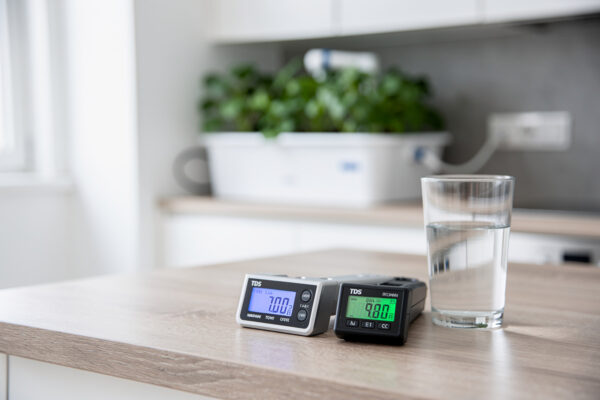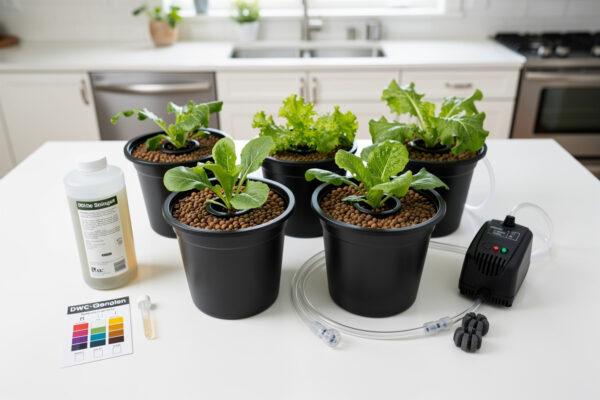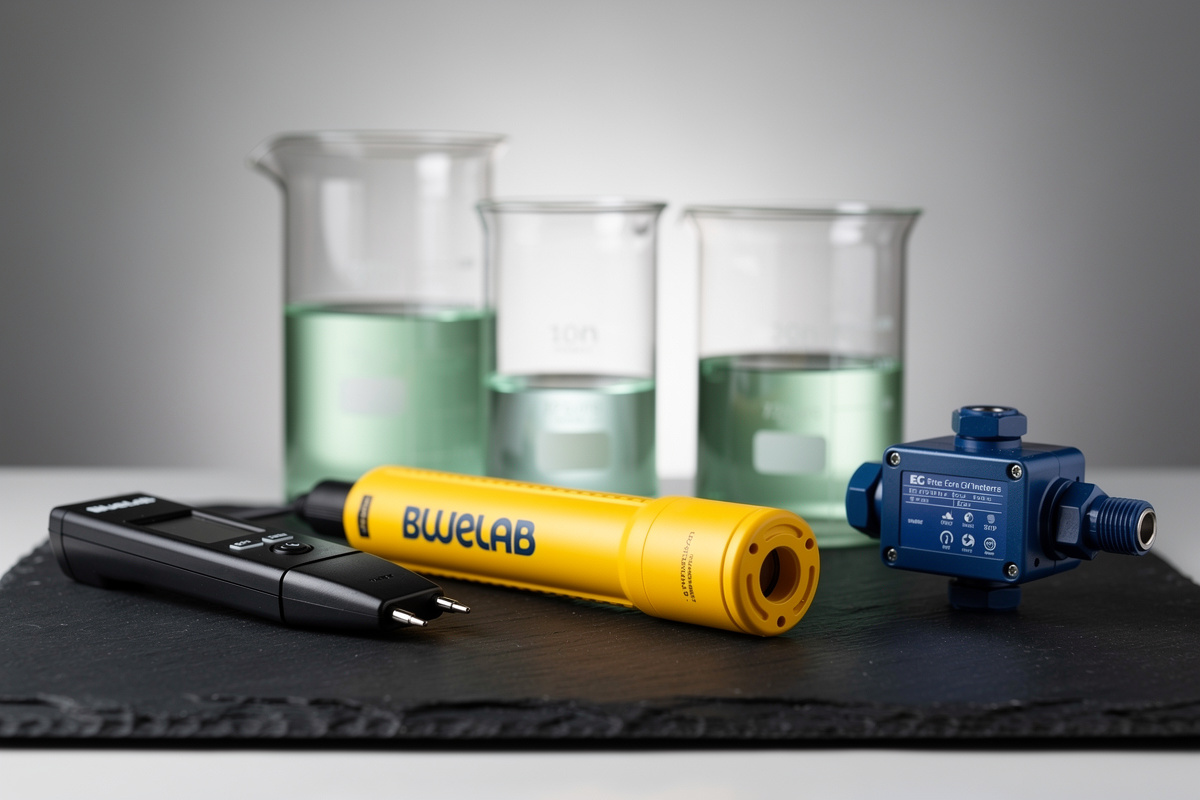
An EC meter measures the electrical conductivity of your hydroponic nutrient solution, telling you whether plants are getting enough fertilizer (or too much). For most home growers, a $20 to $50 digital pen is all you need — calibrated monthly with a small bottle of 1.413 EC reference solution.
Reading EC accurately is the difference between a thriving system and one that mysteriously stalls every two weeks. This guide explains what EC actually measures, the two scales that cause endless confusion (500 vs 700), how to calibrate any meter in three minutes, and what specific EC numbers mean for the crop you are growing. If you want a deep dive on the gold-standard meter most commercial growers use, see my Bluelab Truncheon buyer’s guide.
As an Amazon Associate I earn from qualifying purchases.
What an EC Meter Actually Measures
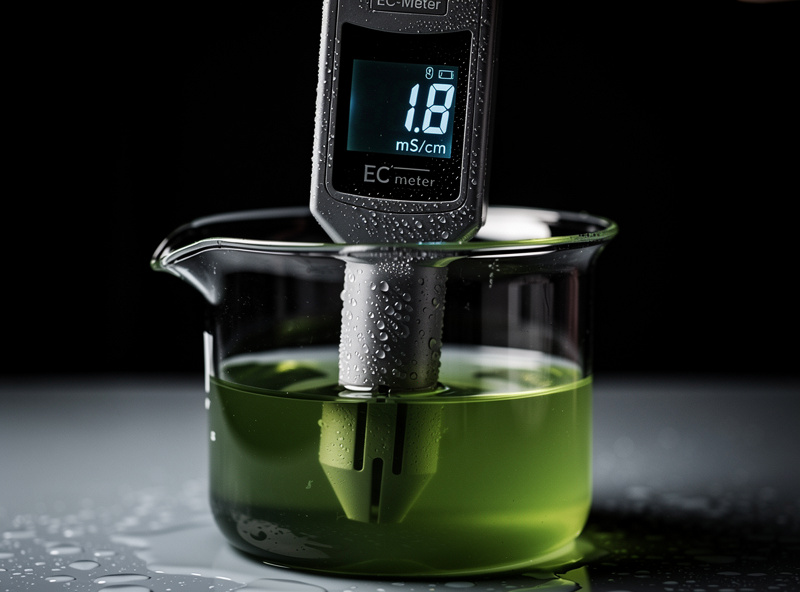
Electrical conductivity measures how easily electricity flows through your nutrient solution. Pure water conducts almost no electricity. Add dissolved mineral salts (which is exactly what hydroponic nutrients are) and conductivity rises in direct proportion to the dissolved nutrient concentration. An EC meter passes a tiny current between two probe tips and reports the resulting conductivity as a number, usually in millisiemens per centimeter (mS/cm).
What an EC meter does NOT measure is which specific nutrients are present. A reading of 1.5 EC could come from a balanced hydroponic mix or from straight calcium chloride dissolved in water — the meter cannot distinguish. This matters because plants take up some elements faster than others, slowly distorting the ratio while the EC reading stays constant. This is why complete reservoir changes every 10 to 14 days matter even when EC looks fine.
EC is one of three numbers a hydroponic grower watches every day. The other two are pH and water temperature. EC tells you “how much nutrient is dissolved.” pH tells you “can plants absorb it.” Temperature tells you “how fast everything happens.” All three matter — never optimize one in isolation.
EC vs PPM: Two Scales, Same Solution
The most confusing part of EC measurement is that the same solution reads differently depending on which conversion scale your meter uses. There are two competing standards, and they disagree by a factor of 1.4 — meaning the same nutrient mix can read 750 PPM on one pen and 1,050 PPM on another.
The 500 scale (sometimes called the NaCl scale) multiplies EC by 500. So an EC of 1.5 reads as 750 PPM. This scale is used by HM Digital, most cheap Amazon-brand pens, and most Chinese-manufactured meters. It is the dominant standard in North American hydroponics.
The 700 scale (sometimes called the 442 scale or the European scale) multiplies EC by 700. So an EC of 1.5 reads as 1,050 PPM. This scale is used by Bluelab, Hanna Instruments, and most European brands. Some meters let you switch between scales in the settings; others are locked to one.
The fix is simple: always work in EC, never in PPM. EC is a direct physical measurement that does not depend on conversion math. When a feeding chart or YouTube tutorial gives you “1,200 PPM,” you cannot use that number unless you know which scale they used. EC 1.5 is EC 1.5 everywhere on the planet — the 500-vs-700 mismatch is the first thing I check whenever a reading looks off from what I’d expect on my own bench. The full nutrient strategy that EC supports is in my complete guide to hydroponic nutrients.
EC Targets by Crop
Every crop has a specific EC tolerance range — too low and plants underperform, too high and root tips burn within 48 hours. The numbers below are starting points for the bottom of each range. New growers should aim low and only push higher if growth seems slow.
| Crop | Stage | Target EC | 500 Scale PPM | 700 Scale PPM |
|---|---|---|---|---|
| Lettuce, leafy greens | Whole cycle | 0.8-1.2 | 400-600 | 560-840 |
| Spinach, kale | Whole cycle | 1.0-1.4 | 500-700 | 700-980 |
| Basil, mint, herbs | Whole cycle | 1.0-1.6 | 500-800 | 700-1120 |
| Strawberries | Vegetative | 1.4-2.0 | 700-1000 | 980-1400 |
| Tomatoes, peppers | Vegetative | 1.5-2.2 | 750-1100 | 1050-1540 |
| Tomatoes, peppers | Flowering/fruiting | 2.5-3.5 | 1250-1750 | 1750-2450 |
| Cucumbers | Whole cycle | 1.8-2.5 | 900-1250 | 1260-1750 |
Your reservoir EC should be measured after nutrients have fully dissolved (wait at least 3 minutes after mixing) and after pH adjustment is complete. EC drifts as plants feed — usually downward as nutrients are taken up. A daily check tells you when to top off and when to do a full reservoir change (UF/IFAS HS1422 covers the reasoning behind the leafy-green end of this range in more depth). For sizing, temperature targets, dissolved oxygen levels, and change schedules by system type, the hydroponic reservoir guide covers the full maintenance framework.
How to Calibrate Your EC Meter
An EC meter that is not calibrated lies to you. Calibration drift starts the day a meter ships from the factory and accelerates with use. Calibrate every 30 days for casual use, every 7 days if you check EC multiple times per day, and immediately whenever a reading looks suspicious.
You need three things: a small bottle of EC calibration solution (most pens calibrate to 1.413 mS/cm reference, sometimes called “1413 µS”), distilled or RO water for rinsing, and a small clean cup for the calibration solution. A 250 ml bottle of calibration solution costs $5 to $10 and lasts a year for most home growers.
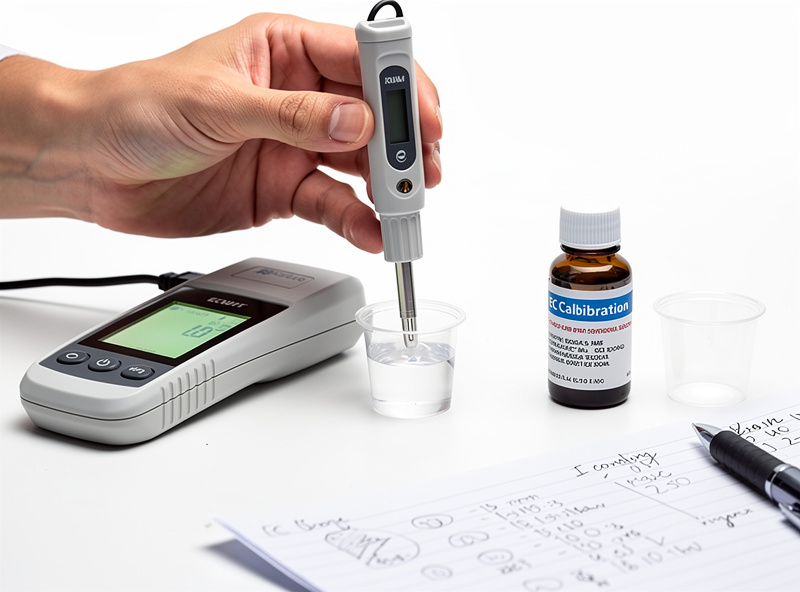
The process takes three minutes. Pour about 30 ml of calibration solution into a clean cup (never dip the probe directly into the calibration bottle — you will contaminate the rest of the bottle). Rinse the meter probe with distilled water and shake off excess. Submerge the probe in the calibration solution and stir gently for 30 seconds to displace air bubbles. Wait for the reading to stabilize (usually another 30 seconds), then press the calibration button. The meter should now read exactly 1.413, or “1413” if it displays in microsiemens.
Discard the used calibration solution — never pour it back into the bottle. Rinse the probe with distilled water and store the meter in its cap (most cap reservoirs hold a few drops of storage solution that keeps the probe membrane wet). A dried-out probe loses accuracy permanently within a few weeks.
Choosing an EC Meter for Your Setup
Three categories of meter cover every home grower’s needs. Pick by how often you check EC and how big your operation is.
Budget pen (Apera EC60, HM Digital COM-100, Aiboully — $20 to $40). Pocket-sized digital pens with a built-in probe. Accuracy of ±0.05 EC is plenty for hobby use. Battery-powered, with replaceable probes that last 1 to 2 years. Best for: single-system home growers checking EC once a day. Limitations: probes are not field-replaceable on the cheapest models, and accuracy drifts faster than premium options. Calibrate every 2 to 4 weeks.
Premium pen (Bluelab EC Pen, Hanna HI98129 Combo — $80 to $150). The same pen format with serious sensor quality. Accuracy of ±0.02 EC. Probes are user-replaceable. Battery life measured in years rather than months. Best for: growers running multiple reservoirs or anyone who wants a meter that lasts 5+ years. The Bluelab pen also reads pH in the same unit, eliminating a second device.
Continuous truncheon (Bluelab Truncheon, Bluelab Combo Meter — $130 to $300). Larger handheld units with a deeply socketed probe designed for continuous reservoir dipping. No buttons to press during measurement — light it up, dip it in, read the LCD. Indestructible build, factory-calibrated, no calibration solution required for years. Best for: serious hobbyists, anyone with multiple grow rooms, anyone tired of breaking pens. The truncheon is the one I keep at my main DWC row precisely because I got tired of a $25 pen drifting out of calibration mid-cycle. I unpack the Bluelab option specifically in my Bluelab Truncheon buyer’s guide.
Avoid TDS-only pens that lock you to a specific PPM scale without showing raw EC. They make cross-referencing feeding charts unnecessarily painful. The broader equipment landscape is covered in my hydroponic equipment buying guide.
How to Read EC Correctly
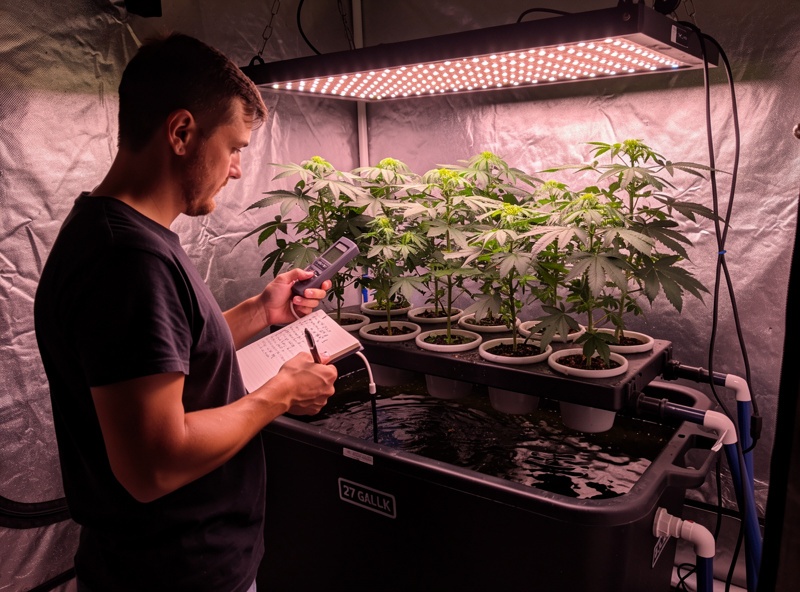
Three details separate accurate EC readings from false ones. Each takes about 10 seconds to do correctly.
Wait for stable readings. When you first dip the probe, the displayed number jumps around for 15 to 30 seconds as the probe equilibrates with the solution temperature and dissolves any biofilm on the sensor. Read the number only after it stops drifting. Quick “dip and glance” readings are usually 10 to 15% off.
Stir gently while reading. Stagnant solution next to the probe membrane reads slightly different than the rest of the reservoir. A gentle 360-degree stir of the probe (or stirring the reservoir for 10 seconds before measuring) gives you a representative reading.
Account for temperature. EC readings are temperature-dependent. Most modern meters auto-compensate for temperature (look for “ATC” in the spec sheet) but cheap meters do not. The standard temperature coefficient for nutrient solutions is around 2% per degree Celsius (Atlas Scientific’s breakdown of temperature and conductivity covers the physics), so a reservoir at 60°F can read roughly 15 to 20% lower EC than the same nutrient mix at 75°F if the meter does not auto-compensate — enough to make you second-guess a perfectly good mix. Check whether your meter has ATC and adjust expectations accordingly.
Frequently Asked Questions
What does an EC meter measure in hydroponics?
Electrical conductivity, which corresponds to total dissolved nutrient concentration in your reservoir. The meter passes a tiny current between two probe tips and reports the result in millisiemens per centimeter. Higher EC means more dissolved fertilizer; lower EC means less.
What is a good EC meter for hydroponics?
For most home growers, a $20 to $40 digital pen like the Apera EC60 or HM Digital COM-100 covers all needs. Serious hobbyists running multiple systems should step up to a Bluelab Truncheon or Bluelab Combo Meter at $130 to $300 for accuracy and durability.
How often should I calibrate my EC meter?
Every 30 days for casual use, every 7 days if you check EC multiple times per day, and immediately whenever a reading looks suspicious. Use a 1.413 mS/cm calibration solution and follow your meter’s calibration button procedure. Calibration takes 3 minutes.
What is the difference between EC and PPM?
EC is a direct physical measurement of electrical conductivity. PPM is EC converted using either a 500 scale (HM Digital, cheap pens) or 700 scale (Bluelab, European brands) — and the same solution can read 750 PPM or 1050 PPM depending on which scale your meter uses. Always work in EC to avoid confusion.
What EC should hydroponic lettuce be?
0.8 to 1.2 EC for the entire growing cycle. Lettuce is a low-feed crop and burns easily at higher concentrations. Stay at the bottom of the range during seedling stage and increase only after plants have established 4 to 6 true leaves.
Can I use an EC meter without calibration solution?
Not reliably. EC meters drift over time, and without periodic calibration to a known reference solution, you cannot trust the reading. A 250 ml bottle of 1.413 EC calibration solution costs $5 to $10 and lasts a typical home grower a full year — there is no good reason to skip this step.