An off-grid hydroponic system needs to keep its pump running 15 minutes per hour, every hour, year-round — even on cloudy days, even at 3 a.m. For a 50 W DC pump on a flood-and-drain cycle that comes out to roughly 9 kWh per month for the pump alone (300 Wh/day at a 25% duty cycle). Add lights, sensors, and air pumps and a small 4-tower NFT setup needs roughly 100-120 kWh per month from solar plus battery; a 24-tower commercial NFT setup needs 600-700 kWh.
This guide walks through how to size that system honestly: which loads are continuous and which can be timed around solar production, how much battery capacity buys you which length of cloudy spell, and the inverter choice that actually matters when half your loads are 12 V DC and the other half are 120 V AC LED drivers. I run every reservoir on my own bench on grid power with a battery-backed low-voltage cutout for pump redundancy rather than a full solar-plus-battery build — but the load math below is the exact same math I use to size that backup, just scaled up to cover the whole system instead of a few hours of bridge power.
Load Profile First, Panels Second
Off-grid sizing starts with a watt-hour-per-day total, broken down by load. For hydroponics, the four common loads are: water pump (continuous duty cycle), air pump (continuous), grow lights (12-18 hours scheduled), and sensors plus controllers (continuous low draw). Skip the load profile and you will either oversize panels by 2x or undersize battery and watch lettuce wilt during a three-day overcast stretch.
A typical 4-tower NFT setup: 50 W DC water pump on a 25% duty cycle (300 Wh/day), 5 W aquarium air pump continuous (120 Wh/day), 240 W LED grow array on a 14-hour schedule (3,360 Wh/day), 2 W sensor plus relay controller (48 Wh/day). Total: 3,828 Wh/day, of which 88% is the lights. The lights also happen to be the only load that can be perfectly aligned with solar production — run them dawn-to-dusk and you eliminate most of the battery requirement.
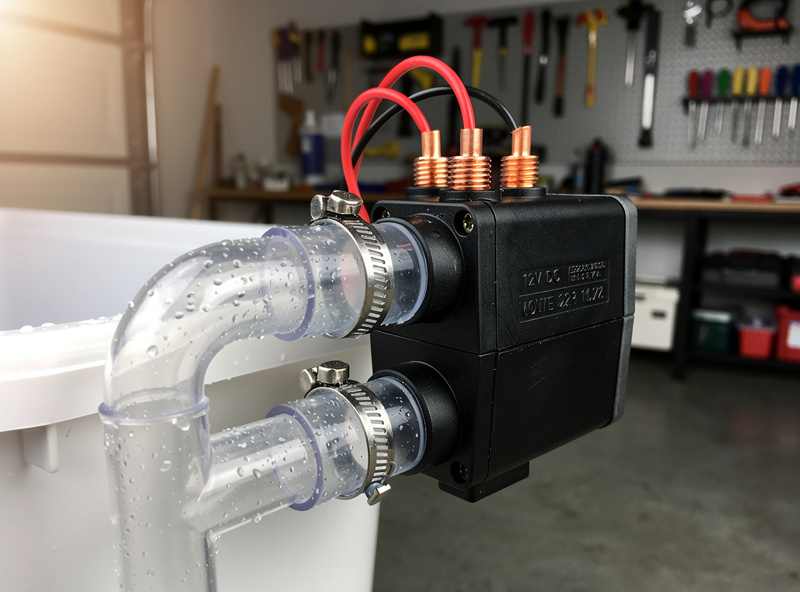
DC vs AC: Where the Inverter Matters and Where It Hurts You
The single biggest off-grid efficiency win is keeping low-power continuous loads on DC and letting the inverter sleep. A 50 W AC pump running 24% of the time draws ~12 W average. Push that through an 89% inverter and the actual battery draw is 13.5 W average — but the inverter idle draw at no-load can be another 8-15 W on top, so total system draw at idle is 23-30 W just to keep the inverter awake for a 50 W intermittent load. That is a doubling of the loss budget.
The fix: 12 V or 24 V DC pumps connected directly to the battery bus, with the inverter only handling the AC grow lights (which need to be on continuously for 14 hours anyway, so inverter idle loss is amortized over real load). Air pumps and sensors stay on DC. Grow-light drivers can be sourced as native DC for some LED brands, in which case the inverter can be sized purely for occasional AC loads (workshop tools, a backup outlet) and runs at maybe 5% of the year.
If you are shopping inverters for the AC light circuit, the chemistry-and-controller logic of which hybrid inverter to pick is its own subject — my sister site BatteryStorageHQ has the 2026 hybrid inverter comparison covering Sol-Ark, EG4, Victron, and Growatt, including no-load idle draw figures that make the difference for a load profile this small.
Battery Sizing: Days of Autonomy and the Cloudy-Week Problem
The right battery size is the daily kWh load divided by depth-of-discharge target, multiplied by days of autonomy. For LiFePO4 at 80% DOD, the 3,828 Wh/day load needs 4,785 Wh of nameplate capacity per day of autonomy. For 3 days of autonomy (the standard for grid-down resilience without generator backup), that is 14.4 kWh of LiFePO4 — roughly 12 of the 100 Ah / 12.8 V cells, or three 48 V server-rack batteries.
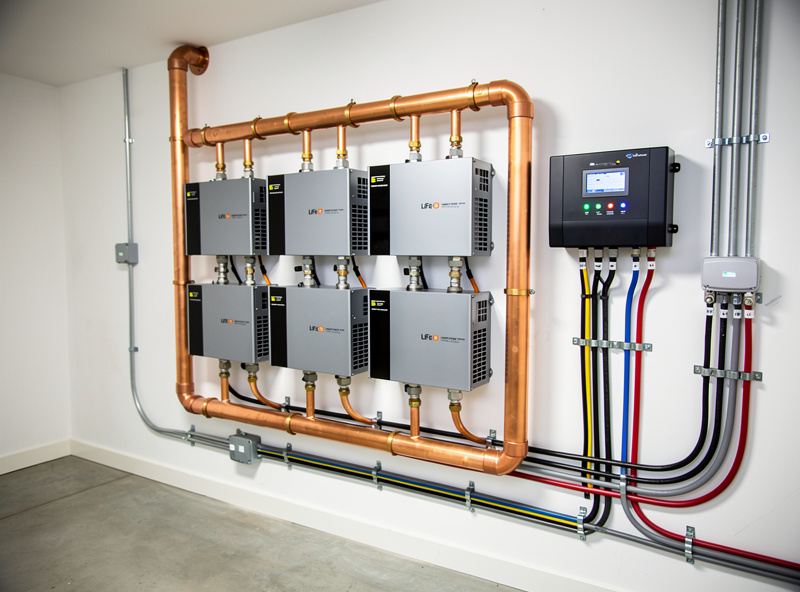
The trade-off curve is steep: 1 day of autonomy is 4.8 kWh and tolerates a single overcast day; 3 days is 14.4 kWh and tolerates a typical low-pressure system; 7 days is 33.5 kWh and gets you through a Pacific Northwest winter week. Most grow operations land at 3 days because the marginal cost per additional day rises faster than the marginal risk reduction once you are past day 3 — you are better off adding a small inverter generator for the rare 5+ day events than oversizing the battery for them.
Cycle life matters here too. LiFePO4 at 80% DOD delivers 4,000-6,000 cycles depending on chemistry brand and operating temperature. A daily full cycle gives 11-16 years of life, which means battery cost per kWh delivered over the full lifetime is the right comparison metric — not nameplate $/kWh at purchase. The full chemistry breakdown lives on my sister site’s battery chemistry guide for home storage, including which BMS settings actually matter for cycle life.
Solar Panel Sizing for Continuous Pump Operation
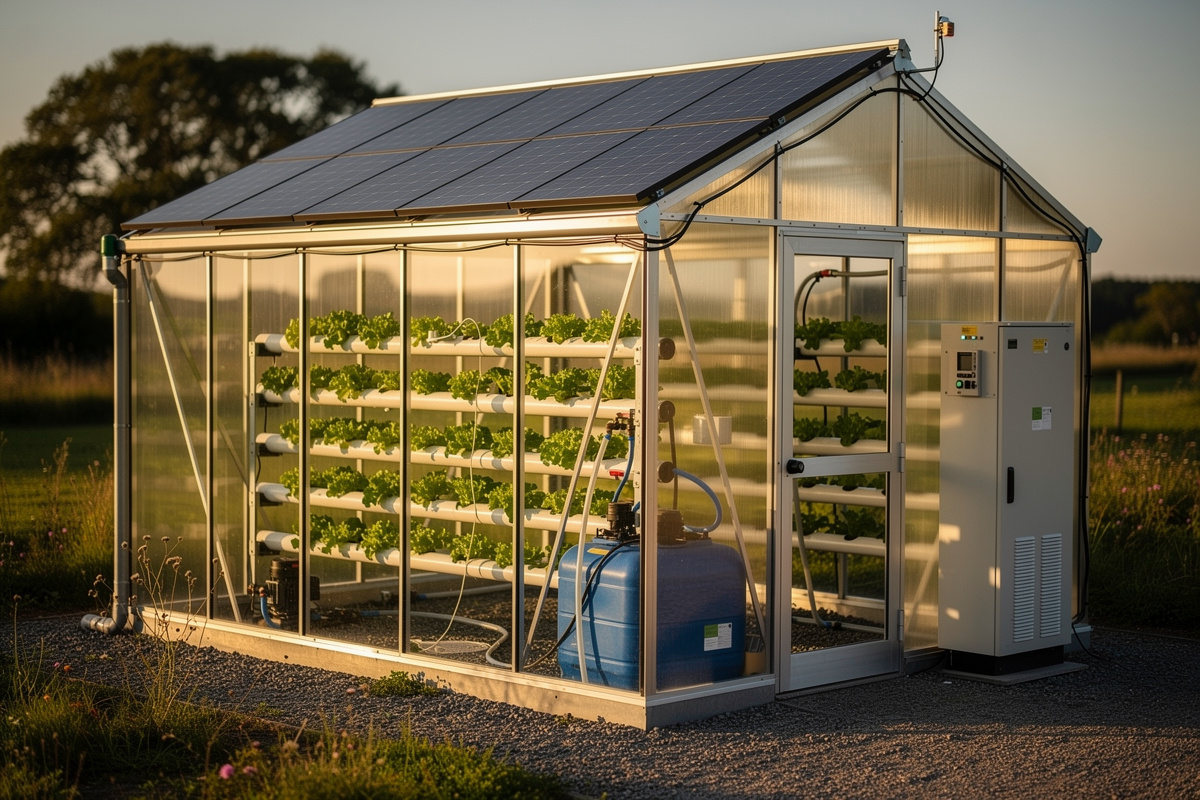
The panel array needs to refill the daily load plus cover 2-3 days of worst-case insolation deficit. A 4-tower NFT system at 3,828 Wh/day in a region averaging 4 sun-hours/day in winter needs 1,200 W of panels to break even on a typical day. To buffer against a 50% production deficit during a cloudy week and still recover the battery in a couple of clear days afterward, oversize to 1.5-2x: 1,800-2,400 W of panel.
That is 4-6 standard 410 W residential panels — roughly 100 square feet of roof or ground-mount space. Cost at 2026 prices: $700-1,000 in panels, $300-500 in MPPT charge controller, $400-700 in mounting hardware. The full battery-and-inverter side adds another $5,000-8,000 for the 14 kWh LiFePO4 bank and a 5 kW hybrid inverter. Total system cost for an off-grid 4-tower NFT setup: roughly $7,000-10,500 not counting the hydroponic equipment itself.
System Comparison: 4-Tower vs 24-Tower vs Single Bucket
| System Size | Daily kWh | Battery (3-day, LiFePO4) | Solar Panels (winter) | Inverter Class | Approx Cost |
|---|---|---|---|---|---|
| 1 DWC bucket (1 plant) | ~0.4 kWh | 1.5 kWh | 200-300 W | None (DC only) | $600-900 |
| 4-tower NFT (60 plants) | 3.8 kWh | 14.4 kWh | 1,800 W | 3-5 kW hybrid | $7,000-10,500 |
| 12-tower NFT (180 plants) | 10.5 kWh | 40 kWh | 4,800 W | 5-8 kW hybrid | $18,000-25,000 |
| 24-tower commercial | 22 kWh | 83 kWh | 10 kW | 10-15 kW split-phase | $38,000-55,000 |
| Hobby aeroponic (8 plants) | 1.2 kWh | 4.5 kWh | 500 W | 1.5 kW | $2,200-3,000 |
Pump Reliability: The Failure Mode That Kills Plants
Lights going out for 18 hours rarely kills a hydroponic crop — plants slow growth and recover. A pump going out for 18 hours during a heat wave kills lettuce in a single afternoon because the root zone overheats and oxygen drops below survival thresholds. Off-grid hydroponics demands pump redundancy in a way grid-tied systems don’t.
The minimum redundancy stack: primary 12 V DC pump, secondary identical pump on a relay triggered by a flow sensor or pressure switch, and a battery-backed UPS-style capacitor bank for the 30-second window when the relay switches. This is roughly $80 in parts and prevents most single-pump-failure crop losses — I run the same smart-plug-and-sensor logic behind this redundancy stack across every reservoir on my own bench, off-grid or not, because a pump failure kills a crop just as fast on grid power. For the climate side of the same problem — automated humidity, temperature alerts, root-zone monitoring — the smart sensor build is covered in my smart hydroponic sensors guide.
What to Build First, What to Add Later
The right off-grid hydroponic build sequence:
- Week 1 — Load profile. Measure actual draw of each component with a USB power meter or DC ammeter. Do not trust nameplate ratings.
- Week 2 — DC-first migration. Replace any AC pumps and air pumps with 12 V DC equivalents. Wire directly to the battery bus.
- Week 3 — Battery bank install. Start with 1 day of autonomy (lower budget) and verify the system works before committing to the full 3-day bank.
- Week 4 — Solar array. Size for the calculated kWh/day and add a 50% buffer.
- Week 5+ — Pump redundancy and monitoring. Secondary pump, flow sensor, low-voltage cutout on the BMS, low-power data-logger.
For the broader equipment selection — pumps, channels, reservoirs, controllers — my hydroponic equipment buying guide and my hydroponic systems comparison cover the upstream choices that determine your kWh/day baseline.
For deeper background on the science of off-grid power budgeting, Penn State’s stand-alone PV system sizing course notes walk through the same autonomy-and-battery math this guide uses. NASA’s POWER solar irradiance data portal is the free dataset I’d point you to for region-specific sun-hours numbers instead of the generic “4 sun-hours” figure used above.
Frequently Asked Questions
Can a small solar setup actually run a hydroponic system?
Yes — a single 1-plant DWC bucket runs on under 0.5 kWh per day, which a 200-300 W panel and a 1.5 kWh LiFePO4 battery handles year-round in most climates. Larger NFT or aeroponic systems scale linearly: every 4 plants under LEDs adds roughly 1 kWh per day to the load.
Why use 12V DC pumps instead of regular AC pumps?
DC pumps eliminate the 8-15% inverter conversion loss and avoid the 8-15 W inverter idle draw needed to keep the AC bus alive. For continuous low-power loads like hydroponic pumps, switching from AC to DC roughly halves your battery drawdown over 24 hours.
How much battery do I need for 3 days of cloudy weather?
Multiply daily kWh load by 3, divide by 0.8 (LiFePO4 depth of discharge). A 4-tower NFT system at 3.8 kWh per day needs 14.4 kWh of nameplate LiFePO4 for 3-day autonomy. That is approximately three 48V server-rack batteries or twelve 100Ah 12.8V cells.
What happens if the pump stops while I’m away?
Roots overheat and oxygen drops within 4-8 hours during warm weather, killing crops. Pump redundancy — a secondary pump on a flow-sensor relay — costs about $80 and prevents the most common single-failure crop loss in off-grid systems. A low-voltage cutoff on the BMS protects the battery if drain exceeds expectations.
Can I run grow lights at night using stored solar?
You can, but it doubles the battery requirement compared to running lights during daylight hours. The optimal schedule for off-grid hydroponics is dawn-to-dusk LED operation, which lets the panels feed the lights directly with minimal battery cycling. Crops grown under this schedule still hit production targets if light intensity is correct.
What inverter size do I need for off-grid hydroponics?
Size for the peak AC load, not the average. A 4-tower NFT with 240W of LED drivers and a 50W AC pump peaks at roughly 400W, so a 1500-3000W inverter handles it with margin for occasional workshop loads. For larger systems with 1kW+ of grow lights, a 5kW hybrid inverter is the standard choice.
Is off-grid hydroponics actually cheaper than grid power?
Over 10-15 years, yes — but only if you would have built grid-tied solar anyway. The hydroponic load profile is so small that adding it to an existing solar plus battery system costs almost nothing per kWh produced. Building solar plus battery purely for hydroponics rarely beats grid power on cost alone, but it does buy resilience.