“How often should I change my reservoir water?” is one of those questions where the honest answer is “it depends” — and then people groan, because they wanted a number. So here is the number: most growers should do a full water change every one to two weeks, then adjust based on what their meters and their nose tell them. The calendar is the starting point; the reservoir itself decides the rest.
On my bench, a full water change is the reset that topping off cannot provide. Top-off keeps the level and EC in check day to day, but plants take up nutrients unevenly, so certain salts pile up no matter how careful you are — and only dumping and remixing clears that. This guide gives you the cadence by crop and tank size, the signals that override the calendar, and exactly how I run a change.
How Often Should You Change Hydroponic Reservoir Water?
Change the full reservoir every one to two weeks for most crops. Smaller reservoirs and fast-growing or heavy-feeding plants need changing more often; large, stable tanks can stretch longer. Top off with plain water between changes to maintain volume. Override the schedule whenever EC drifts badly, pH won’t hold, or the water smells off.
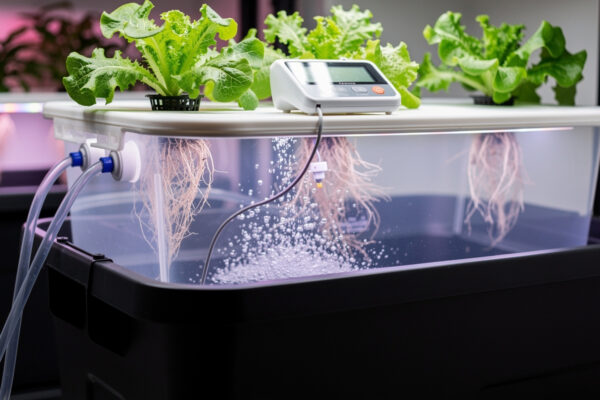
The one-to-two-week window covers the majority of home setups, but it flexes hard at the edges. A small lettuce tote in vigorous growth concentrates and imbalances quickly, so I change it weekly. A large, well-buffered fruiting reservoir can comfortably go two weeks or a touch more. The point of the full change is not freshness for its own sake — it is resetting the accumulated salt imbalances that build up as plants feed selectively, plus refreshing oxygen and clearing any biofilm starting to form.
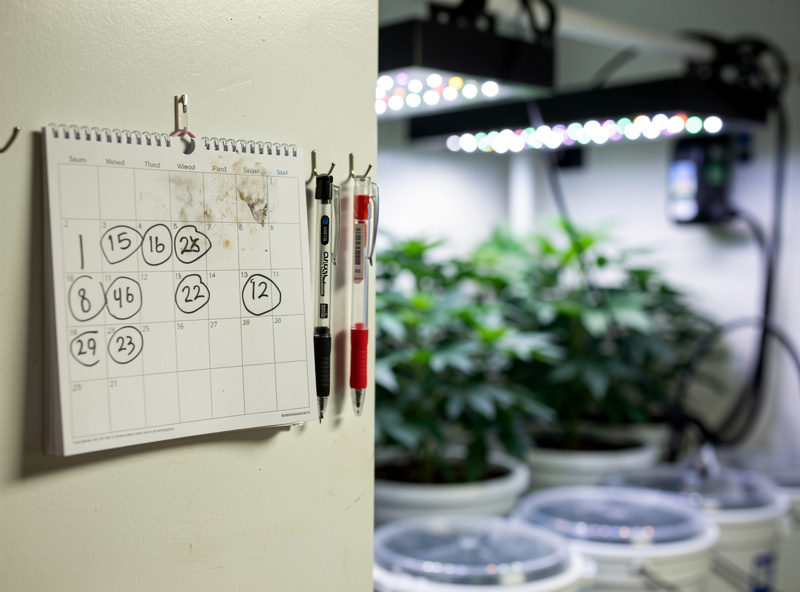
Top-Off vs Full Change: Don’t Confuse Them
Topping off restores water lost to evaporation and transpiration and dilutes EC drift; a full water change empties the tank entirely and refills with fresh solution to reset salt imbalances. You top off as often as the level drops, sometimes daily, but you only do a full change every week or two. Each job does something the other cannot.
This is the distinction that trips people up most. Topping off with plain water keeps your EC from drifting upward as the level falls, but it does nothing about the uneven salt buildup underneath — the plants are pulling more of some ions than others, slowly skewing the ratio in ways your EC pen cannot even see. A full change is the only fix for that skew. I cover the top-off side in depth in the reservoir guide; this article is about the full-change half of the cycle.
| Crop / Tank | Change Frequency | Why |
|---|---|---|
| Lettuce / greens, small tote | Weekly | Concentrates and imbalances fast |
| Herbs, medium reservoir | 1–2 weeks | Moderate feeding |
| Fruiting crops, large tank | ~2 weeks | Big buffer, steady feeding |
| Any tank, hot conditions | More often | Faster drift and biofilm |
| Seedlings, low EC | 1–2 weeks | Light feeders, watch pH |
Signals That Override the Calendar
Change the water immediately — regardless of the schedule — if EC has drifted far from target and won’t correct with plain water, if pH becomes unstable and keeps swinging, if the water smells sour or swampy, or if roots show signs of stress. These are the reservoir telling you it is past due.
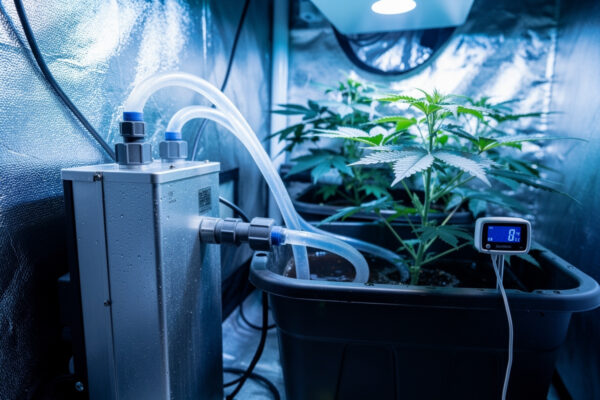
I let the tank overrule the calendar every time. An EC that climbs and will not settle back with a plain-water top-off means salts have accumulated unevenly and need a reset. A pH that you correct in the morning and find swinging again by evening usually means the buffering is exhausted or something biological is happening — both point to a change. And a sour smell is unambiguous: the water has gone anaerobic, and no amount of pH Down fixes that. Reading those signals correctly depends on a trustworthy EC meter and watching water temperature, since heat from a warm tank (see my water temperature guide) accelerates every one of these problems.
How to Do a Water Change
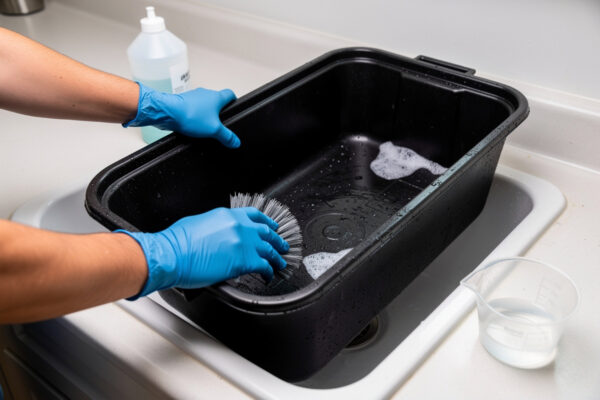
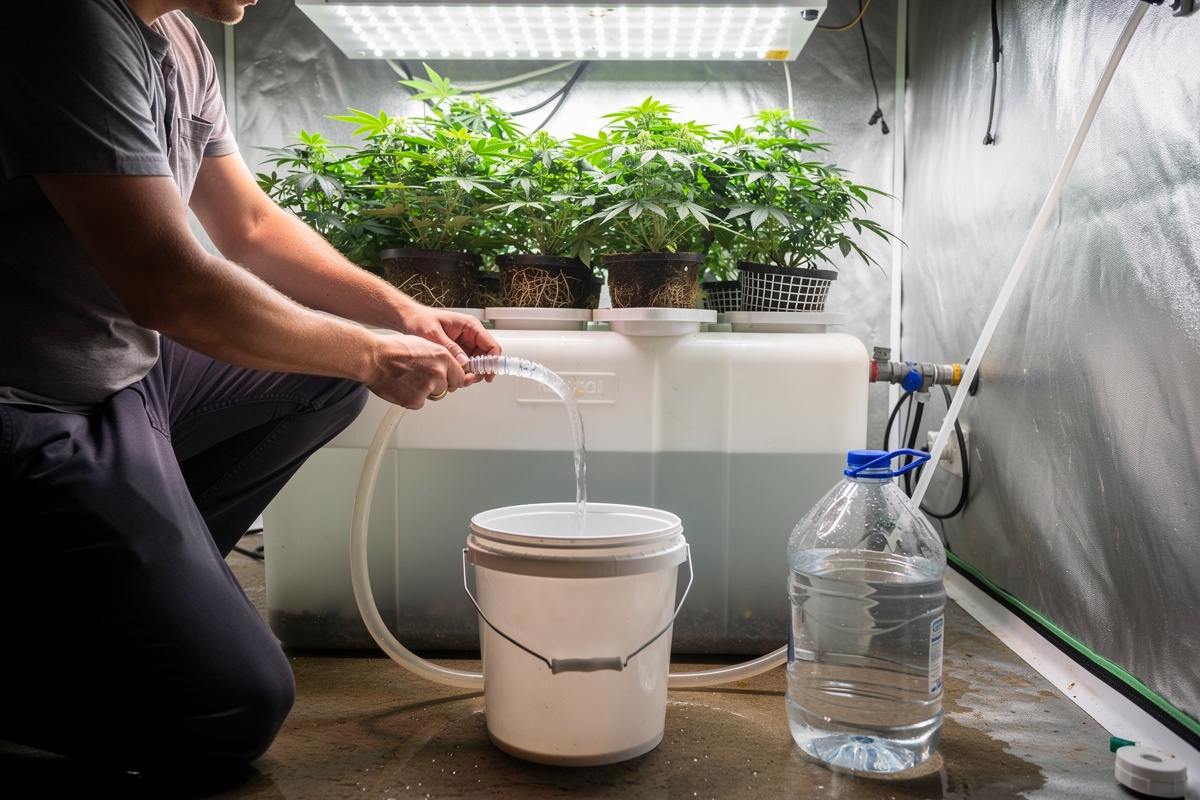
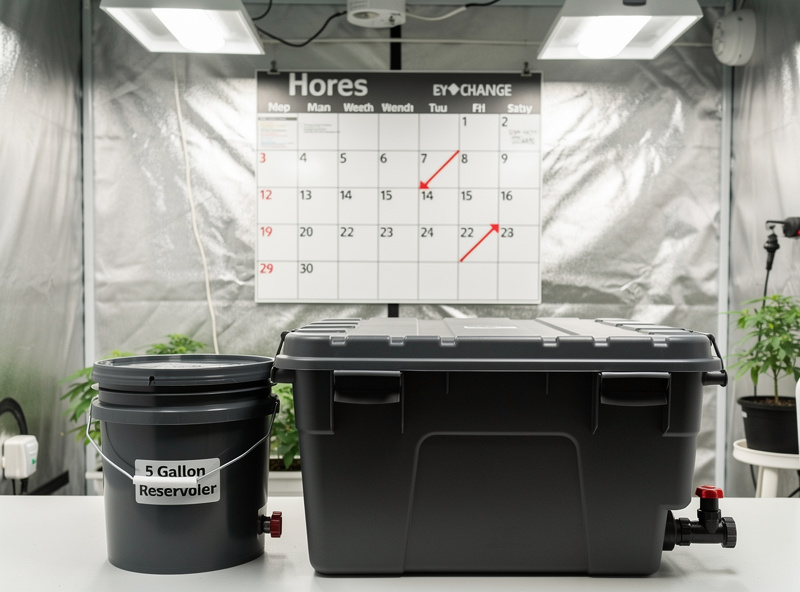
Drain the old solution completely, clean and sanitize the empty reservoir, refill with fresh water, mix nutrients to your target EC, adjust pH into range, then return the plants and restart aeration. Doing the clean while the tank is empty is the most efficient routine — never refill a dirty reservoir.
My routine is one continuous job. I siphon or pump the old solution out — a small submersible utility pump makes draining a large tank painless — then scrub and sanitize the empty tank before a drop of fresh water goes in. Then I refill, mix to target EC, and check it with the EC pen, adjust pH into the 5.5–6.0 band with a pH Down solution, and only then restart the air stones and return the roots. The cleaning step that belongs in the middle of this is detailed in my reservoir cleaning guide, and the actual nutrient mixing is in the nutrient guide — this article is the water-change cadence and process around them.
What to Do With the Old Solution
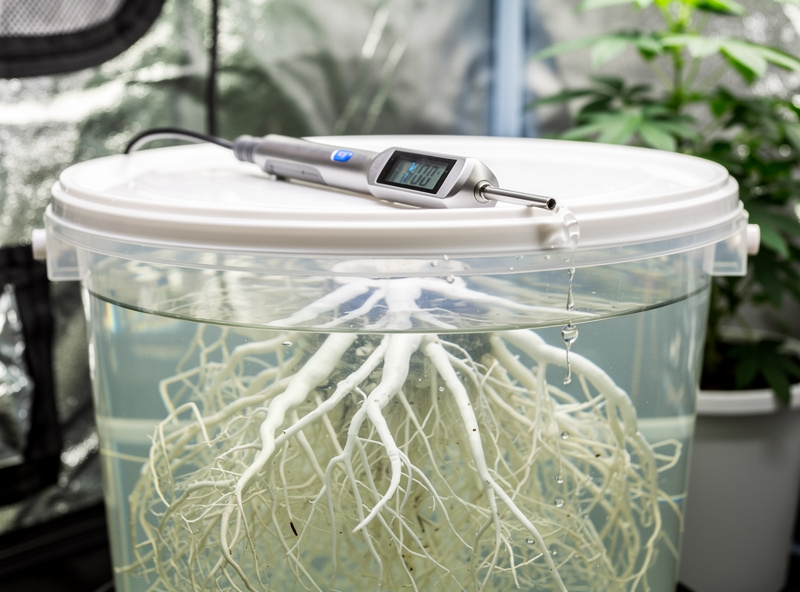
Old hydroponic reservoir water is mild fertilizer, so the simplest use is watering soil plants — houseplants, garden beds, or a lawn — where the residual nutrients and varied salts are an asset rather than a liability. Do not pour large volumes down a storm drain, and dilute it if your tap goes to a septic system. It is a resource, not just waste.
I never tip a drained reservoir away if there is a pot nearby to take it. The very salt imbalances that make the solution wrong for a hydroponic crop are harmless and even useful in soil, where the soil buffers everything and the plant roots pick what they need. My outdoor beds and houseplants drink my spent res water happily. This is one of those quiet polymath crossovers — the same instinct that has me feeding spent grain to other parts of the network, here turning a maintenance byproduct into free feed for the garden. Just use common sense on volume and your local drainage, and keep concentrated nutrients out of waterways.
Seasonal Changes to Your Schedule
Adjust your change frequency with the seasons. Hot, bright summer conditions drive faster evaporation, EC drift, and biofilm growth, so reservoirs need changing more often. Cool, low-light winters slow everything down, letting you stretch the interval — a real factor for indoor growers in cold climates.
My schedule is not the same in July as it is in December, and yours should not be either. Under intense summer light and heat, a tank drifts and fouls fast, pulling the change interval shorter. In my short-daylight Nordic winters the room is cool and the plants transpire less, so a well-managed reservoir holds far longer between changes. The variable underneath all of it is temperature, which is exactly why I keep coming back to the water temperature guide — a cool res in any season is a reservoir that needs less intervention. Let the meters confirm what the season suggests rather than rigidly following a fixed weekly date.
Stretching the Time Between Changes
You can safely extend the interval between changes by using a larger, more stable reservoir, keeping water cool below 68°F, maintaining a tight opaque lid against algae, and topping off diligently with plain water. A bigger, cooler, cleaner tank imbalances more slowly, so it needs full changes less often.
Everything that makes a reservoir stable also makes it last longer between changes. Volume is the biggest lever — the sizing guide explains why a large tank’s chemistry shifts so much more slowly than a small one’s. Cool, dark, oxygenated water resists the biofilm and pathogen growth that force an early change. And disciplined topping off keeps EC from running away in the meantime. None of this lets you skip changes entirely — the salt imbalance still builds — but it turns a weekly chore into a comfortable fortnightly one.
Affiliate disclosure: some links above are Amazon affiliate links. I may earn a small commission at no extra cost to you. I only recommend gear I run on my own reservoirs.
Frequently Asked Questions
How often should I change hydroponic water?
Do a full water change every one to two weeks for most crops. Small tanks and heavy feeders need it sooner; large, stable reservoirs can stretch longer. Top off with plain water in between, and change early if EC, pH, or smell signal trouble.
What is the difference between topping off and a water change?
Topping off adds plain water to restore the level and dilute EC drift. A full water change empties the tank and refills with fresh solution to reset uneven salt buildup. You top off often; you do a full change every week or two.
How do I know when to change reservoir water early?
Change immediately if EC drifts far from target and will not correct with plain water, if pH keeps swinging, if the water smells sour or swampy, or if roots look stressed. These signals override the calendar schedule.
Do larger reservoirs need changing less often?
Yes. A larger tank has more buffering volume, so its EC and pH drift more slowly and salt imbalances build up more gradually. That lets you stretch the interval between full changes compared with a small, fast-drifting reservoir.
Should I clean the reservoir during a water change?
Yes, always. The empty tank during a water change is the ideal time to scrub off biofilm and sanitize before refilling. Pouring fresh solution into a dirty reservoir reintroduces the pathogens you just drained away.
Can I go longer than two weeks between changes?
Sometimes, with a large, cool, well-lidded reservoir and diligent plain-water top-offs. But salt imbalances still accumulate, so monitor EC and pH closely and change as soon as either drifts or the water shows any sign of going off.