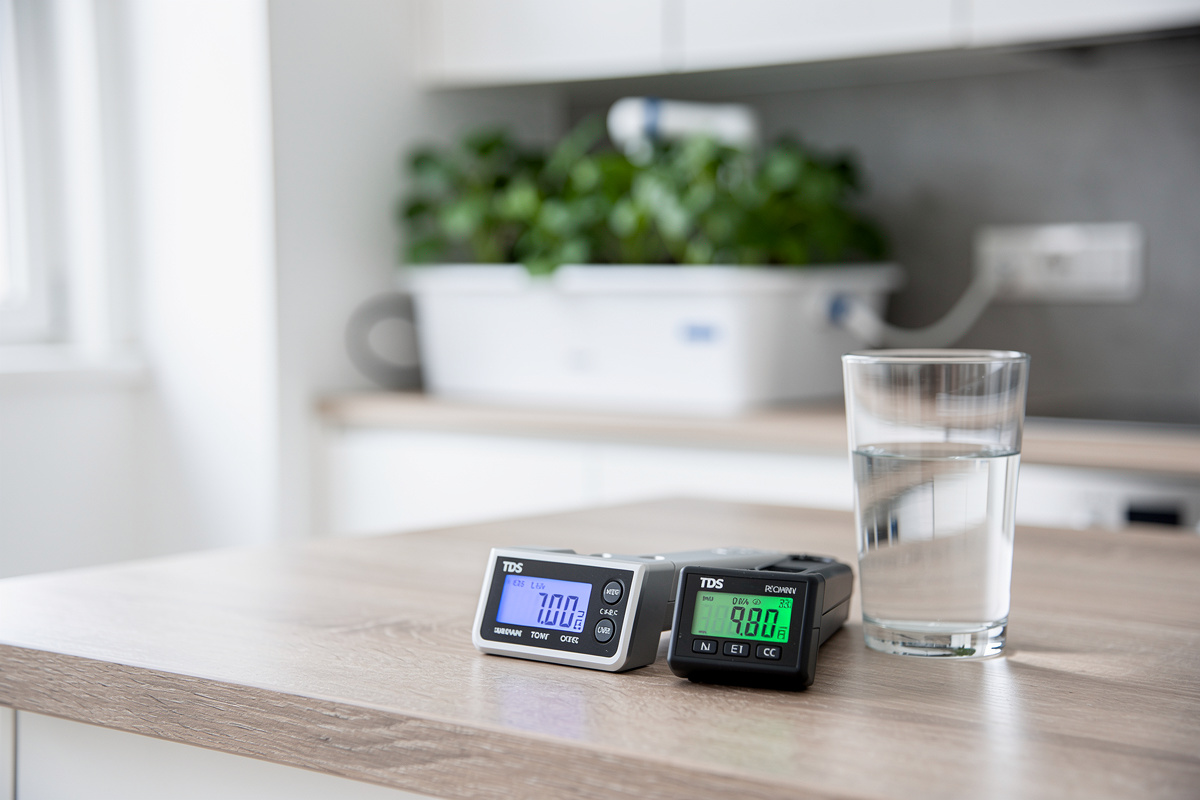
The same TDS meter you use to check your hydroponic reservoir tells you exactly what is already in your source water before a single drop of nutrient goes in. Most tap water reads 150–400 PPM of dissolved solids — minerals that are either a head start on your target EC or a hidden imbalance that throws your Ca:Mg ratio off before you have mixed anything. Growers who never test their source water end up chasing phantom nutrient problems that are actually just baseline mineral content they never accounted for.
I noticed how much this mattered by accident. The EC meter lives on the same counter where I mix nutrient solution for the DWC buckets, and one afternoon I dipped it into a fresh jug of tap water out of curiosity before adding a single milliliter of Flora trio. The tap water here in Sweden reads 320–380 PPM — genuinely hard, mineral-heavy water, which is exactly why I go through more pH Down on straight-tap reservoirs than on the ones I top off with RO. Knowing that number changed how I dose every reservoir I fill from that tap.
This article is about the water-quality lens every hydroponic grower needs before they mix a single reservoir: what is actually in your source water, why zero-TDS water is not automatically “clean” for plants, and how to read the numbers the same way you read a res change.
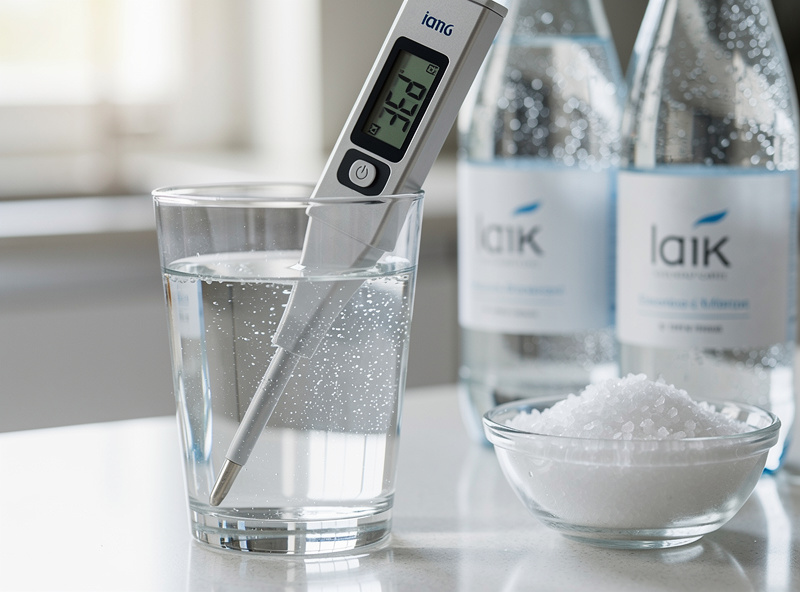
What Your EC Meter Is Actually Measuring
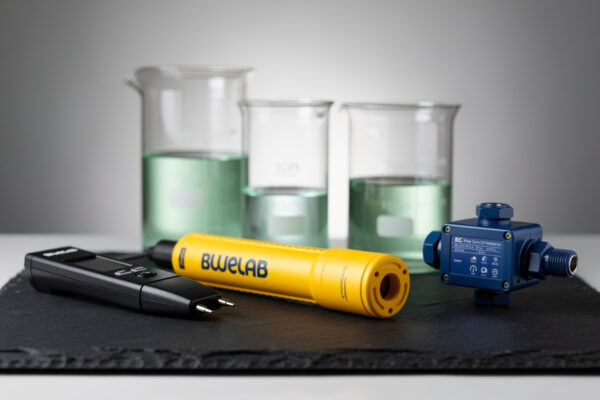
An EC meter measures electrical conductivity in microsiemens per centimeter (µS/cm), which is a proxy for total dissolved solids (TDS) measured in parts per million (PPM). The conversion varies by meter brand — some use a 0.5 conversion factor, some use 0.7 — but the principle is consistent: higher EC means more dissolved minerals. I run an HM Digital TDS-EZ ($15 on Amazon) for a quick check of a new water source and a Bluelab Truncheon for the actual reservoirs because the Bluelab’s calibration holds for months and I do not want to recalibrate before every top-up. The TDS-EZ uses a 0.5 conversion factor (NaCl reference), the Bluelab a 0.7 (442 reference) — same physics, different display number, and it is the first thing I check when a reading looks off between the two.
| Water Source | Typical TDS (PPM) | Typical EC (µS/cm) | What It Means for Your Reservoir |
|---|---|---|---|
| Distilled / RO water | 0–10 | 0–20 | Zero mineral baseline — you supply 100% of Ca/Mg via CalMag before dosing the trio |
| Soft tap water | 50–200 | 100–400 | Small mineral head start; still add CalMag, just less of it |
| Medium-hard tap water | 200–400 | 400–800 | Meaningful mineral head start; reduce CalMag dose and recheck EC after mixing |
| Hard tap / well water | 400–700+ | 800–1,400+ | Ca/Mg often already adequate or excessive; skip CalMag, watch for lockout at high pH |
| Rainwater (collected) | 0–50 | 0–100 | Behaves like soft-to-RO water — treat it as a near-zero baseline |
The number that actually matters is not the raw PPM, it is what that PPM does to your target EC once you start dosing. A reservoir mixed from 350 PPM tap water and dosed to a 1,400 PPM target has genuinely different available mineral content than the same dose in 20 PPM RO water, even though your meter reads the same final number on both. That gap is where a lot of “my plants look off but my EC reads fine” troubleshooting actually lives.

Why Zero-TDS Water Is Not “Clean” for Plants Either
RO and distilled water read as the cleanest thing on the table, and that is exactly the trap. Reverse osmosis strips essentially all dissolved minerals, including the calcium and magnesium your plants need for cell wall structure and chlorophyll production — RO water arrives at your reservoir with close to zero natural Ca/Mg and no buffering capacity at all. Run RO water without adding CalMag and you get the same deficiency symptoms as underfeeding: interveinal chlorosis starting on the older leaves, weak stems, and — on fruiting crops — blossom-end rot from a calcium shortfall the plant cannot fix no matter how much N-P-K you throw at it. Cornell’s greenhouse hydroponic nutrient-recipe reference walks through exactly this water-source-dependent adjustment (A Recipe for Hydroponic Success, Cornell CEA), covering how alkalinity and starting Ca/Mg content change what you need to add. The same reason I never run straight RO into a hydroponic nutrient reservoir without CalMag is the reason “pure” water is not automatically the right water — plants need minerals in the water column, and zero-TDS water gives them none to start from.
Chlorine, Chloramine, and Root-Zone Biology
Municipal tap water contains chlorine or chloramine as a disinfectant. Chlorine dissipates if you leave water sitting uncovered for 12–24 hours. Chloramine does not — it is more stable and requires activated carbon filtration or a dechlorinating agent like a campden tablet to remove reliably. For hydroponics this is a real problem, not a cosmetic one: chlorinated water kills the beneficial Bacillus and other microbes I dose into my reservoirs (the same inoculant covered in my Pest & Disease IPM routine), and sensitive crops like lettuce and herbs show root stress at even modest chlorine residual levels. Standard activated carbon filtration removes free chlorine effectively; chloramine needs a catalytic carbon stage to break down fully, which basic pitcher-style filters do not always provide (University of Nebraska Extension guide to activated carbon filtration).
I run a carbon-block filter on the kitchen tap where I fill the hydro reservoirs — the unit was $30 and the replacement cartridges run $12 every six months. It knocks the chlorine taste and residual out reliably; the TDS itself barely moves, maybe 10–20 PPM, because minerals pass straight through a carbon filter — only the disinfectants and organic off-tastes get pulled out. For the equipment cost of a single mid-range air pump, you get source water that stops fighting your root-zone biology before you have even mixed a nutrient dose.
Building a Source-Water Testing Routine
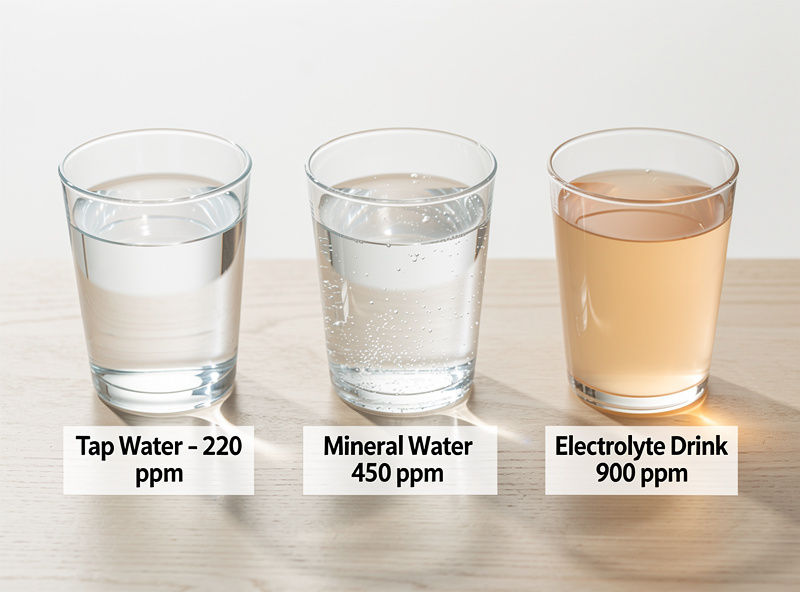
Test your source water once before you build a new reservoir, and again any time your municipal supply could have changed — a boil-water notice, a new well, a move to a new house. It takes thirty seconds with a $15 meter and saves you a season of second-guessing your dosing. Log the baseline PPM next to the reservoir it feeds, the same way you’d log EC and pH on the reservoir itself.
The routine I actually run: dip the TDS meter in a fresh jug straight from the tap before mixing anything, note the number, then dose the trio to my target EC and check the final reading against what I expected given that baseline. If the final number is meaningfully higher than baseline-plus-dose, something in the water — usually hardness — is adding more than I accounted for, and I back the CalMag off next time. If it is close to what I expected, the water is behaving as a near-neutral carrier and I dose it the same every time. One or two reservoirs of tracking is usually enough to know which kind of water you are working with for good.
What Years of EC Logs Taught Me About Source Water
Running a hydroponic system long enough changes how you think about water because you stop treating it as a background input and start treating it as a variable with measurable properties. pH, EC, temperature, dissolved oxygen — these are not abstract water-quality metrics, they are numbers I adjust every reservoir to keep four different systems running consistently. The biggest lesson from years of logging is that “my tap water” is not a constant — hardness shifts seasonally here, enough that a dose that was dead-on in spring runs slightly hot by late summer if I do not re-check the baseline.
I keep an HM Digital TDS-EZ next to the kitchen tap now, not because it is strictly necessary gear but because it answers “why did this reservoir come in high” with a number instead of a guess. When the number says my tap is running 380 PPM instead of the 320 I am used to, the answer is “cut the CalMag this batch.” A $15 meter and thirty seconds of curiosity replaced a fair amount of trial-and-error dosing.
Frequently Asked Questions
Can I use the same TDS meter for source water and my reservoir?
Yes. TDS meters measure dissolved solids regardless of what water you dip them in. Rinse the probe between a source-water check and a reservoir reading to avoid cross-contamination from nutrient solution skewing your next reading.
Do I need to filter my tap water before using it in a hydroponic reservoir?
If your municipal supply uses chlorine, letting water sit uncovered 12-24 hours dissipates most of it. If it uses chloramine, that does not work reliably and you need activated carbon filtration. Either way, chlorinated water stresses beneficial root-zone microbes and sensitive crops like lettuce.
Is RO or distilled water better for hydroponics than tap water?
Neither is automatically better. RO and distilled water start at zero TDS, which means zero natural calcium and magnesium, so you must add CalMag or the plant shows deficiency symptoms. Hard tap water may already carry enough Ca/Mg that added CalMag becomes unnecessary or even excessive.
Why does my reservoir EC read higher than what I dosed?
Your source water already carried dissolved minerals before you added a single milliliter of nutrient. Test your source water’s baseline TDS before mixing so you know how much of your final EC reading is pre-existing hardness versus what you actually dosed.
How often should I test my source water?
Once before you build a new reservoir, and again any time your municipal supply could change — a boil-water notice, a new well, a move. Water hardness can also drift seasonally, so re-checking once or twice a year catches dosing drift before it shows up as a plant problem.
What TDS range is considered hard water for hydroponics?
Above roughly 400 PPM (800 µS/cm EC) is generally considered hard enough that you should expect meaningful pre-existing calcium and magnesium, and should reduce or skip added CalMag accordingly. Below 200 PPM, treat the water as a near-zero mineral baseline.