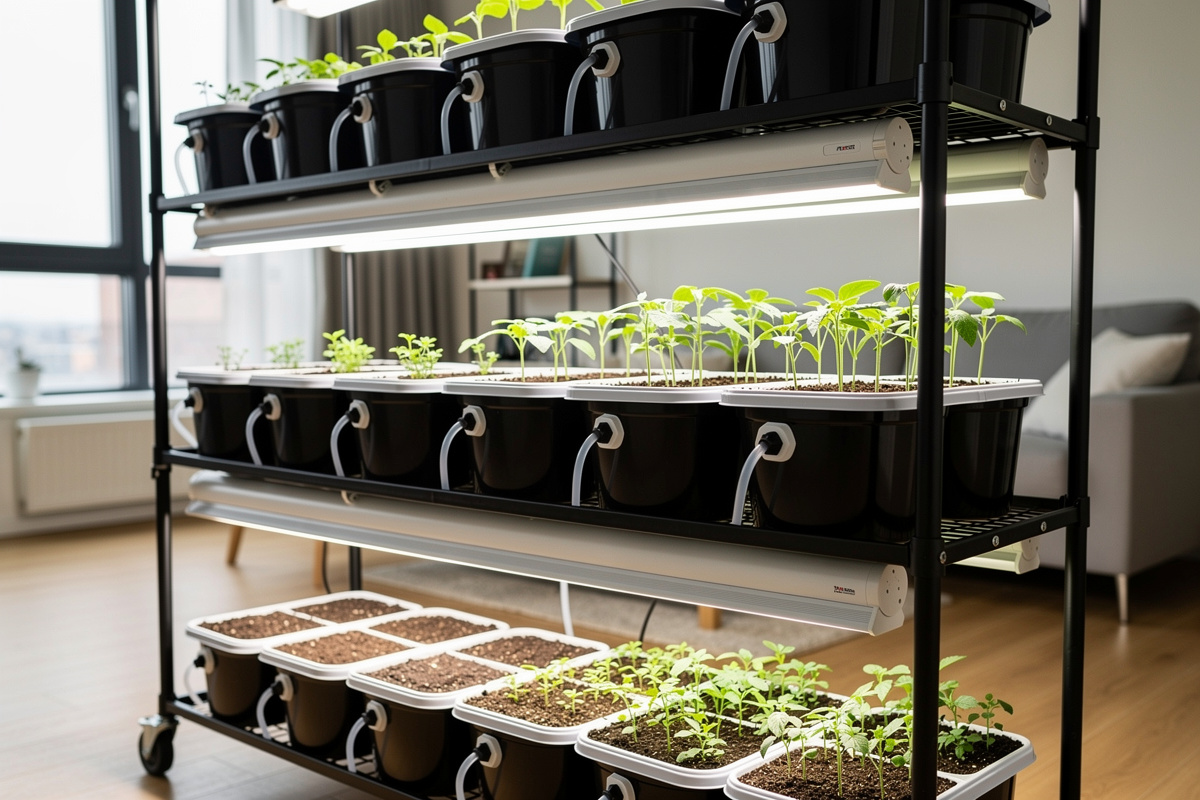
A full-spectrum LED panel in the 4000K-5000K range with at least 200 PPFD at 12 inches covers both hydroponic leafy greens and soil-based seed starting without swapping fixtures. You do not need separate lights for hydro and seeds — you need one good panel and the understanding to adjust height and duration per growth stage. The light that grows a healthy basil seedling in rockwool at 14 hours of 350 PPFD is the same light that prevents leggy tomato starts in potting mix at 16 hours of 250 PPFD. The fixture stays the same; the schedule and distance change.
Why One Light Works for Both Applications
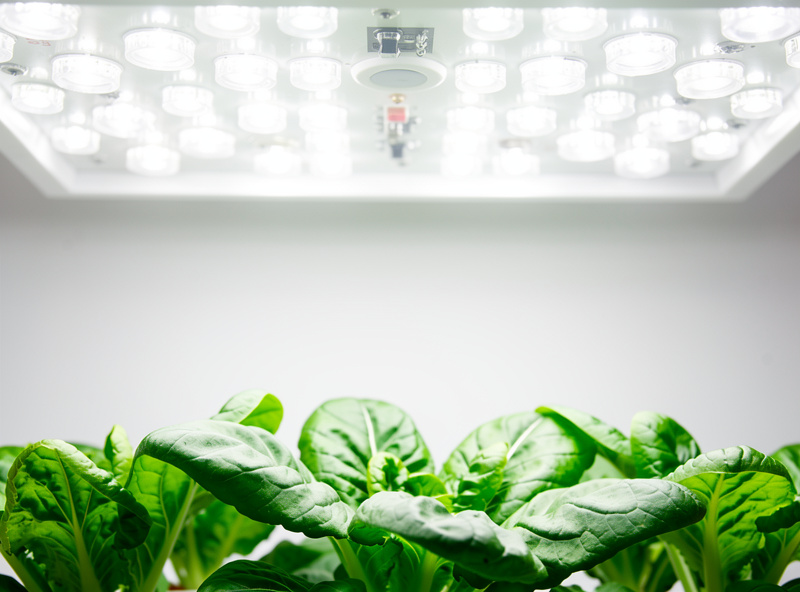
Seed starting and vegetative hydroponics share the same core light requirement: blue-weighted spectrum in the 400-500 nanometer range, which drives compact internode spacing and root development while suppressing the stretch response that produces weak, floppy stems. Both applications need moderate photosynthetic photon flux density — roughly 200-400 PPFD at canopy level — and neither requires the deep-red 660nm spike that flowering and fruiting stages demand. This overlap is why a single 4000K-5000K LED panel handles microgreens in trays on Monday, buttercrunch lettuce in a DWC bucket on Wednesday, and tomato starts in cell packs on Friday. The plant does not know whether its roots are in soil or nutrient solution; it only responds to the photons hitting its leaves.
Spectrum: What the Numbers Actually Mean
Grow-light marketing makes spectrum sound like a proprietary secret, but the physics is simpler than the brochure. Plants absorb light primarily at 450nm (blue) and 660nm (red) with secondary peaks at 430nm and 630nm. For dual-use seedling and veg lights, you want a panel that dedicates real diode count to the 400-500nm band rather than just enough to earn a “full spectrum” sticker on the box. Most white-LED panels running at 4000K-5000K deliver this natively because white LEDs are blue diodes with a phosphor coating — the phosphor converts some blue to longer wavelengths, but plenty of original blue passes through, which is exactly the blue-heavy signal that keeps stems short and internodes tight instead of stretching toward the light. The red spike at 660nm matters for flowering and fruiting but is irrelevant for seedlings and leafy greens; a panel that spends watts on 660nm LEDs is giving you nothing for the dual-use case and probably costs more for no benefit.
For the sensor-minded grower, the color temperature is a rough proxy. 3000K panels lean warm (more red, better for flowering). 6500K panels lean cool (strong blue, good for compact seedlings but less efficient for biomass). 4000K-5000K sits in the sweet spot where the blue-to-red ratio produces stocky, healthy vegetative growth in both hydro and soil. If you are buying one light to do both jobs, stay in this range.
PPFD and Distance: The Schedule That Makes Dual-Use Work
PPFD — photosynthetic photon flux density, measured in micromoles per square meter per second — is the number that matters more than watts. For dual-use, here is the practical distance and duration chart that I use in my own setup, where one panel serves both a DWC lettuce bucket and a tray of basil starts:
Purdue University Extension’s research on vegetable transplant quality is a useful sanity check once you’ve picked a PPFD target: lower-light crops like lettuce top out around a 10-15 mol/m²/day daily light integral, while fruiting transplants such as tomato and pepper want closer to 15-20 mol/m²/day — so the same PPFD reading needs a longer photoperiod for a pepper tray than for a lettuce tray to hit its DLI target.
| Application | Target PPFD | Typical Panel Height | Daily Duration |
|---|---|---|---|
| Seed germination (soil or rockwool) | 100–150 | 24–30 inches | 14–16 hours |
| Seedling stage (first true leaves) | 200–250 | 18–24 inches | 16 hours |
| Vegetative leafy greens (hydro) | 300–400 | 12–18 inches | 14–16 hours |
| Microgreens (soil or hydro pad) | 150–200 | 20–24 inches | 12–14 hours |
| Hardening off (pre-outdoor transplant) | 400–500 | 10–14 inches | 16–18 hours |
These numbers assume a mid-range 100-150 watt LED panel with standard 90-degree or 120-degree lens angles. Cheap panels with no lens (bare diodes) lose PPFD faster with distance — you may need to run them 4-6 inches closer than this table to hit the same numbers. If you do not own a PAR meter, the Photone app on a modern smartphone (used with its diffuser accessory) gets you close enough for home growing — independent reviewers who’ve benchmarked it against a $500-class Apogee sensor generally rate it usable, though accuracy drifts more on panels with a heavy 660nm red spike, so treat the reading as a ballpark, not a lab-grade number, and don’t chase the last 10% of precision on a dual-use setup.
Heat Management Across Two Different Setups
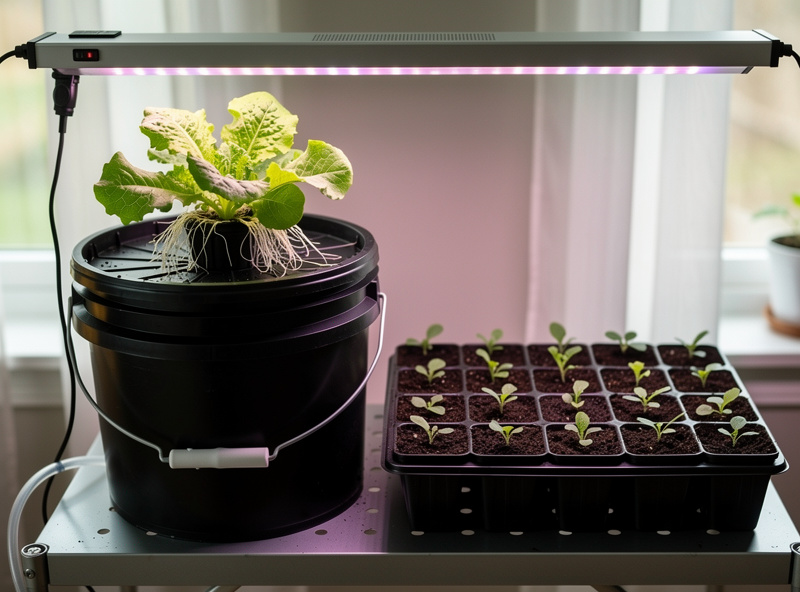
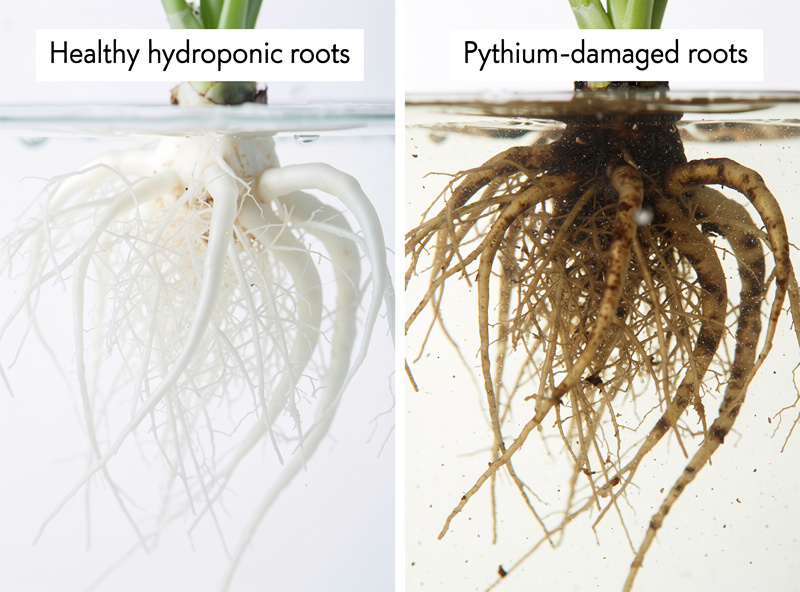
The one real constraint on dual-use is heat. Hydroponic reservoirs are the same story as everywhere else on my bench: ≤68°F (20°C) is the safe zone, and anything above 72°F (22°C) is where Pythium root rot gets its foothold. Seed-starting trays on heat mats want 21-24°C for germination. The same LED panel running at the same intensity on the same shelf can cook a hydro reservoir while leaving a seed tray perfectly warm, because water conducts and retains heat differently than soil mix. The fix is simple: run the panel slightly higher above the hydro setup than the seed tray (add roughly 3-4 inches of clearance over DWC buckets compared to cell-pack trays) and use a small clip-on fan to push warm air away from the reservoir surface. In my own setup, a 4-inch USB fan running on low pushes enough air to keep reservoir temperatures 2-3 degrees cooler than ambient, which is the difference between a healthy root mass and a brown slimy one by week three.
If you are starting seeds in soil, the full guide to indoor growing — from germination through hardening off — lives over at CityRooted’s indoor plant growing guide, which covers soil-specific light positioning that complements the hydro-focused approach here.
Panel Recommendations for Dual-Use Buyers
You do not need a $300 panel with app-controlled spectrum tuning and a sunrise-sunset simulator. For dual-use at home scale, a standard 100-150 watt full-spectrum LED board with Samsung LM301B or LM301H diodes at 4000K will run both hydro greens and seed trays for years. The key features that actually matter: dimmability (so you can reduce intensity for germination without raising the panel to ceiling height), a Mean Well driver (the XLG or HLG series are silent and efficient, and Mean Well’s own published spec sheets rate the HLG line at roughly 62,000 hours of operating life backed by a 7-year warranty — well beyond what the no-name drivers in bargain panels are built to survive), and a panel shape that matches your grow area. A rectangular quantum board covers a 2×4-foot shelf perfectly; a square board leaves dark corners in an elongated seed tray.
One specific note: avoid panels marketed as “blurple” — the red-blue combo that looks purple to human eyes. These were designed when blue and red diodes were the only efficient wavelengths available. Modern white-LED panels are more efficient, cheaper per watt, and let you actually see your plants well enough to notice yellowing leaves, pest damage, or nutrient deficiency symptoms before they become crises. Blurple lights hide plant health problems; white lights reveal them.
Running Cost You Can Actually Verify
A dual-use panel is running most of the day, so it is worth doing the electricity math instead of guessing. A 100-150 watt LED board pulling 14-16 hours a day works out to roughly 1.4-2.4 kWh per day (100W × 14h = 1.4 kWh; 150W × 16h = 2.4 kWh). At the current U.S. average residential rate of around $0.18-0.19 per kWh, that lands somewhere between about $0.25 and $0.46 a day — call it $8 to $14 a month for one panel running both a hydro bucket and a seed tray underneath it. That is the whole point of dual-use: you are not running that cost twice for two separate fixtures. If your rate runs higher (mine does, on Swedish household electricity), scale the number up accordingly — the wattage-times-hours math is what matters, not the specific price per kWh, which changes by region and season.
Reading the Plants When You Don’t Trust the Meter
Even with a calibrated meter or a decent phone app, the plants themselves are the better instrument once you know what to look for, and this is doubly true on a dual-use panel where you are eyeballing two different crops under one light. Stretching, pale stems and increased spacing between leaf sets mean the panel is too far away or too dim for that growth stage — the plant is reaching for light it cannot find. Leaf-edge curling, bleaching, or a bluish-grey cast on the youngest leaves means the opposite: too close, too intense, too soon. On my own bench the mistake I made once and do not repeat is mounting a new panel at the height printed on the box and then not touching it again for the first two weeks — that height assumes a specific diode count and lens angle, and mine was denser than the generic recommendation, so the pepper starts underneath it stretched noticeably before I caught it and raised the panel three inches. Now I check the seedlings daily for the first ten days regardless of what the meter says, because the plant will tell you it is wrong before the number does.
Frequently Asked Questions
Can I use the same LED light for hydroponics and seed starting?
Yes. A full-spectrum 4000K-5000K LED panel producing 200-400 PPFD works for both hydroponic leafy greens and soil-based seed starting. Adjust height rather than buying separate fixtures — seedlings need 24-30 inches of clearance while mature hydroponic greens can handle 12-18 inches.
What color temperature is best for dual-use grow lights?
4000K to 5000K provides the optimal blue-to-red ratio for both seed starting and vegetative hydroponics. 3000K panels lean too warm and encourage stretch in seedlings. 6500K panels are unnecessarily blue-heavy and less electrically efficient for biomass production than mid-range spectra.
Do I need a blurple light for hydroponics?
No. Modern white-LED panels outperform blurple lights on efficiency cost per watt and practical usability. Blurple light hides chlorosis pest damage and nutrient deficiency symptoms that are immediately visible under white light. Skip the purple panels entirely.
How many hours per day should dual-use lights run?
14-16 hours for vegetative hydroponics and seedling growth. Microgreens need 12-14 hours. Reduce to 12 hours if you see leaf-edge curling or bleaching — classic signs of excessive daily light integral. Use a simple plug timer rather than manual switching.
Can grow lights overheat my hydroponic reservoir?
Yes, especially with DWC buckets where water absorbs infrared from LEDs. Keep the panel 3-4 inches higher over hydro than over seed trays and use a small clip-on fan to push warm air away from the water surface. Keep reservoirs at or below 20°C (68°F) — above 22°C (72°F) invites Pythium root rot.
What PPFD do seedlings need vs mature hydroponic plants?
Seedlings need 200-250 PPFD at 18-24 inches of panel height. Mature hydroponic leafy greens need 300-400 PPFD at 12-18 inches. Germination requires only 100-150 PPFD. Increase intensity gradually over the first 10 days to avoid photoinhibition in young plants.