Bottom line up front: In a Masterblend mix, calcium nitrate goes in last because its calcium ions react with sulfate and phosphate the instant they meet in concentration, dropping out as white precipitate. Add it pre-dissolved into a full, low-pH reservoir and the chalk never forms. On my bench, a 2-1-2 fruiting batch built this way reads a clean EC 2.0–2.4 mS/cm with zero sediment.
I run DWC totes, NFT, Kratky, and an ebb-and-flow hydroton bed side by side, and I mix every reservoir to a target EC rather than by feel. Masterblend is one of the two dry systems I keep on the shelf (the GH Flora trio is the other), and the single mistake that wrecks more Masterblend batches than any other is the order you add the salts. Get the sequence wrong and you spend the evening looking at a cloudy res and a layer of grit on the tote floor. Get it right and the whole thing is boring — which, in hydroponics, is exactly what you want.
This article is the deep version of one rule from the Masterblend nutrient system guide: calcium nitrate goes in last. I want to explain why in plain chemistry, then walk through the exact way I add it so you never see precipitate again.
What calcium nitrate actually does in the mix
Quick answer: Calcium nitrate (15.5-0-0, about 19% calcium) supplies the calcium that Masterblend lacks entirely and delivers most of the batch’s nitrogen as nitrate — the nitrogen form hydroponic roots take up most readily. It is the piece that makes the three-part recipe complete.
Masterblend 4-18-38 is sold as the “Tomato & Vegetable Formula,” and it is a genuinely good base salt: that 4-18-38 N-P-K plus a full chelated micronutrient package covers most of what a fruiting plant needs. But it is not complete on its own. It carries no calcium at all and only a token amount of magnesium. That is by design — the manufacturer leaves the two reactive ingredients out so you can add them separately and keep the bag stable on the shelf.
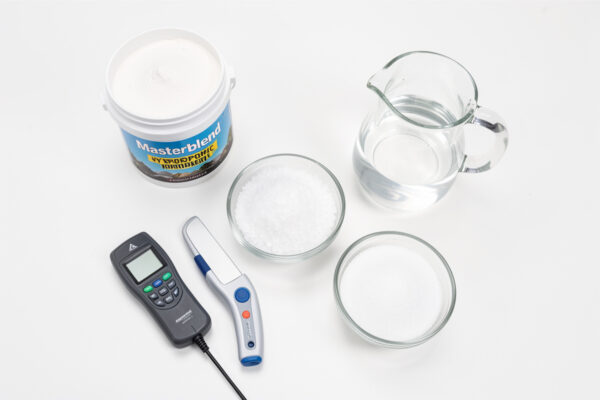
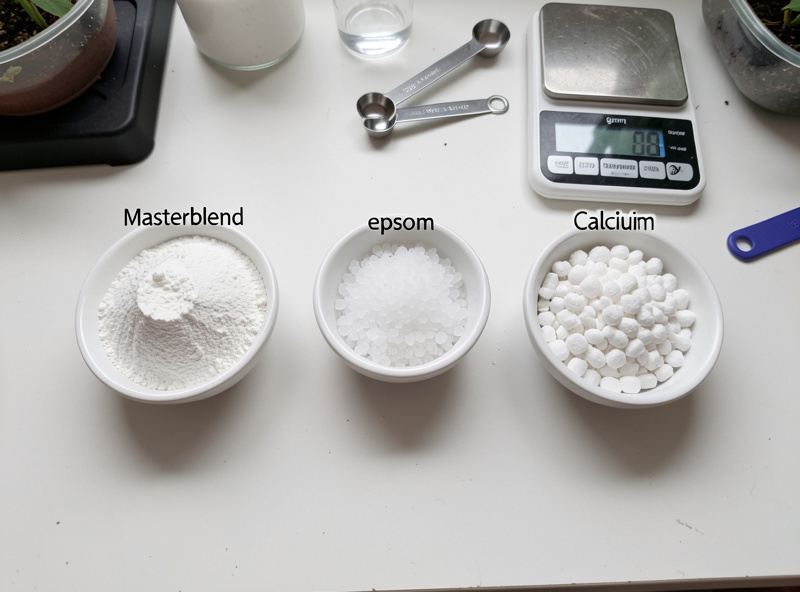
So the standard recipe is three salts. Masterblend 4-18-38 is the base. Epsom salt (magnesium sulfate heptahydrate, MgSO₄·7H₂O, roughly 9.8% Mg and 13% sulfur) fills the magnesium and sulfur gap. And calcium nitrate (15.5-0-0, around 19% Ca) brings the calcium plus a big slug of nitrate nitrogen. The classic ratio I mix is 2-1-2 by weight — Masterblend : Epsom : calcium nitrate — which at a full fruiting dose is 2 grams Masterblend, 1 gram Epsom, and 2 grams calcium nitrate per US gallon, landing me around EC 2.0–2.4 mS/cm. I cover the dosing math and EC targets in the 2-1-2 mixing ratio breakdown; here I only care about one of those three salts and when it joins the party.
Calcium matters more than people new to dry salts expect. It is a structural nutrient — cell walls, growing tips, fruit skins. Run short on it in a fruiting crop and you get blossom-end rot and weak new growth even when everything else reads fine. The nitrate side matters too: roots in a soilless system strongly prefer nitrogen as nitrate (NO₃⁻) over ammonium, and calcium nitrate is the dominant nitrate source in this recipe. So you cannot just skip it. You have to add it — carefully.
The precipitation chemistry, in plain terms
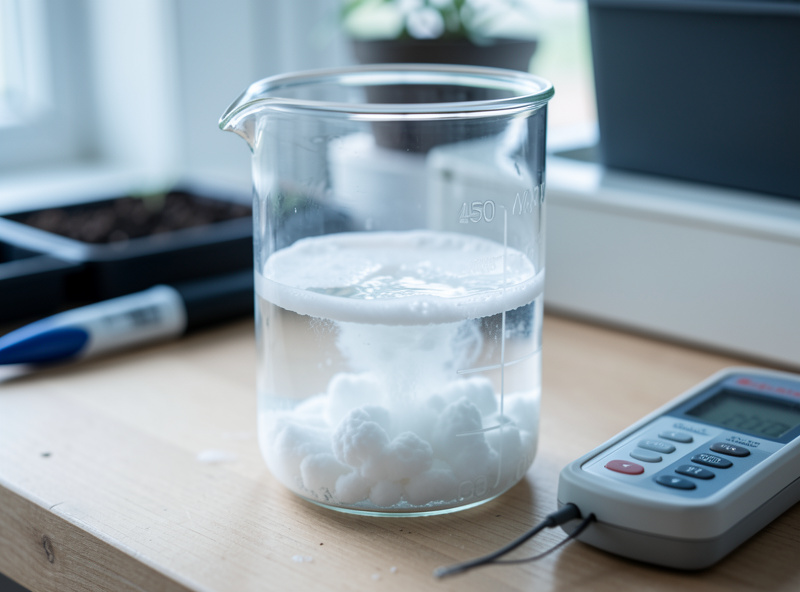
Quick answer: Calcium ions from cal-nit react with sulfate from the Epsom salt to form calcium sulfate (gypsum), and with phosphate from Masterblend’s 18% P to form calcium phosphate. Both are near-insoluble, so they fall out of solution as the white “chalk” you see on the res floor.
Here is what is really happening. When calcium nitrate dissolves, it releases free calcium ions, Ca²⁺. Those ions are looking for a partner, and in a Masterblend reservoir there are two waiting. The first is sulfate (SO₄²⁻), which comes from the Epsom salt. The second is phosphate, which comes from the phosphorus in Masterblend’s 4-18-38 — that 18 is a lot of P.
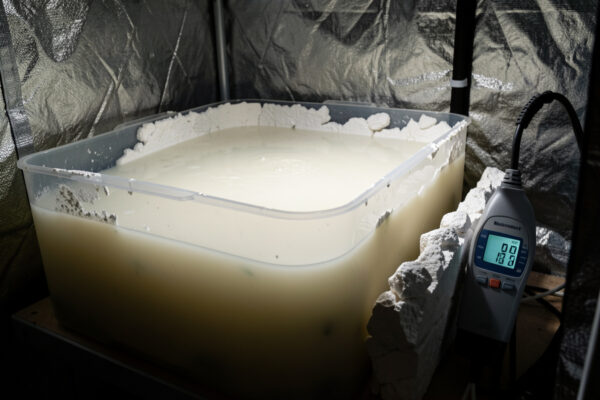
Calcium plus sulfate gives you calcium sulfate, CaSO₄ — gypsum. It is the same compound as drywall and plaster, and it is poorly soluble in water. Calcium plus phosphate gives you calcium phosphate, which is even less soluble — it is essentially the mineral in bone and tooth enamel. Neither compound wants to stay dissolved, so the moment they form, they precipitate: they drop out as fine white solids. That is the cloudiness, and then the grit on the bottom of your tote.
The part that makes this fixable is concentration. These reactions only run when the calcium, sulfate, and phosphate are crowded together at high concentration — exactly the condition you create if you dump dry calcium nitrate onto dry Masterblend, or pour a strong calcium nitrate stock straight into a strong Epsom-and-Masterblend stock. Spread the same total amount of each salt across a full reservoir of water and the ions are too dilute to find each other and lock up. They drift around as free nutrients, which is the whole point.
Two things make the chalk worse, and both are worth checking. High pH is the first: above about 6.5, phosphate shifts toward forms that bind calcium far more eagerly, so an alkaline res precipitates much faster. Hard tap water is the second: it already carries dissolved calcium and bicarbonate, so you are starting the reaction half-loaded before you add a single salt. If you fight persistent precipitate, those two are usually the culprits — I dig into both in the Masterblend precipitation troubleshooting guide.
Why “last” is the answer: sequence and dilution
Quick answer: Adding calcium nitrate last, pre-dissolved, into a full low-pH reservoir keeps every ion dilute and gives the Masterblend and Epsom time to disperse first. The calcium never meets a concentrated pocket of sulfate or phosphate, so nothing precipitates.
The fix follows straight from the chemistry: keep the reactive partners from ever being concentrated together. In practice that means a strict order and a refusal to mix dry salts or strong stocks.
This is the exact sequence I use on every Masterblend reservoir:
- Start with a full reservoir of water, not a partial one. Volume is your dilution. A full tote means every salt you add is immediately spread thin.
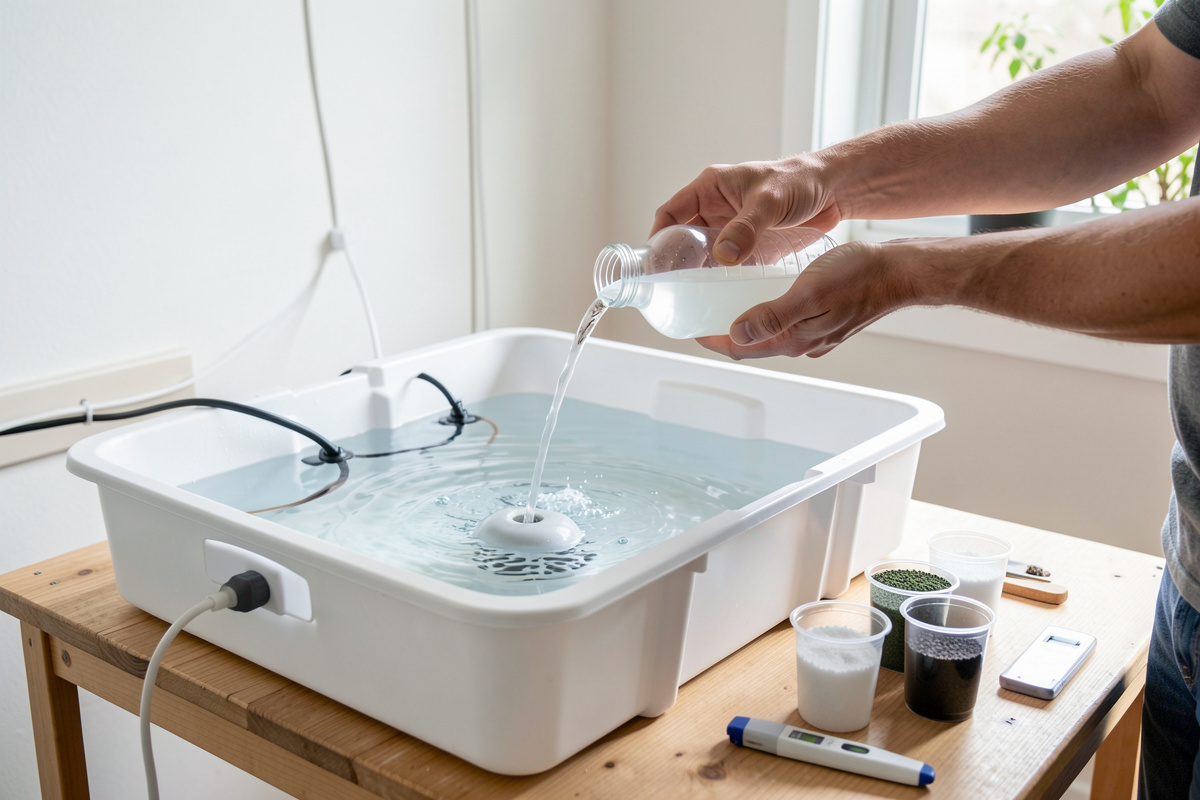
- Dissolve each salt separately in its own cup of warm water before it touches the res. Never combine the dry powders. I pre-dissolve all three in three separate cups while the res circulates.
- Add Masterblend first. Pour the dissolved Masterblend into the moving water and let it disperse fully. The air stone or pump should be running.
- Add Epsom salt second. Pour in the dissolved magnesium sulfate and let it mix. Now the sulfate is in the res — but spread across the full volume, nowhere near concentrated.
- Adjust pH down before the calcium goes in. Get the res to 5.5–6.0 first. A low pH keeps phosphate in its more soluble, less calcium-hungry form, so the calcium you are about to add has the easiest possible landing.
- Add calcium nitrate last, pre-dissolved, and trickle it into moving water — a thin stream poured near the pump return, not a single glug into a still corner. Slow delivery into circulation is the final guarantee that the calcium meets only fully diluted sulfate and phosphate.
Every step here is doing the same job: making sure the Ca²⁺ never encounters a high-concentration pocket of its reaction partners. Full reservoir = dilution. Separate dissolution = no dry-on-dry reaction. Calcium last and trickled = the sulfate and phosphate are already dispersed and stationary when the calcium arrives drop by drop. The general framework for adding salts to water lives in my how to mix a hydroponic nutrient solution walkthrough — this is that framework with the calcium-last rule made explicit.
One habit that pays off: after the calcium nitrate is fully in, let the res run for a few minutes, then look at it under good light. A correctly built batch is clear or very faintly tinted — no haze, no settling grit. If you see cloudiness, you have precipitate, and the usual cause is that something went in too concentrated or the pH was still high. Note it in your res log and adjust the next batch; on my bench a 2-1-2 fruiting mix done this way reads a stable EC 2.0–2.4 mS/cm with nothing on the tote floor.
The A/B concentrate rule for stock solutions
Quick answer: When you pre-make concentrated stock bottles, calcium nitrate must live alone in “Part A,” while Masterblend and Epsom go together in “Part B.” Concentrating calcium with sulfate or phosphate is the one thing the whole system is designed to prevent.
Mixing fresh per reservoir is fine for one or two totes, but once you run several systems you start making concentrated stock solutions to save time — scoop from a jug instead of weighing salts every change. The instant you concentrate, the precipitation risk comes roaring back, because a stock bottle is by definition high concentration. So the same logic that governs the reservoir governs the bottles, just more strictly.
The rule is simple: calcium nitrate goes alone in Part A. Masterblend and Epsom go together in Part B. Never put calcium nitrate in the same concentrate as either of the other two. Part A is your calcium-and-nitrate bottle; Part B is your phosphate-sulfate-micros bottle. They only meet when you dose both into a full, diluted reservoir — and even then you add Part B first and Part A (the calcium) last, exactly as with dry salts.
This is why commercial liquid nutrient lines always ship as a two- or three-part system with the calcium isolated in its own bottle. It is not a marketing gimmick to sell you two bottles — it is the same chemistry. You cannot keep calcium and phosphate-sulfate stable in one concentrated container; they would turn to sludge on the shelf. Keep your homemade stocks split the same way and they will stay liquid and dose cleanly. If you want a calcium nitrate that dissolves clean for stock-making, the greenhouse-grade 15.5-0-0 hydroponic calcium nitrate is what I keep on the shelf, and a complete Masterblend 4-18-38 complete kit bundles all three salts so your ratios start right.
As an Amazon Associate I earn from qualifying purchases.
Storing calcium nitrate: the hygroscopic problem
Quick answer: Calcium nitrate is strongly hygroscopic — it pulls water straight out of the air and cakes into a solid brick. Stored loose in a humid space it turns to a clump you have to chip apart, which throws off your weights and slows dissolution. Keep it sealed and dry.
The last thing that makes calcium nitrate the awkward member of the trio has nothing to do with the reservoir. It is how the salt behaves on the shelf. Calcium nitrate is hygroscopic, meaning it absorbs moisture from the surrounding air aggressively. Leave the bag open in a damp basement or a humid grow room and within weeks the loose prills fuse into a rock-hard cake.
That matters for two reasons. First, accuracy: I mix to a target EC by weight, and a caked, water-logged salt no longer weighs what it should per gram — part of what you scoop is absorbed water, so your dose drifts low and your EC comes in under target. Second, convenience: a bricked-up salt dissolves slowly and unevenly, which works against the “fully pre-dissolved before it goes in” rule that keeps precipitate away.
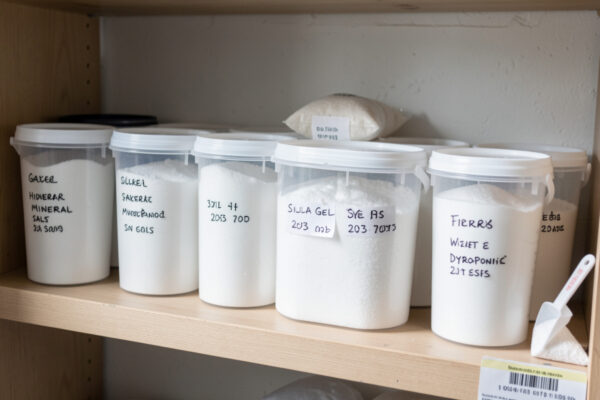
My storage approach is the same for all dry salts but matters most for the calcium nitrate. Keep it in an airtight container — the original bag rolled and clipped is the bare minimum; a sealed bucket or a heavy zip bag inside a tub is better. Add a desiccant pack if your space is humid, and store it off a cold concrete floor where condensation collects. I keep mine in the driest corner of the room and it stays pourable for a year. The broader routine for keeping every salt in your kit dry and accurate is in my guide to storing dry hydroponic nutrients.
None of this is hard once you understand the single thread running through all of it: calcium is the reactive one. It wants to grab sulfate and phosphate the moment they are concentrated together, and it grabs water out of the air on the shelf. Respect that and the rule writes itself — dissolve it separately, keep it alone in Part A, store it sealed, and add it to the reservoir last, trickled into moving water at a low pH. Do that and your Masterblend res stays clear, your EC lands where you aimed, and your plants get the calcium they actually need.
Frequently asked questions
Why does my Masterblend mix turn cloudy and leave white residue?
That cloudiness is calcium sulfate and calcium phosphate precipitating out. It happens when calcium nitrate meets sulfate (from Epsom) or phosphate (from Masterblend) while they are concentrated together — usually because you mixed the dry salts or added the calcium to a partial or high-pH reservoir. Dissolve each salt separately, fill the res fully, drop pH to 5.5–6.0, and add the calcium nitrate last, pre-dissolved and trickled into moving water.
Can I just mix all three Masterblend salts together dry?
No. Combining dry calcium nitrate with dry Masterblend and Epsom puts calcium, sulfate, and phosphate in direct concentrated contact, which is the exact condition that drives precipitation. Always dissolve each salt in its own cup of water first, then add them to a full reservoir in order — Masterblend, then Epsom, then calcium nitrate last.
What does calcium nitrate add that Masterblend doesn’t have?
Masterblend 4-18-38 carries no calcium and only trace magnesium by design. Calcium nitrate (15.5-0-0, about 19% Ca) supplies the calcium your plants need for cell walls, growing tips, and fruit skins, and it also delivers most of the batch’s nitrogen as nitrate — the form hydroponic roots absorb most readily. It is what makes the three-part recipe complete.
How do I store calcium nitrate so it doesn’t turn into a brick?
Calcium nitrate is hygroscopic, so it pulls moisture from the air and cakes solid if left open. Keep it in an airtight container, add a desiccant pack if your space is humid, and store it off cold concrete where condensation forms. A water-logged, caked salt also weighs wrong per gram, throwing off your EC target, so sealed and dry storage protects both your salt and your dosing accuracy.
Why do liquid nutrients ship as separate A and B bottles?
For the same reason calcium nitrate goes in last: you cannot keep calcium concentrated alongside sulfate and phosphate without them precipitating into sludge. Commercial lines isolate calcium nitrate in Part A and put the phosphate-sulfate-micros package in Part B, and the two only meet diluted in a full reservoir. If you make your own concentrated stocks, split them exactly the same way — calcium nitrate alone in Part A, Masterblend and Epsom together in Part B.