The masterblend 4-18-38 recipe I run is a three-salt mix, not a one-bag wonder. Per US gallon I dissolve 2 g Masterblend 4-18-38, 1 g Epsom salt, and 2 g calcium nitrate, each in its own water, calcium nitrate added last. At full fruiting strength that lands my reservoir at roughly EC 2.0–2.4 mS/cm (about 1000–1200 ppm on the 500 scale) at pH 5.8.
I’ve been mixing this dry-salt program on my own bench for years, side by side with the GH Flora liquid trio, across DWC totes, NFT channels, Kratky jars, and an ebb-and-flow hydroton bed. The liquid trio is convenient. The dry salts are cheap and predictable once you understand that “Masterblend” is really three things in a bag-and-a-half, and that you mix to a number on a meter, not to a colour or a feeling. This is exactly the way I dial mine in.
For the full nutrient family and where this recipe sits, start at my Masterblend hydroponic nutrients hub. This page is the bench routine: weigh, dissolve, measure, adjust.
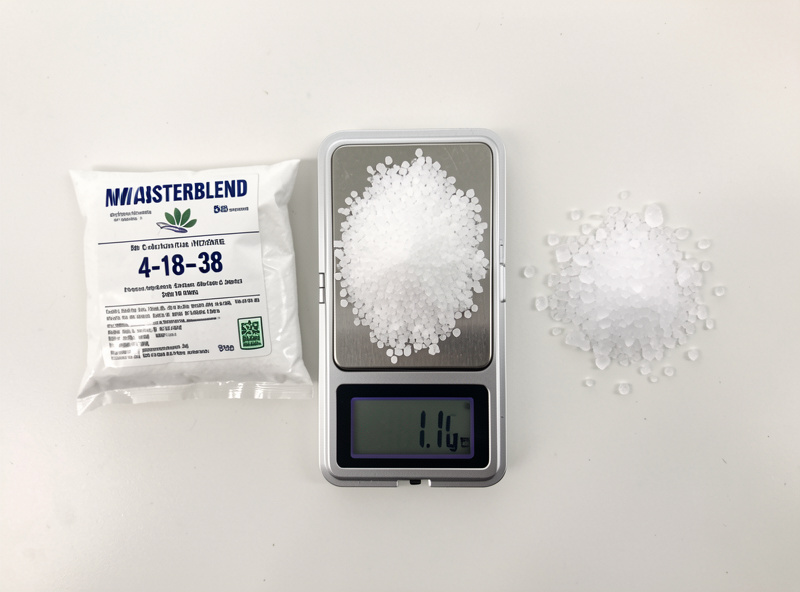
What 4-18-38 actually is (and why it needs cal-nit + Epsom)
Quick answer: Masterblend 4-18-38 is the “Tomato & Vegetable Formula” — 4% N, 18% P2O5, 38% K2O plus chelated micros. It carries no calcium and not enough magnesium, so it is never complete alone. You always pair it with calcium nitrate and Epsom salt.
The “4-18-38” is the guaranteed analysis on the bag: 4% nitrogen, 18% phosphate (P2O5), 38% potash (K2O). It also brings the chelated micronutrients — iron, manganese, zinc, boron, copper, molybdenum — which is why your leaves don’t go interveinal-yellow when you run it properly. What it deliberately leaves out is calcium, and it’s thin on magnesium. That’s by design: calcium and phosphate/sulfate don’t like sharing a concentrated bottle, so the formulator keeps calcium in a separate bag you add yourself.
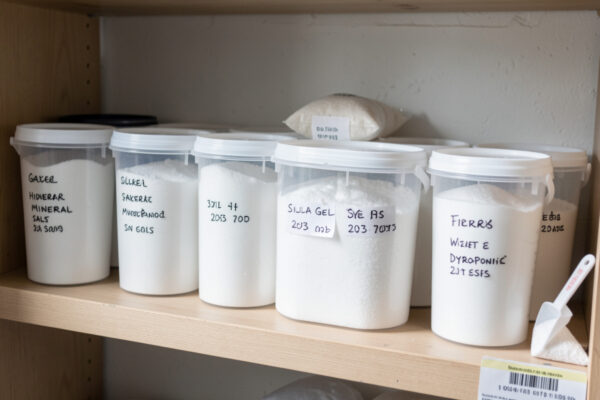
That separate bag is calcium nitrate, 15.5-0-0, about 19% Ca. It does two jobs at once on my bench: it supplies the calcium the 4-18-38 lacks, and it carries the bulk of the nitrogen as nitrate. So the headline “4% N” on the Masterblend bag is misleading on its own — most of the actual nitrogen your plants see comes from the cal-nit. One catch from my res logs: cal-nit is hygroscopic and cakes into a solid brick if you leave the lid off in humid air. I keep mine in a sealed jar with the scoop hung outside.
The third salt is Epsom salt, magnesium sulfate (MgSO4·7H2O), about 9.8% Mg and 13% S. It tops up the magnesium the 4-18-38 can’t cover and adds sulfur. It’s also the easiest of the three to dissolve — it disappears in cool water almost instantly, where cal-nit takes a stir and Masterblend wants a moment. For the deeper calcium chemistry, I keep a dedicated calcium nitrate Masterblend mix write-up.
So when someone asks me “is Masterblend a complete nutrient?”, the honest answer on my bench is no — the 4-18-38 bag is two-thirds of a recipe. Run it solo and within a couple of weeks you’ll see the classic calcium deficiency: new growth deforming, leaf tips burning, blossom-end rot on tomatoes. That’s not a flaw in the product; it’s the design. The formulator deliberately split calcium out because you cannot keep a high-calcium, high-phosphate, high-sulfate concentrate stable in a single bottle. Liquid one-parts get around this with aggressive chelation and weaker concentration; the dry three-salt route just hands you the calcium separately and trusts you to add it last. That trade is exactly why the dry program costs a fraction of the bottled equivalent — you’re doing the formulating work the liquid maker would otherwise charge you for.
The 2-1-2 base recipe
Quick answer: By weight the program is Masterblend : Epsom : calcium nitrate = 2 : 1 : 2. Per US gallon that’s 2 g Masterblend, 1 g Epsom, 2 g calcium nitrate. Per 5 gallons it’s simply 10 g, 5 g, 10 g. That’s the full fruiting dose.
People write the ratio a few ways and it confuses newcomers, so here’s how I hold it in my head: two parts Masterblend, one part Epsom, two parts cal-nit. Same thing as “2 g Masterblend, 2 g cal-nit, 1 g Epsom” — just reordered. The 2-1-2 label is the by-weight relationship; the grams-per-gallon are the dose. I keep the full breakdown in my Masterblend 2-1-2 mixing ratio guide, but the working numbers are right here.
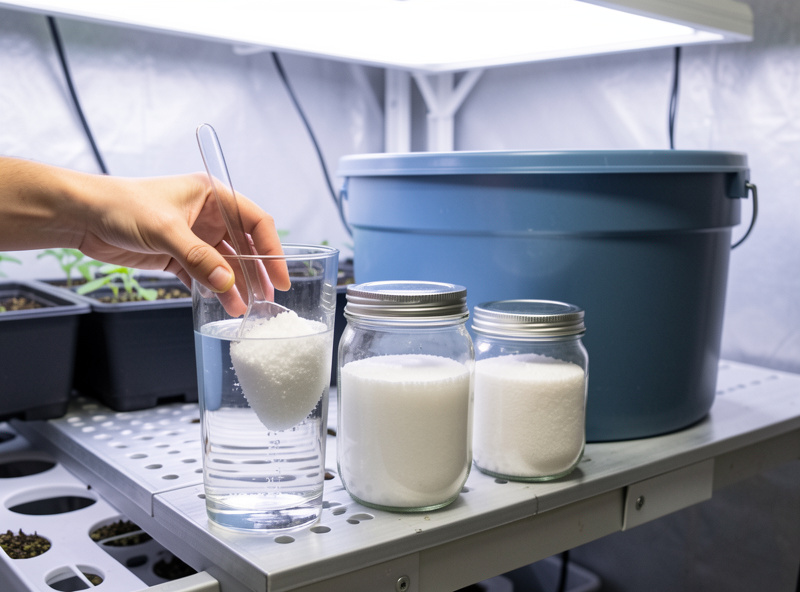
The mixing order is the part people skip and then wonder why their res clouds up with white sediment. On my bench the rule is absolute: dissolve each salt separately in its own water, then add to a FULL reservoir in the order Masterblend → Epsom → calcium nitrate last. Cal-nit goes last because concentrated calcium reacts with sulfate to form gypsum (CaSO4) and with phosphate to form calcium phosphate — both insoluble, both that chalky white cloud. By diluting the cal-nit into a large, already-mixed, slightly acidic volume, the reaction never gets the concentration it needs and the calcium stays in solution. If you dump all three dry salts into one jar together, you make rock.
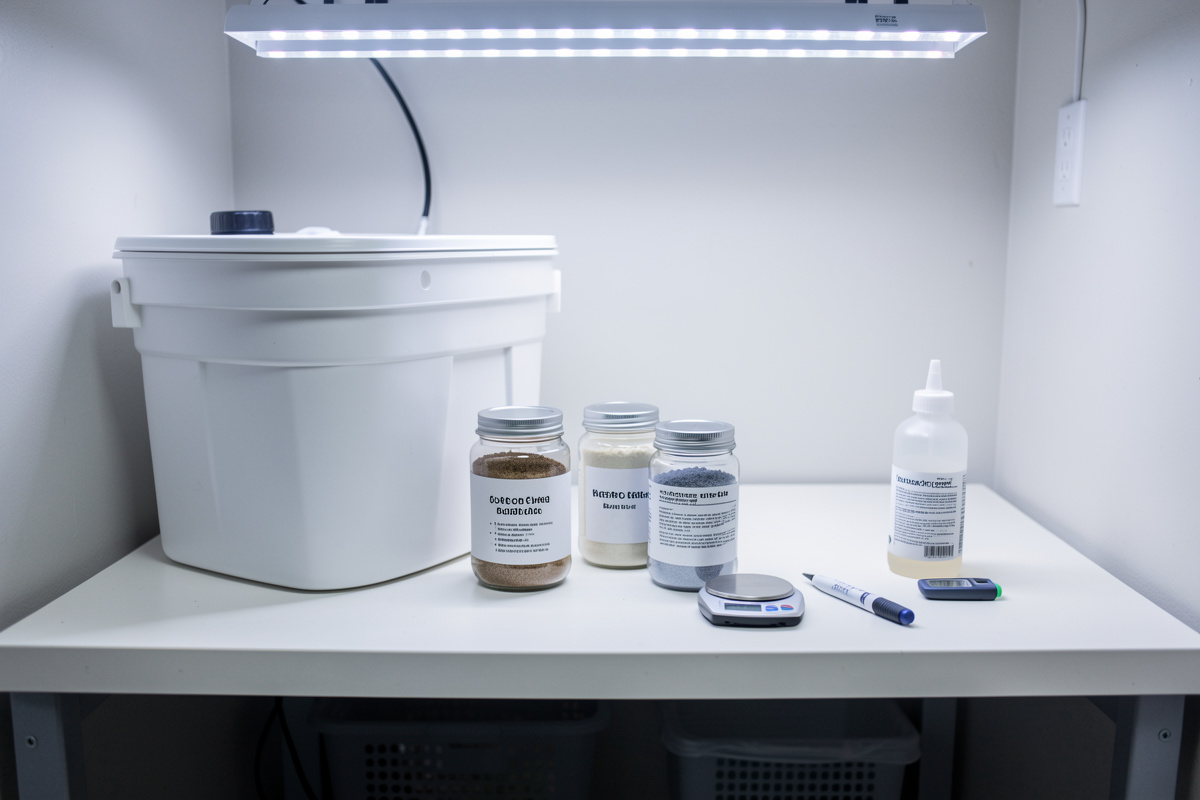
My actual bench sequence looks like this. I start with the reservoir already filled to its working volume with water at room temperature — cold water dissolves salts slower and I’m in a cold climate, so I let it come up to the room first. I weigh the Masterblend on the 0.1 g scale into a jar, add maybe 200 ml of warm water, and shake until clear, then pour it into the res and stir. Same jar rinsed, Epsom next, dissolved and poured in. Last is the cal-nit: its own jar, its own water, fully dissolved, then trickled into the moving reservoir while I stir. The whole thing takes under five minutes and I have never had a precipitate cloud since I started doing it in this order. The one time I see white haze now is if I’ve let the cal-nit jar sit too concentrated — the fix is simply more water in that jar before it goes in.
Scaling per gallon vs per litre
Quick answer: The dose is linear, so just multiply. Per US gallon (3.78 L): 2 g Masterblend, 1 g Epsom, 2 g cal-nit. Per litre that’s roughly 0.53 g, 0.26 g, 0.53 g — which is why I batch by the gallon or by full reservoirs, not by single litres.
I run a mix of systems and most of my reservoirs are sized in litres, but the recipe was written in US gallons, so I keep both columns taped to the bench. The table below is what I actually mix to. The left strength block (lettuce) is what most of my leafy DWC totes run; the fruiting block is the full 2-1-2 dose above.
| Strength / stage | Masterblend | Epsom | Calcium nitrate | Target EC (mS/cm) |
| Lettuce / leafy (per US gal) | 1 g | 0.5 g | 1 g | 0.8–1.4 |
| Lettuce / leafy (per litre) | 0.26 g | 0.13 g | 0.26 g | 0.8–1.4 |
| Herbs (per US gal) | 1.5 g | 0.75 g | 1.5 g | 1.0–1.6 |
| Herbs (per litre) | 0.40 g | 0.20 g | 0.40 g | 1.0–1.6 |
| Fruiting veg (per US gal) | 2 g | 1 g | 2 g | 1.8–2.4 |
| Fruiting veg (per litre) | 0.53 g | 0.26 g | 0.53 g | 1.8–2.4 |
| Fruit set (per US gal) | 2.5 g | 1.25 g | 2.5 g | 2.4–3.5 |
A note on the scale this calls for: at the lettuce strength you’re weighing half a gram of Epsom, and a kitchen scale that rounds to 1 g simply can’t see that. This is where a 0.1 g digital pocket scale earns its keep — it’s the difference between a repeatable recipe and guessing. If you want the dedicated leafy program, I keep a Masterblend for lettuce and leafy greens page with the lower-EC schedule.
How I dial to a TARGET EC
Quick answer: I calibrate the EC pen against 1.413 mS/cm solution, mix the recipe at strength, then read the res and nudge: if it reads high I add plain water, if low I add a pinch more of the three salts in 2-1-2 proportion. I chase a number, never a colour.
The recipe gives you a starting point; the meter gives you the truth. My routine never changes. First I calibrate the EC pen against 1.413 mS/cm calibration solution — an uncalibrated pen will read 10–20% off and quietly ruin a whole res. Cheap pens drift; I check mine every mix. For the meter side of this, my EC meter for hydroponics guide covers what to buy and how often to calibrate.
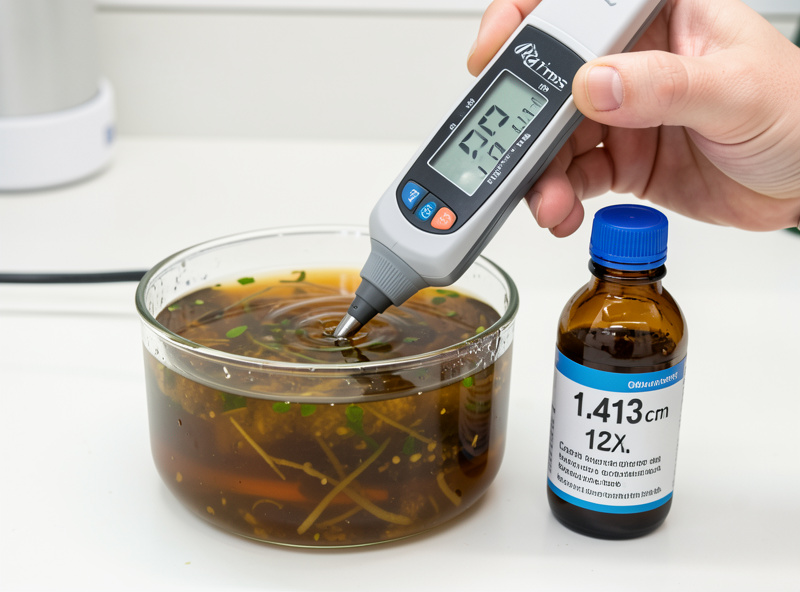
Then I mix to the recipe, stir, let it settle a minute, and read. If my target is fruiting EC 2.0 and the pen says 2.3, I add measured plain water until it drops to 2.0. If it reads 1.7, I dissolve a small extra pinch of the three salts — kept in 2-1-2 proportion so the nutrient balance doesn’t drift — and re-read. A few cycles and you’ll know your own water and salts well enough to hit the number on the first pour.
One ordering rule that saves a lot of grief: set EC before pH. Adding salts changes pH, so there’s no point adjusting pH on a half-strength res. I bring the EC to target first, then check pH and pull it into the 5.5–6.0 band (up to about 6.2 for fruiting). My full step-by-step lives in how to mix hydroponic nutrient solution, but the principle is short: concentration first, acidity second.
Tap-water baseline EC matters
Quick answer: Your tap water already has an EC — mine reads a non-zero baseline straight from the tap. That baseline is part of your total, so I read raw tap EC first and treat the recipe’s target as the number I’m building UP to, not adding on top of zero.
This trips up people who mix by the gram and then can’t understand why their EC overshoots. If your tap reads, say, 0.3 mS/cm before you add anything, and the recipe pushes another 1.8, you’re at 2.1, not 1.8. So the first thing I do on any fresh res is dip the pen in the raw tap water and write that number down. Hard-water areas can start surprisingly high; in cold-climate Sweden my tap is fairly soft but never zero. If your baseline is very high, you either run a touch less salt to hit the same target EC, or you switch to RO water for full control. Either way, the meter, not the recipe card, has the final word.
There’s a second reason raw tap EC matters that the recipe cards never mention: what’s in that baseline. If your water is hard, that EC is mostly calcium and magnesium carbonates — which means you’re already getting some of what the cal-nit and Epsom supply, and your pH will want to climb because carbonates buffer upward. Soft or RO water reads near zero and lets the recipe land exactly where the grams say it should, but then you’re relying entirely on the three salts for calcium and magnesium, so don’t be tempted to skimp on the Epsom or cal-nit. I run mostly soft tap here and the recipe behaves predictably; when I’ve travelled and mixed on hard water, I’ve had to drop the salt dose and watch pH drift up over the first day. Knowing your tap baseline turns those surprises into expected adjustments.
One more habit from my res logs: I don’t just read EC once at mix time. I read it again 24 hours later. Plants drink water and nutrients at different rates, so a res that started at EC 2.0 can climb to 2.3 as the plant pulls more water than salt (concentrating what’s left) or drop if it’s a heavy feeder. Topping off with plain water brings a concentrated res back down; a falling EC tells me it’s time for a fresh mix or a partial salt top-up. That feedback loop — mix to a number, watch the number move, respond — is the whole game, and it only works if the pen is calibrated and the recipe was repeatable to begin with.
Cost-wise this program is hard to beat. A roughly $30–40 kit of 4-18-38, calcium nitrate, and Epsom mixes well over 1,000 gallons at lettuce strength — that works out to fractions of a cent per litre once you’ve got the pen and a decent scale. If you want the bags as one box, this Masterblend 4-18-38 complete kit search keeps all three salts together.
As an Amazon Associate I earn from qualifying purchases.
Is Masterblend 4-18-38 a complete nutrient on its own?
No. The 4-18-38 bag has no calcium and not enough magnesium. It’s always paired with calcium nitrate (15.5-0-0, ~19% Ca) and Epsom salt (magnesium sulfate). The three together make a complete solution; the 4-18-38 alone will leave you calcium- and magnesium-deficient.
What is the basic Masterblend 4-18-38 recipe per gallon?
Per US gallon (3.78 L), the full fruiting dose is 2 g Masterblend 4-18-38, 1 g Epsom salt, and 2 g calcium nitrate. That’s the 2-1-2 ratio by weight and reads roughly EC 2.0-2.4 mS/cm. For lettuce I run about half that.
Why do I add calcium nitrate last?
Concentrated calcium reacts with sulfate to form gypsum and with phosphate to form calcium phosphate, both insoluble white precipitate. Dissolving each salt separately and adding cal-nit last into a full, already-mixed reservoir keeps the calcium dilute enough that it never precipitates out.
What EC should a Masterblend solution be?
It depends on the crop: lettuce and leafy greens 0.8-1.4 mS/cm, herbs 1.0-1.6, fruiting vegetables 1.8-2.4, and fruit set up to 2.4-3.5. On the 500 scale, ppm = EC x 500, so fruiting EC 2.0 is about 1000 ppm. Always note which TDS scale your pen uses.
How do I convert the per-gallon recipe to litres?
Divide the per-gallon grams by 3.78. So 2 g per gallon becomes about 0.53 g per litre, 1 g becomes about 0.26 g, and 0.5 g becomes 0.13 g. Because these are sub-gram amounts, weigh on a 0.1 g pocket scale or batch by full gallons.
Should I set EC or pH first?
Set EC first. Adding salts shifts pH, so adjusting pH before the solution is at full strength is wasted effort. Mix to your target EC, then bring pH into the 5.5-6.0 band (up to about 6.2 for fruiting crops) and re-check both.