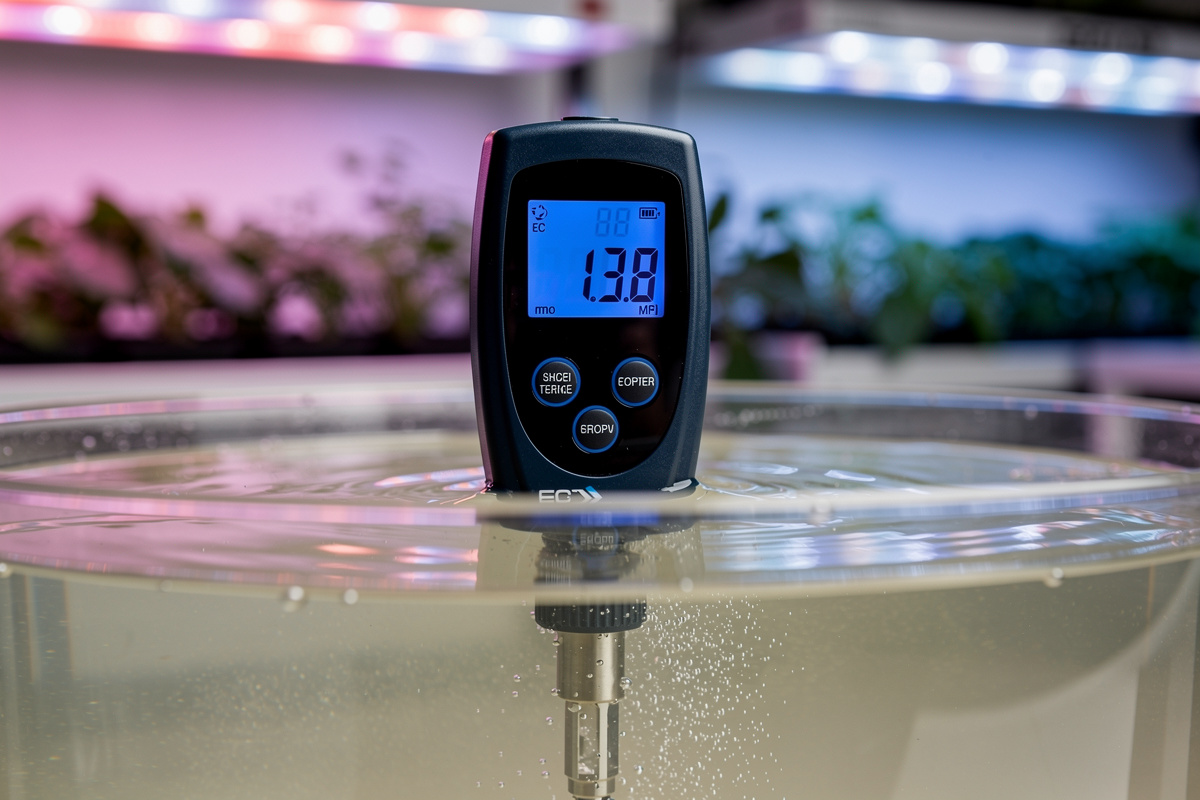
My Bluelab Truncheon reads dissolved solids the same way whether the probe is in a DWC bucket that’s been feeding tomatoes all week or a fresh batch of Masterblend I just mixed to spec. It doesn’t know or care what’s dissolved — calcium nitrate, potassium sulfate, magnesium — it only reports how much current the ions in solution let through. That single number, read consistently, tells you more about what’s actually happening in your reservoir than eyeballing the fill line ever will.
As an Amazon Associate I earn from qualifying purchases.
The gap between “the res looks full” and “the res is actually feeding the plants” is where most beginner hydro trouble starts. Water and minerals leave a reservoir at different rates — evaporation pulls water, roots pull minerals — and topping off with plain water without checking EC first just papers over whichever direction the drift went. I check EC on every system I run before I touch anything else, because the number tells me what to add before the plants have to tell me by looking bad.
What Your Reservoir’s EC Numbers Actually Mean
Electrical conductivity in a hydroponic reservoir measures the concentration of dissolved mineral salts — calcium nitrate, potassium phosphate, magnesium sulfate, the whole nutrient stack — as a single number, usually read in millisiemens per centimeter (mS/cm) or its cousin, parts per million (ppm/TDS). A lettuce seedling runs happily at 0.8 to 1.2 mS/cm. A fruiting tomato in full swing wants 2.0 to 3.0. UF/IFAS extension pegs mature lettuce specifically at 1.4 to 1.8 mS/cm with pH held 6.0–7.0, which lines up closely with what I run on my own leafy-green totes — I sit toward the low end early and let it climb slightly as the canopy fills in.
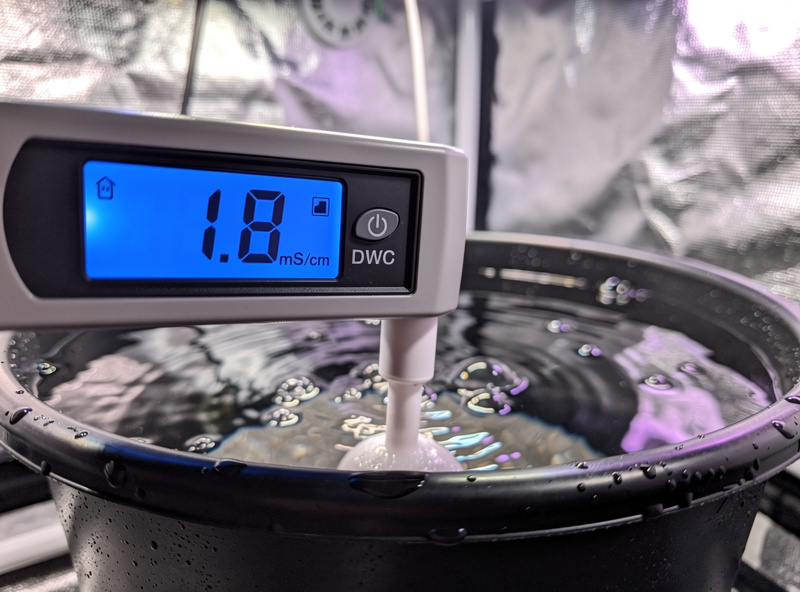
When the number drifts upward between checks, water has evaporated or transpired off faster than the plants pulled minerals, and the solution has concentrated. When it drifts downward, the roots pulled more minerals out of solution than the evaporation rate concentrated them back in — a hungry crop in a small reservoir will do this fast. The corrective action is directionally simple: add plain water to dilute a solution that’s climbed too high, or add a small dose of nutrient stock to bring a solution that’s fallen too low back to target. The part beginners get wrong is skipping the meter and just guessing which direction to correct. For the full walk-through on calibrating and reading the number correctly, the EC meter guide covers the process start to finish.
Why EC Drifts: Evaporation vs. Uptake
A reservoir loses volume two ways — evaporation off the surface and air stones, and transpiration pulled through the roots by the plant — and both are constant while nutrient uptake is selective. Plants take up nitrogen, potassium, and calcium fastest during active vegetative growth, phosphorus and potassium more heavily once flowering or fruiting starts, and they leave some ions — sodium and chloride, if they’re present at all in your source water — behind almost untouched. That selective uptake is why a reservoir that’s been running a long crop cycle without a full change doesn’t just get weaker or stronger evenly; it gets skewed, with some ions depleted and others accumulating. This is the real argument for a full res change on a schedule rather than topping off indefinitely: a scheduled dump-and-refill every 7 to 10 days resets the ratio, not just the total concentration.
A grower who tops off with plain water for several days running without checking EC ends up with a reservoir that reads fine on volume and wrong on everything else — the plants look okay for a stretch, then start yellowing from the bottom leaves up because there’s nothing left in solution for the roots to pull. That’s the single most common beginner mistake I see repeated across every method I run, and it’s entirely avoidable with a five-second dip of the meter before you add anything.
Target EC by Crop Stage and by Method
The right EC isn’t one number — it depends on the crop’s growth stage and, just as much, on which method is holding the water. On my bench I run DWC, NFT, Kratky, and ebb-and-flow side by side, and each behaves differently even feeding the same crop at the same nominal target.
DWC and ebb-and-flow are reservoirs I check daily and correct actively — they drift, but I’m intervening constantly, so I keep them tight to the target band for the crop stage.
NFT circulates continuously through a shared reservoir, so the whole channel run reads close to uniform; I still check daily because a small NFT tank concentrates fast in a warm room.
Kratky is the one that catches new growers off guard, because it’s designed to run without a top-off at all. The reservoir starts full and is never refilled — as the plant drinks, the water level drops and what’s left concentrates, because plants pull water faster than they pull the dissolved minerals. Documented Kratky guidance puts the concentration factor at roughly 4 to 5 times the starting EC by the end of the cycle, which is exactly why Kratky growers deliberately start weak — around 0.6 to 0.8 mS/cm for leafy greens — instead of mixing to the same 1.4–1.8 mS/cm target I’d run in a DWC bucket that gets topped off. Mix a Kratky jar to a DWC-strength EC and you’ll cook the roots by week three as it concentrates past what the crop can handle.
The same logic that governs hitting the right starting number governs mixing it correctly in the first place — dissolve each component fully before adding the next, check the EC after mixing rather than trusting the recipe blindly, since tap water hardness and mineral content shift the final number. The full process is in how to mix a nutrient solution.
Reading and Calibrating Your EC Meter
An EC meter is only as good as its last calibration. I calibrate mine against a 1.413 mS/cm reference solution and cross-check pH with 4.0 and 7.0 buffer solutions on a rotation — probes drift with use, and a meter that’s six months uncalibrated will lie to you confidently, which is worse than not checking at all. Rinse the probe with distilled or RO water between uses; residual nutrient film on the electrodes reads high on the next dip and sends you chasing a drift that isn’t real.

pH and EC are read together, not separately, because pH governs whether the minerals your EC meter is confirming are actually in solution or have precipitated out and gone unavailable to the roots — a reservoir can read a perfect EC and still starve a crop if the pH has drifted outside the range where those nutrients stay soluble. I keep mine in the 5.5 to 6.5 window depending on crop, checking both numbers on the same dip so I’m never reading one without the other. If you’re just getting a system running for the first time, the beginner’s guide covers where pH and EC fit into the whole setup, and smart Wi-Fi sensors are worth a look once you’re tired of manual dips twice a day — I run one on my main DWC row now and it’s cut my missed-drift incidents to nearly zero.
The Reservoir Maintenance Routine That Actually Works
The routine that keeps every recirculating system on my bench healthy is the same regardless of crop: dip the meter, read the number, decide whether to add water or nutrient, and do a full reservoir change on a fixed schedule rather than waiting for a problem to show up in the leaves. For DWC and ebb-and-flow, that’s a full res change every 7 to 10 days — sooner in a warm room where evaporation and microbial load both climb faster. Topping off between changes is fine and expected; it’s the skipped meter check before the top-off that causes trouble.
The single most common mistake I see repeated — across DWC, NFT, and especially ebb-and-flow beds — is treating the fill line as the only signal that matters. The reservoir looks full, so it must be fine. It isn’t. Volume tells you nothing about concentration or ratio; only the meter does. A res that’s been topped off with plain water for a week reads full and starves the crop anyway, and by the time the bottom leaves go pale you’re already several days behind the fix. Five seconds with a calibrated meter before you add anything is the entire discipline, and it’s the difference between a hydro system you manage and one that manages you.
Frequently Asked Questions
What EC should I run for lettuce versus tomatoes?
Lettuce and other leafy greens run well at 0.8 to 1.2 mS/cm as seedlings, climbing toward 1.4 to 1.8 mS/cm as the canopy fills in, which matches UF/IFAS extension guidance for hydroponic lettuce. Fruiting crops like tomatoes want more once they’re setting fruit, typically 2.0 to 3.0 mS/cm. Start any new crop at the low end of its range and adjust up only after confirming the plants are actively pulling nutrient, not just water.
Why does my EC keep drifting upward between checks?
Upward drift almost always means evaporation or transpiration removed water faster than the roots removed minerals, concentrating what’s left. It’s more pronounced in warm rooms, in smaller reservoirs, and in systems with more air-stone surface agitation. Dilute back to target with plain water rather than guessing, and check again the next day to see how fast the drift is actually moving.
Can I top off my reservoir with plain water instead of checking EC first?
Not without checking first. Topping off blind for several days in a row dilutes the mineral concentration even though the reservoir looks full, and the plants will show it eventually as pale, hungry lower leaves. A five-second EC check before adding anything tells you whether plain water or a small nutrient dose is the right call.
Why does Kratky use a much lower starting EC than DWC?
Kratky reservoirs are never topped off or refreshed during the grow cycle, so the solution concentrates as the plant drinks water faster than it pulls minerals — documented guidance puts that concentration factor at roughly 4 to 5 times the starting EC by harvest. Starting a Kratky jar around 0.6 to 0.8 mS/cm for leafy greens leaves room for that natural concentration; mixing it to DWC-strength EC from the start risks cooking the roots well before harvest.
How often should I calibrate my EC meter?
I recalibrate against a 1.413 mS/cm reference solution on a regular rotation, and cross-check pH against 4.0 and 7.0 buffer solutions at the same time, since probes drift with normal use. An uncalibrated meter doesn’t fail obviously — it just reports a confidently wrong number, which is more dangerous than not checking at all because you’ll trust it.
How does pH affect what my EC meter is telling me?
EC confirms how many dissolved ions are in solution, but pH determines whether those minerals stay soluble and available to the roots or precipitate out. A reservoir can read a perfect EC and still leave a crop deficient if the pH has drifted outside the 5.5 to 6.5 window most crops need for good nutrient uptake. Read both numbers on the same dip, not separately.
Sources: UF/IFAS Extension — Growing Lettuce in Small Hydroponic Systems; Science in Hydroponics — Five Tips to Succeed with the Kratky Method.
Related Articles
- EC Meter for Hydroponics: How to Read and Calibrate
- Hydroponic Nutrients: The Complete Guide to Feeding Your Plants
- Smart Hydroponic Sensors: Wi-Fi pH, EC, and Water Level Monitoring
- How to Mix Hydroponic Nutrient Solution: Step-by-Step Guide
- Hydroponics for Beginners: The Ultimate Getting Started Guide