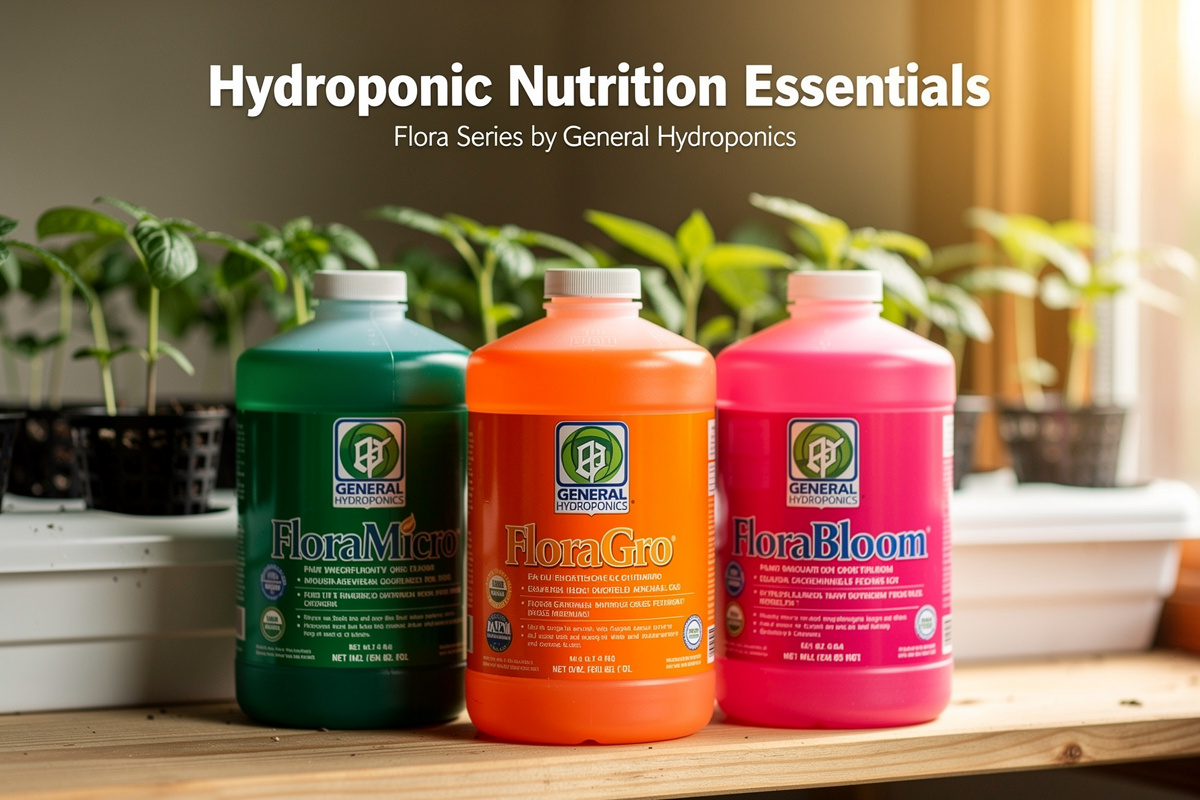
FloraGro, FloraMicro, and FloraBloom are the three bottles that make up the General Hydroponics Flora Series, one of the longest-running 3-part hydroponic nutrient systems on the market. Each bottle carries a distinct subset of the full nutrient profile — FloraMicro the calcium and chelated micronutrients, FloraGro the vegetative-stage potassium, FloraBloom the flowering-stage phosphorus and sulfur — and together they cover every macro and micro element a hydroponic crop needs.
The reason for the split is chemistry, not branding. Putting calcium nitrate (in FloraMicro) into the same bottle as concentrated phosphate or sulfate salts (in FloraBloom) at storage concentrations causes calcium phosphate and calcium sulfate to crystallize out of solution as solid white sediment within hours. Three bottles is the minimum container count required to keep the full hydroponic nutrient profile shelf-stable. This article walks through what is in each bottle at the macronutrient level, what they each do for a plant, and why the combined system works the way it does. For the practical mixing schedule, see my complete GH Flora Series 3-part system guide and feeding schedule.
Why a Single Bottle Cannot Do This Job
The first question new growers ask is why other brands sell a complete formula in one bottle but General Hydroponics needs three. The answer is solubility chemistry — calcium ions react with both phosphate and sulfate ions to form near-insoluble calcium phosphate and calcium sulfate at the concentrations needed for shelf-stable storage.
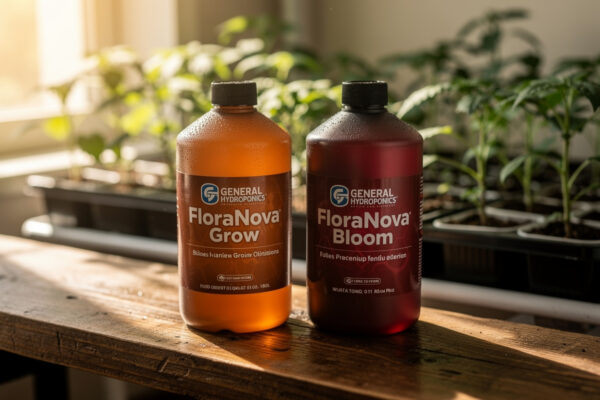
At diluted reservoir concentrations (1 to 2 grams per liter total) the ions stay dispersed because the volume is large enough to keep them apart. At bottle-storage concentrations (200 to 400 grams per liter) they collide constantly and lock up as crystals within hours. The Flora Series solves this by physically separating calcium (in FloraMicro) from sulfates and phosphates (in FloraBloom) until the moment of mixing. FloraNova’s one-bottle approach uses a thickening agent that holds particles in colloidal suspension — works, but requires shaking before every dose. Dry powders like MaxiBloom skip the problem entirely because the salts cannot react until they hit the reservoir.
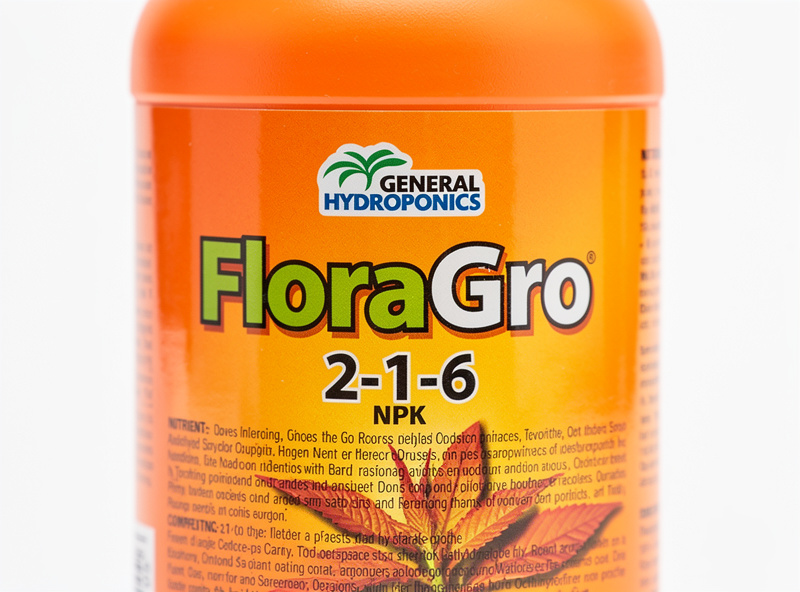
FloraGro — The Vegetative Potassium Driver
FloraGro carries an N-P-K of 2-1-6, which makes it the highest-potassium bottle in the Flora Series. Potassium drives cell wall structure, water regulation, and overall vegetative vigor. The 2 percent nitrogen contribution is meaningful but not the bottle’s primary role — most of the system’s nitrogen comes from FloraMicro, not FloraGro.
The FloraGro label lists the macronutrients in two forms: nitrogen as both nitrate and ammoniacal forms (totaling 2 percent), phosphorus as soluble phosphate (1 percent), and potassium as soluble potash (6 percent). Beyond the headline N-P-K, FloraGro also delivers magnesium — meaningful enough to cover most magnesium needs in vegetative-stage feeding without supplementation.
What FloraGro does not contain is calcium (zero) and almost no micronutrients. Both come from FloraMicro. This split is what lets FloraGro carry the high potassium concentration safely on the shelf — without calcium present, the potassium and magnesium ions have nothing to react with.
FloraGro doses climb from 1 ml per gallon at seedling to 6 ml at late vegetative, then drop sharply once a fruiting crop transitions to bloom — 2 ml at early bloom and zero by mid-bloom. The drop is intentional: once flowers set, killing the FloraGro dose redirects energy from new leaf production to fruit and flower development.
FloraMicro — The Calcium and Micronutrient Base
FloraMicro is the workhorse bottle in the Flora Series. The label N-P-K reads 5-0-1, but the meaningful numbers are not on the front of the bottle — calcium at 5 percent and the full chelated micronutrient package make this the bottle that makes the entire system work.
Most of the nitrogen in a Flora Series feed comes from FloraMicro, despite FloraGro carrying the “Gro” name. The 5 percent nitrogen in FloraMicro versus 2 percent in FloraGro means that even at equal dose ratios, FloraMicro contributes 2.5x more nitrogen to the reservoir. At the standard 6-6-2 ml per gallon late-vegetative dose, that works out to roughly 70 percent of the total nitrogen in the system coming from FloraMicro, not FloraGro.
The calcium contribution is what makes FloraMicro essential. Calcium drives cell wall integrity, root tip development, and prevents blossom end rot in fruiting crops. The 5 percent calcium concentration is delivered as calcium nitrate, which doubles as the primary nitrogen source. This is why FloraMicro must be added to the reservoir FIRST in the mixing order — adding FloraBloom before FloraMicro causes calcium to react with phosphate before it can disperse, dropping the calcium out as sediment within minutes. I’ve watched it happen on my own bench when I got sloppy with the order — a hazy reservoir that took a full remix to fix.
The chelated micronutrients (iron, manganese, zinc, copper, boron, molybdenum) are bonded to EDTA or DTPA carriers that keep them soluble across the 5.5 to 6.5 working pH range. Non-chelated micronutrients precipitate at hydroponic pH and lock plants out of elements physically present in the reservoir.
FloraMicro ships in regular and Hardwater variants. The Hardwater version cuts calcium sharply — about 1 percent versus the regular formula’s 5 percent — and is required for tap water above 200 PPM background or roughly 70 PPM calcium; it’s the bottle I default to given how hard the tap runs where I am in Sweden. Test your water with an EC pen first, my EC meter for hydroponics guide covers selection.
FloraBloom — The Flowering and Fruiting Driver
FloraBloom carries an N-P-K of 0-5-4 — the only bottle in the system with zero nitrogen, the highest phosphorus, and a heavy potassium load. The product was designed to do one job: drive reproductive growth in fruiting and flowering crops.
The zero-nitrogen design is intentional. Once a fruiting crop transitions to flowering, additional nitrogen pushes new leaf growth at the expense of fruit set, sugar, and aromatic compounds — tomatoes fed nitrogen through bloom produce small, watery, low-flavor fruit, which is exactly what I got the one time I ran FloraGro too long into a tomato bloom cycle out of habit. FloraBloom isolates the bloom-driving elements (P, K, Mg, S) from the leaf-driving element (N), letting the grower shut nitrogen off cleanly by replacing FloraGro with FloraBloom.
The 5 percent phosphorus drives flower development, root mass expansion, and ATP energy transfer. The 4 percent potassium drives fruit sugar synthesis and the stress tolerance that lets a plant carry a heavy fruit load. Sulfur (about 1 percent) supports amino acid synthesis and the aromatic compounds that determine flavor.
FloraBloom doses climb steadily through bloom: 1 ml per gallon in seedling, 2 ml in late veg, 4 ml at transition, 10 ml at early bloom, 12 ml mid-bloom, and 15 ml in late ripening. Under-dosing FloraBloom is the most common cause of small fruit and weak yields on hydroponic tomatoes and peppers — see my breakdown of common hydroponic mistakes that kill plants for the full diagnostic sequence.
What Each Bottle Contributes — Side by Side
The table below summarizes what each Flora bottle actually delivers at the elemental level. Reading the standard N-P-K ratios alone misses the calcium and magnesium picture, which is where most diagnostic confusion comes from.
| Element | FloraGro (2-1-6) | FloraMicro (5-0-1) | FloraBloom (0-5-4) |
|---|---|---|---|
| Nitrogen (N) | 2.0% (low) | 5.0% (primary source) | 0% (zero — by design) |
| Phosphorus (P) | 1.0% (low) | 0% (none) | 5.0% (primary source) |
| Potassium (K) | 6.0% (primary source) | 1.0% (low) | 4.0% (significant) |
| Calcium (Ca) | 0% (none) | 5.0% (sole source) | 0% (none) |
| Magnesium (Mg) | 0.5% (significant) | 0% (none) | 1.5% (primary source) |
| Sulfur (S) | 0.5% (low) | 0% (none) | 1.0% (primary source) |
| Chelated micros (Fe/Mn/Zn/Cu/B/Mo) | None | Full package | None |
The pattern is clear. Calcium and chelated micronutrients only come from FloraMicro. Phosphorus and sulfur only come from FloraBloom. Potassium comes from all three but FloraGro carries the heaviest load. Nitrogen is FloraMicro’s job, with a small contribution from FloraGro and none from FloraBloom.
How the Three Combine for a Complete Profile
At the late-vegetative 6-6-2 ml per gallon ratio, the three bottles deliver an EC of 1.2 to 1.5 with a fairly balanced N-P-K profile relative to each other. At the peak-bloom 0-12-12 ratio, EC climbs to 2.4 to 2.8 and the profile shifts hard toward phosphorus and potassium, with nitrogen dropping as a share of the total even though FloraMicro’s dose has doubled — the point of killing FloraGro at this stage is to stop feeding leaf growth, not to starve the plant of nitrogen entirely.
The same three bottles deliver both profiles by changing only the relative dose. No supplementation is needed for a complete feed across the crop life cycle, with one exception: reverse-osmosis or distilled water requires CALiMAGic because the Flora formulation assumes the water source contributes baseline calcium and magnesium — I learned this running one reservoir on RO water with no CalMag and watching classic calcium-deficiency tip burn show up on lettuce within a week. For the full mixing technique, see my how to mix hydroponic nutrient solution guide.
Common Misconceptions About 3-Part Nutrients
Several persistent misconceptions about the Flora Series cost growers yield. Three are worth correcting directly.
FloraGro is not the main nitrogen source. The bottle name suggests it drives vegetative growth, and it does — through potassium, not nitrogen. FloraMicro is the nitrogen source. New growers who try to push more nitrogen by overdosing FloraGro end up with a potassium-saturated reservoir that locks out calcium uptake, while still under-feeding nitrogen.
The “2-1-6” rating is not the dose ratio. 2-1-6 is the percent composition of the bottle (N-P-K by weight). It is not how much of each bottle to mix. The actual dose ratio across the three bottles changes with crop stage and is set by the feeding schedule, not the bottle labels.
FloraBloom is not optional for fruiting crops. Using only FloraGro and FloraMicro produces a vegetative-balanced reservoir that grows leaves well but yields small, weak fruit. FloraBloom delivers the only phosphorus and most of the sulfur — both essential for fruit set and quality.
When Two Bottles Are Enough
The Lucas formula uses only FloraMicro and FloraBloom at a fixed 8-and-16 ml per gallon ratio, skipping FloraGro entirely. The combined profile still delivers meaningful potassium (FloraBloom carries 4 percent, FloraMicro carries 1 percent) to drive vegetative growth without FloraGro’s contribution. Lucas works because the system is robust enough that the missing potassium load from FloraGro is partially compensated by the heavier FloraBloom dose.
Lucas is the right pick for single-stage crops (lettuce, herbs) and growers who want to skip the feeding schedule entirely. In my own comparisons the gap to a properly staged 3-part schedule is small for a single crop cycle. For fruiting crops at peak bloom, the full 3-bottle schedule still wins. My Flora Series 3-part system guide covers Lucas in more detail.
Next Steps
Understanding what is in each Flora bottle is the conceptual half of running the system; the practical half is the mixing routine. For the full feeding schedule with crop-specific ratios, see the GH Flora Series 3-part system guide. For the broader product context — how Flora compares to FloraNova and MaxiBloom — see my General Hydroponics complete brand guide. To compare GH against other major brands, my roundup of the best hydroponic fertilizer for 2026 walks through the head-to-head choices.
Frequently Asked Questions
What is the difference between FloraGro, FloraMicro, and FloraBloom?
FloraGro is the high-potassium vegetative driver at NPK 2-1-6. FloraMicro is the calcium and chelated micronutrient base at 5-0-1, and the primary nitrogen source. FloraBloom is the high-phosphorus flowering driver at 0-5-4 with zero nitrogen. Together they form a complete hydroponic nutrient profile.
Which Flora bottle has the most nitrogen?
FloraMicro contains 5 percent nitrogen — more than FloraGro at 2 percent. Despite the name, FloraGro is not the main nitrogen source. FloraMicro delivers about 70 percent of the total nitrogen in a standard Flora Series feed. FloraBloom contains zero nitrogen by design.
Why does FloraBloom have zero nitrogen?
Once a fruiting crop transitions to flowering, additional nitrogen pushes new leaf growth at the expense of fruit set, fruit size, and flavor. FloraBloom isolates the bloom-driving elements — phosphorus, potassium, magnesium, sulfur — from nitrogen, letting growers cleanly shut nitrogen off by switching from FloraGro to FloraBloom.
Can I use just FloraMicro and FloraBloom without FloraGro?
Yes. The Lucas formula uses 8 ml FloraMicro and 16 ml FloraBloom per gallon, skipping FloraGro entirely. The combined potassium from both bottles is enough to drive vegetative growth. In grower comparisons the gap to the full 3-part schedule is small for most crops on a single cycle.
Why does FloraMicro have to be added first?
FloraMicro carries calcium. Adding FloraBloom or FloraGro before FloraMicro causes calcium to react with phosphate or sulfate before it can disperse evenly through the reservoir, dropping calcium out as a chalky white precipitate within minutes. Always mix FloraMicro into the full water volume first.
Do I need all three bottles to grow lettuce?
No. Lettuce and leafy greens grow well on either the full 3-part schedule at 3-3-1 ml per gallon or the Lucas 2-bottle formula at 8-and-16 ml per gallon. For lettuce specifically, FloraNova Grow alone in a single bottle is also a perfectly valid simpler option.