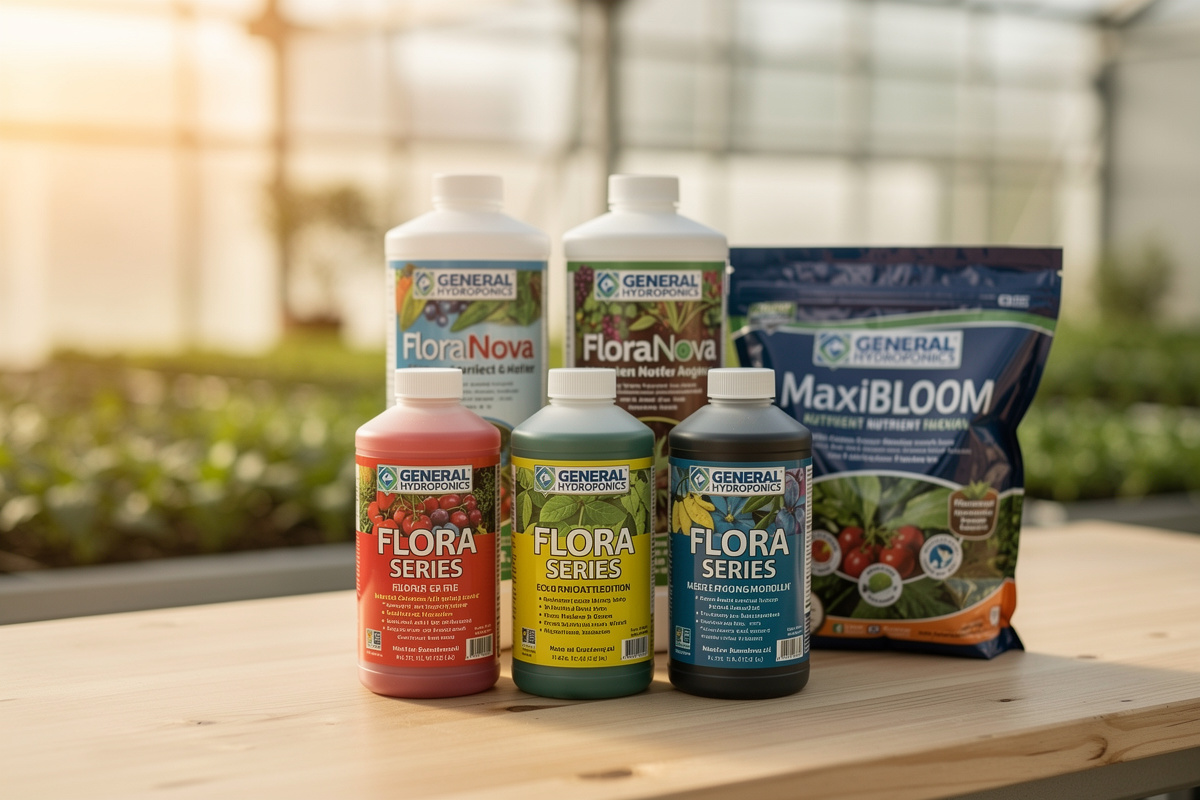
General Hydroponics is the oldest and most widely sold hydroponic nutrient brand in the United States, founded in 1976 in a Berkeley, California garage by Lawrence Brooke (the company is headquartered in nearby Sebastopol today). Three product lines do almost all the work: the Flora Series 3-part liquid, FloraNova one-part liquid, and MaxiSeries dry powder. Together they cover every system and crop a home grower will run.
The catalog stretches well past those three lines — bloom boosters, beneficial microbe additives, pH buffers, organic alternatives, and crop-specific supplements — and that breadth is exactly what makes the brand confusing for new growers. This guide breaks down the entire General Hydroponics lineup, explains which product matches which system and crop, walks through honest strengths and weaknesses against competitors, and points you to the deep-dive articles on each major product. If you are still picking a nutrient brand at all, read my broader guide to hydroponic nutrients and my shortlist of the best hydroponic fertilizer for 2026 first — General Hydroponics is one of several solid choices, not always the right one.
As an Amazon Associate I earn from qualifying purchases.
Who Is General Hydroponics?
General Hydroponics was founded by Lawrence Brooke in a Berkeley garage in 1976 (per General Hydroponics’ own company history) and is now owned by the Hawthorne Gardening Company, a subsidiary of Scotts Miracle-Gro since 2015. The brand is sold in nearly every hydroponic shop in North America and is one of the few hydroponic-specific lines stocked by mainstream retailers like Amazon and Lowes.
The company built its reputation on a single product — the Flora Series 3-part liquid system — which has been continuously sold since 1976 with only minor reformulations. That product is still the reference 3-part system that competitors are measured against, and the formulation has been published in commercial growing literature, agricultural research, and home grower guides for almost five decades. Around that core, the company has layered out about 30 additional products across one-part liquids, dry powders, organic certified blends, coco-specific blends, supplements, and pH adjusters.
The Hawthorne acquisition matters mostly for distribution and consistency. The formulations have stayed stable, manufacturing moved into larger facilities, and bottle prices have crept upward over the past several years like most hydroponic nutrient lines — GH doesn’t publish exact figures, but it’s noticeable if you’ve been restocking the same bottles for a while. For the home grower comparing brands today, treating GH as a stable, well-distributed mainstream choice — not a boutique craft option — is the most accurate framing.
The General Hydroponics Product Lineup at a Glance
Twelve products handle 95 percent of what home growers need from the brand. The table below covers the main lines, what each is, and where it fits.
| Product | Format | Bottles | NPK Range | Best For | Typical Retail Price |
|---|---|---|---|---|---|
| FloraGro | Liquid 3-part | 1 of 3 (with Micro + Bloom) | 2-1-6 | Vegetative growth driver | $18 / quart |
| FloraMicro | Liquid 3-part | 1 of 3 (with Gro + Bloom) | 5-0-1 | Calcium/micronutrient base for full Flora system | $20 / quart |
| FloraBloom | Liquid 3-part | 1 of 3 (with Gro + Micro) | 0-5-4 | Flowering and fruiting phase | $18 / quart |
| FloraNova Grow | Liquid 1-part | 1 (single bottle) | 7-4-10 | Veg-stage simplicity in any system | $24 / quart |
| FloraNova Bloom | Liquid 1-part | 1 (single bottle) | 4-8-7 | Bloom-stage simplicity in any system | $24 / quart |
| MaxiGro | Dry powder | 1 (powder + Cal-Mag if RO) | 10-5-14 | Budget veg crops, large reservoirs | $22 / 2.2 lb |
| MaxiBloom | Dry powder | 1 (powder + Cal-Mag if RO) | 5-15-14 | Budget bloom crops, large reservoirs | $22 / 2.2 lb |
| Liquid KoolBloom | Liquid additive | +1 supplement | 0-10-10 | Mid-bloom flower size booster | $22 / quart |
| Floralicious Plus | Liquid additive | +1 supplement | 2-0.8-0.02 | Sweetener / aroma compound additive | $45 / quart |
| CALiMAGic | Liquid Cal-Mag | +1 supplement | 1-0-0 (with 5% Ca, 1.5% Mg) | Adding calcium and magnesium when using RO water | $22 / quart |
| RapidStart | Liquid root stim | +1 supplement | 1-0.5-1 | Cloning and seedling root development | $26 / quart |
| pH Down / pH Up | Liquid pH buffer | 1 each (kept separately) | N/A | Adjusting reservoir pH into the 5.5 to 6.5 range | $15 / quart |
The three top-line systems — Flora Series, FloraNova, MaxiSeries — are functionally substitutes for each other, not stack-on additions. Pick one as your base feed. Everything below the line in the table (KoolBloom, Floralicious, CALiMAGic, RapidStart) is an optional supplement layered on top.
Flora Series — The Original 3-Part Liquid
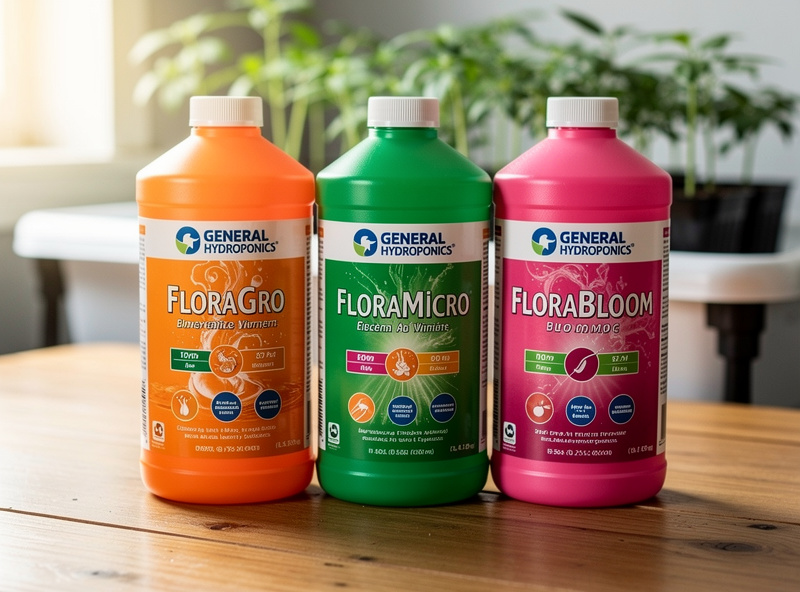
The Flora Series is General Hydroponics’ flagship product and the longest-selling hydroponic nutrient formula in commercial production. It splits the full nutrient profile into three bottles — FloraGro, FloraMicro, FloraBloom — which lets the grower shift the N-P-K ratio across vegetative, transition, and bloom stages by changing how much of each bottle goes into the reservoir.
The split exists for a chemistry reason, not just for marketing. Calcium nitrate (in FloraMicro) and concentrated phosphate or sulfate salts (in FloraBloom) cannot be stored in the same bottle without precipitating out into solid sediment. Keeping them in separate bottles is how the formulation stays stable on the shelf and why three bottles is the minimum for a true full-control hydroponic feed. The standard mixing order is FloraMicro first, FloraGro second, FloraBloom third — adding them out of order can drop calcium out of solution as a chalky white residue inside the reservoir. I learned that one the hard way on an early Flora Series reservoir: dumped Bloom in before Micro had fully dissolved and watched a thin white cloud settle to the bottom overnight. Nothing catastrophic, just wasted nutrient, but I’ve mixed in order every time since.
Where the Flora Series shines is crop versatility. The same three bottles cover lettuce in a Kratky jar at 1.5 ml of each per gallon, tomatoes in NFT at the full 8-15-15 ml schedule, and strawberries in DWC at a custom 5-10-10 ratio. No other GH product gives that range of control. Where it falls short is convenience: three bottles to measure, three bottles to store, and a longer mixing routine than a one-part competitor offers. For step-by-step feeding charts and the full ratio schedule, see my dedicated guide to the GH Flora Series 3-part system. For the bottle-level chemistry — what’s in each of FloraGro, FloraMicro, and FloraBloom and why three bottles is the minimum count — that companion article covers it in depth.
Two important notes on Flora variants. FloraMicro comes in a regular formula and a Hardwater formula — the Hardwater version contains less calcium and is correct for tap water above 200 PPM background. Using regular FloraMicro with hard tap water can push total calcium past 400 PPM and lock out potassium uptake. Check your water with a basic TDS pen before buying which Micro version you need.
FloraNova — One-Bottle Convenience
FloraNova is General Hydroponics’ answer to the convenience question — a single concentrated bottle that holds the full nutrient profile in suspension using a proprietary thickener. It comes in two products: FloraNova Grow for vegetative crops at NPK 7-4-10, and FloraNova Bloom for fruiting and flowering at NPK 4-8-7.
The advantage is speed. One measuring step replaces three, no mixing order to remember, no math when shifting between vegetative and bloom stages — you simply switch from the Grow bottle to the Bloom bottle when the crop transitions. For lettuce, herbs, or any single-crop system that stays in one growth stage, FloraNova Grow alone gets you through the whole cycle.
The trade-off is shake time and ratio control. FloraNova bottles are noticeably thicker than other GH liquids — closer to the consistency of melted ice cream than juice — and they need a 30-second shake before every dose to redistribute the suspended micronutrients. They also lock you into the manufacturer’s NPK ratio. You cannot dial up nitrogen for a heavy-feeding tomato in early veg or push potassium for fruit set without buying a separate supplement. For most home setups this is fine; for someone trying to extract maximum yield from a fruiting crop, it is a real limitation. The full pros, cons, and dose schedule are in my deep-dive on FloraNova Grow vs FloraNova Bloom. For broader buying guidance on hydroponic equipment to pair with FloraNova, see my complete hydroponic equipment buying guide.
MaxiSeries — Dry Powder for Budget Growers
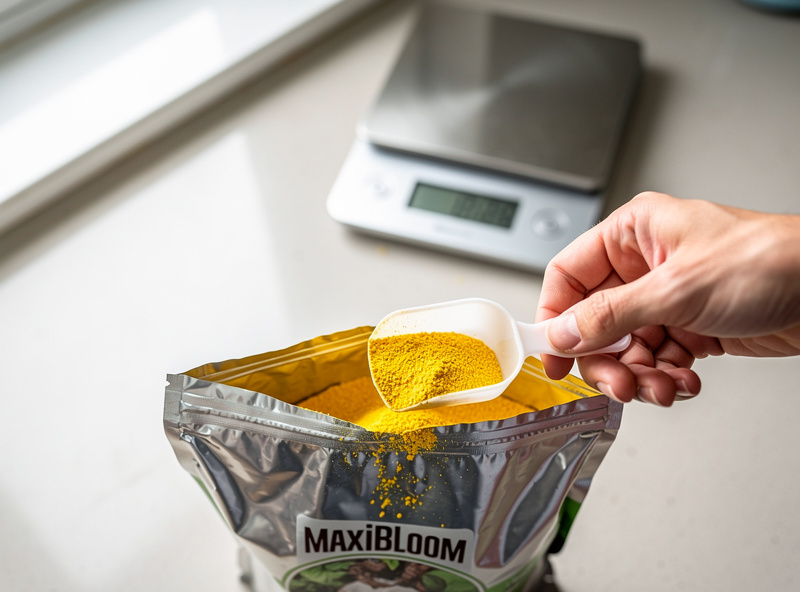
MaxiGro and MaxiBloom are General Hydroponics’ dry powder line, sold in 2.2-pound resealable bags at roughly $22 each. By weight of nutrient delivered to the reservoir, the MaxiSeries is the cheapest product in the GH catalog — about half the per-gallon-of-feed cost of the Flora Series and roughly one-third the cost of FloraNova.
The MaxiSeries works best in larger reservoirs where the small per-gallon weight makes accurate dosing easy with a digital kitchen scale. For a 5-gallon DWC bucket you are measuring 4 to 6 grams of powder — close to the lower limit of cheap kitchen scales, which read in 1-gram increments. For a 50-gallon recirculating reservoir you are measuring 40 to 60 grams, which is precision-easy on any scale and makes the cost advantage real.
Two known issues with the MaxiSeries are worth knowing before buying. First, the powder is hygroscopic — it absorbs moisture from the air and will clump into hard chunks if the bag is left open or stored in a humid garage. Reseal the bag immediately after each use and store it in a dry cabinet. Second, the formulation assumes you are mixing into water that already contains some calcium and magnesium. If you use reverse osmosis or distilled water, you must add CALiMAGic or another Cal-Mag supplement separately — the bag does not contain enough on its own. The full mixing schedule, EC targets, and the 7-gram-per-gallon solo recipe are covered in my dedicated MaxiBloom feeding schedule and recipe guide. If your reservoir routine is the actual problem, my guide to common hydroponic mistakes that kill plants covers the diagnostic steps.
Specialty Bloom Boosters
General Hydroponics sells several bloom-stage additives that layer on top of any base feed — Liquid KoolBloom, Dry KoolBloom, FloraNectar, and Floralicious Plus. These are not replacements for a balanced base nutrient. They are targeted supplements that push specific outcomes during the bloom phase and add a meaningful amount to a grower’s per-cycle nutrient cost — stacking two or three of them on top of a base feed is a real budget line, not a rounding error.
Liquid KoolBloom (NPK 0-10-10). A potassium-and-phosphorus bump used during weeks 2 through 5 of the bloom phase. It accelerates flower size and density on fruiting crops by saturating the reservoir with the elements plants demand most heavily during fruit set. Dose at 1 to 2 ml per gallon on top of your base feed. The cheapest of the bloom boosters and the one with the most consistent reported results.
Dry KoolBloom (NPK 2-45-28). A late-bloom finisher used in the final two weeks before harvest. The very high phosphorus reading is misleading — the actual function is forcing the plant into ripening mode and improving aromatic compound development. Dose at 0.5 to 1 gram per gallon. Often skipped by home growers because the marginal benefit is small for non-commercial yields.
Floralicious Plus (guaranteed analysis 2-0.8-0.02). A liquid sweetener and aroma additive marketed at improving flavor and bouquet on fruiting crops. The most expensive of the GH bloom additives at $45 per quart, and the one with the most uneven user reports. Some growers swear by it on tomatoes and strawberries; others see no measurable difference in fruit. My dedicated guide on Floralicious Plus — when (and whether) to add it covers the dose schedule, the actual formulation, and my honest take on whether the cost is justified.
Supplements and Additives
Beyond the bloom boosters, General Hydroponics sells four supplements that solve specific problems rather than driving overall growth. Use them when the underlying issue exists, skip them otherwise.
CALiMAGic. A 1-0-0 liquid with 5 percent calcium and 1.5 percent magnesium, dosed at 1 to 2 ml per gallon. Required if you mix into reverse osmosis or distilled water, and helpful if your tap water tests below 50 PPM background. Without it, RO water grows plants with calcium deficiency symptoms (blossom end rot on tomatoes, tip burn on lettuce) within two weeks. My hydroponic nutrients guide covers the water-source decision in more detail.
Diamond Nectar. A fulvic acid supplement marketed at improving micronutrient uptake. Real measurable benefit is small in well-managed reservoirs with stable pH; meaningful benefit shows up only in pH-unstable or heavily chelated systems. Optional for most home growers.
RapidStart. A root stimulant rich in plant hormones (kinetins, ascorbic acid, and a vitamin blend) used during cloning, transplanting, and the first two weeks of growth. Dosed at 1 ml per gallon. The clearest measurable benefit of any GH supplement when used as directed during cloning.
FloraKleen. A reservoir flush used between crops or for the final 7 to 10 days before harvest. Dissolves mineral deposits, breaks down salt buildup in growing media, and resets the EC to near zero. Helpful for between-crop reservoir maintenance, optional for harvest flushing on most home crops.
How to Pick a GH Product for Your System and Crop
Two questions narrow the GH catalog to a single product fast: what crop are you growing, and how much mixing complexity do you want to manage. Match those two answers to one of the three base systems and you will pick correctly.
For a single-crop leafy green system (lettuce, herbs, basil, kale) in a beginner DWC, NFT, or Kratky setup: FloraNova Grow alone gets you through the whole cycle with one bottle and no mixing complexity. It is the simplest, fastest path to a working hydroponic feed for a first system. If price is the priority and you have a digital scale, MaxiGro at half the per-gallon cost is the alternative.
For mixed gardens or systems where you cycle through different crops at different stages: the Flora Series 3-part is the right call. The ability to dial the N-P-K ratio for each individual crop is the entire point of the product, and you will use it — it’s the base feed I keep mixed for most of my own DWC and NFT runs precisely because I’m rarely growing just one crop at a time.
For fruiting crops (tomatoes, peppers, cucumbers, strawberries) in any recirculating system: Flora Series 3-part for full life-cycle control, with Liquid KoolBloom added during weeks 2 through 5 of bloom. This combination matches what commercial fruit growers use and produces the most consistent yields. If complexity is the breaking point, FloraNova Grow for veg switching to FloraNova Bloom for flower is the simplified equivalent.
System type matters less than crop type for product choice, with one exception: pure aeroponic and tower systems benefit from staying with liquids over powders, because the very thin nutrient solutions used in aeroponic misters can clog with even small amounts of undissolved powder. For tower systems, my breakdown of DWC, NFT, and Ebb and Flow systems explains which system pairs well with which feed format.
What General Hydroponics Does Better Than Competitors
Three things put General Hydroponics ahead of most competitors at the home-grower scale: distribution, formula stability, and documentation depth.
Distribution and availability. Almost every hydroponic shop in North America stocks at least the Flora Series and FloraNova line. Amazon stocks the full catalog with two-day shipping. Major garden centers like Lowes carry MaxiBloom in season. If a reservoir runs low on a Sunday afternoon, GH is the brand you can get same-day. Boutique competitors like Athena, Jacks, or Nectar for the Gods often require a 3-to-5-day mail order.
Formula stability. The Flora Series formulation has been essentially unchanged since the 1980s. Feeding charts, EC schedules, and recipe variants developed over four decades still apply to the bottles you buy this year. Some competitors reformulate their lineups more often — growers report Advanced Nutrients discontinuing and relaunching products across the years — which makes older community-tested recipes for those brands less reliable over time.
Documentation and grower community. The Flora Series has more independent grower documentation, recipe variants, and forum discussion than any competing nutrient line. The “Lucas formula” — a 2-part variant that uses only FloraMicro and FloraBloom in an 8-ml-and-16-ml-per-gallon ratio — has been documented and validated across thousands of crops since the early 2000s. Athena, Jacks, and Cultured Solutions are all newer and the community-tested recipes are thinner.
Where General Hydroponics Falls Short
Three real weaknesses are worth knowing before committing to the brand.
Premium positioning, mid-tier formulation. By NPK content per dollar, GH liquids are not the best value. Jack’s 321 (a competitor 3-part dry recipe — Jack’s Hydro 5-12-26, calcium nitrate, and Epsom salt) delivers a comparable NPK profile for a fraction of the per-gallon cost once you’re mixing from dry salts. Growers running Athena’s pro-grade two-part liquid report strong fruiting yields too — I haven’t run it side by side on my own bench so I won’t claim it beats the Flora Series, only that GH’s real edge is availability and formula stability, not being the cheapest or the single best performer on paper.
Bloom additive marketing. The Floralicious Plus and FloraNectar lines are aggressively marketed for fruiting and flavor improvements that are difficult to verify in a home setting. The cost per cycle if you stack them all is real (roughly $40 to $60 in additives per crop) and the measurable benefit on most home crops is small. New growers tend to over-buy supplements and under-invest in pH and EC discipline. Skip the additives until you have a reservoir routine that stays within 0.2 EC and 0.3 pH of target across a full week.
Hardwater Micro confusion. The two FloraMicro variants (regular and Hardwater) sit on shelves next to each other and are easy to grab the wrong one. Picking the wrong Micro for your tap water locks out either calcium or potassium within 2 to 3 weeks. The labels are similar enough that even returning customers grab the wrong bottle. Test your tap water before your first purchase and put a sticker on the bottle as a reminder.
Pricing and Where to Buy
General Hydroponics products are sold through three main channels with meaningfully different pricing. Knowing where to buy can meaningfully cut your nutrient bill across a year, especially once you’re buying gallon sizes instead of quarts.
Hydroponic specialty retailers (HTG Supply, GrowGeneration, brick-and-mortar grow shops) carry the full GH catalog, often with a small loyalty discount, and let you grab variants like Hardwater Micro that mass retailers rarely stock. Prices match Amazon at quart sizes; specialty shops beat Amazon on gallon and 6-gallon sizes by 10 to 20 percent. Best for committed growers buying gallons.
Amazon stocks the full GH line with two-day Prime shipping and is usually price-matched within 5 percent of specialty shops at quart sizes. The convenience advantage is real — it’s where I restock my own Flora Series and MaxiGro, especially for restocking a single bottle that ran out mid-cycle. Watch for third-party sellers with inflated pricing on rare variants.
Mainstream garden retailers (Lowes, ACE Hardware, well-stocked nurseries) usually carry only MaxiBloom, MaxiGro, and the Flora Series 3-pack starter. Convenient if you live near one but limited selection. Price is identical to Amazon on the items they stock.
For a typical home grower running a 20-gallon reservoir on a 4-week cycle, expect to spend $35 to $60 on nutrients per cycle with the Flora Series, $25 to $40 with FloraNova, or $12 to $18 with MaxiBloom. These are direct-to-consumer prices. If you scale up to a 100-gallon greenhouse setup, MaxiBloom drops your per-gallon-of-feed cost below $0.20 — a meaningful difference at volume.
Next Steps: Pick a Product and Build a Routine
Picking a General Hydroponics product is straightforward once you know your crop and your tolerance for mixing complexity. The harder part is building the EC and pH routine that makes any nutrient brand actually work. A grower running MaxiBloom with daily pH checks and a weekly reservoir reset will out-yield a grower running the entire Floralicious-stacked Flora Series who never measures EC.
If you do not yet have a meter, my guide to EC meters for hydroponics covers the cheap-to-pro range and my review of the Bluelab Truncheon covers the gold-standard option. For pH adjustment, my breakdown of pH Down for plants covers safe handling, dosing math, and alternatives. And once you have your nutrients and meters, my step-by-step guide to mixing hydroponic nutrient solution walks through the full reservoir build. For crop-specific feeding patterns, see my complete guide to hydroponic plant growing.
Still deciding on a system to grow in? Start with my complete hydroponics for beginners guide or my overview of hydroponic systems. If you are weighing hydroponic against traditional growing, my comparison of hydroponics vs soil covers the trade-offs. And to know what to plant once your system is running, my list of the 15 best plants for hydroponic growing shows you what works fastest.
Frequently Asked Questions
What is the best General Hydroponics product for beginners?
FloraNova Grow alone is the easiest GH product for a first hydroponic setup. One bottle, one measurement, NPK 7-4-10 covers the full vegetative cycle of lettuce, herbs, and most beginner crops. Add FloraNova Bloom only if you grow fruiting crops past flowering.
Do I need to buy all three Flora Series bottles?
For full ratio control, yes — FloraGro, FloraMicro, and FloraBloom together cover the entire crop life cycle. The Lucas formula uses only FloraMicro and FloraBloom at 8 ml and 16 ml per gallon, skipping FloraGro entirely. This works well for many crops and reduces the bottle count to two.
What is the difference between FloraNova and the Flora Series?
FloraNova is a single-bottle, ready-to-use formula at fixed NPK ratios. The Flora Series is three separate bottles that let you adjust the N-P-K ratio for each crop and growth stage. FloraNova trades control for convenience; the Flora Series trades convenience for control.
Is MaxiBloom or Flora Series cheaper?
MaxiBloom is roughly 50 percent cheaper per gallon of mixed feed than the Flora Series. A 2.2-pound bag of MaxiBloom at $22 mixes about 600 gallons of standard solution. The Flora Series at the same volume costs about $45 to $50 across the three bottles.
Can I use General Hydroponics nutrients in soil?
Yes, at half the recommended hydroponic strength. The Flora Series and FloraNova both work as soil drenches, but soil supplies enough calcium and magnesium that adding CALiMAGic on top can cause lockout. Most growers use GH only in hydroponic and coco systems where it was designed to perform.
Why does General Hydroponics sell two FloraMicro versions?
FloraMicro Hardwater is formulated for tap water above 200 PPM background, which already contains significant calcium. Using regular FloraMicro with hard tap water pushes total calcium past 400 PPM and locks out potassium. Test your tap water before buying which version you need.
Is General Hydroponics owned by Scotts Miracle-Gro?
Yes. General Hydroponics has been owned by the Hawthorne Gardening Company, a subsidiary of Scotts Miracle-Gro, since 2015. The acquisition has not changed the formulations of the Flora Series, FloraNova, or MaxiSeries products in any meaningful way through 2026.