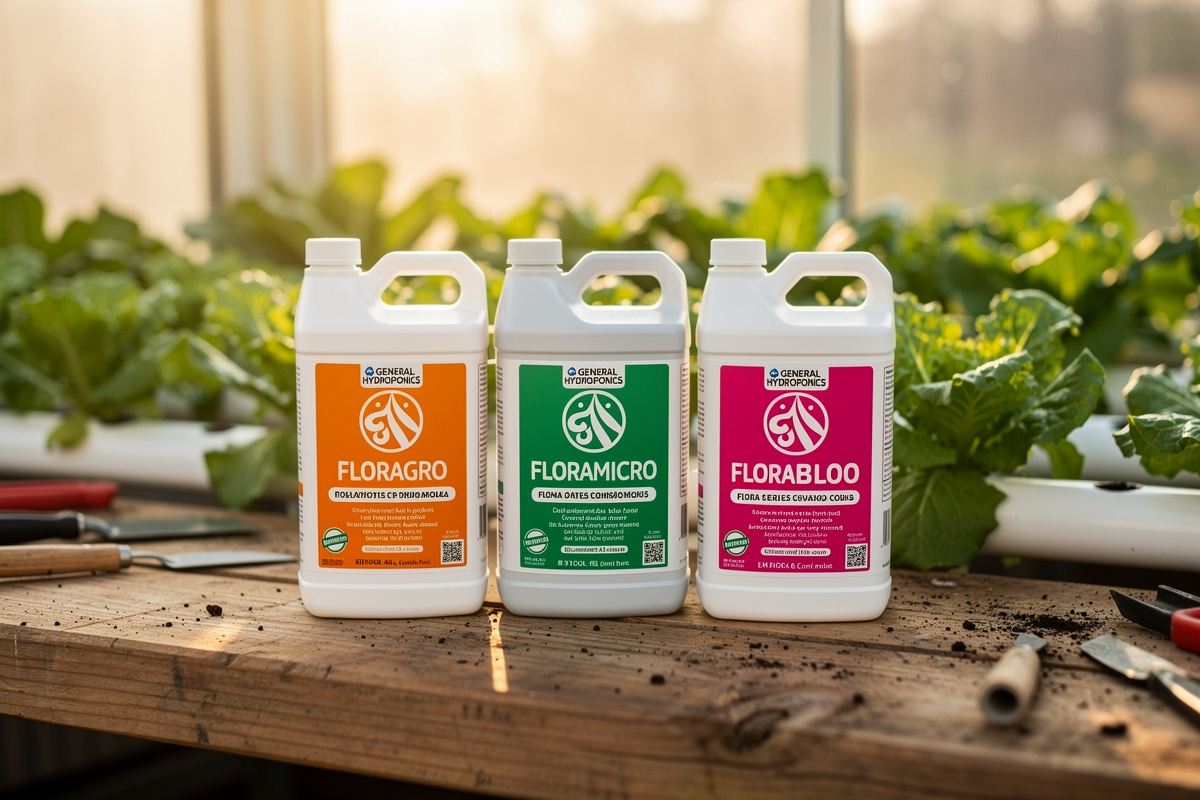
The General Hydroponics Flora Series is a three-bottle liquid nutrient system — FloraGro, FloraMicro, and FloraBloom — that lets a grower shift the N-P-K ratio across the entire crop life cycle. Mixed at standard rates, the schedule runs from 1-1-1 ml per gallon at seedling stage up to FloraMicro and FloraBloom alone at 8-15 ml per gallon during late bloom on a fruiting crop, with FloraGro tapering to zero once fruit sets.
The Flora Series has been the reference 3-part hydroponic formula since 1976, and almost every other 3-part liquid nutrient on the market is benchmarked against it. The split into three bottles is a chemistry requirement, not a marketing choice — calcium nitrate and concentrated phosphates cannot stay in the same bottle without precipitating into solid sediment. This guide walks through what each bottle contains, the full week-by-week mixing schedule, the reservoir build sequence, and the common variant recipes that experienced growers use to dial yields. For background on where this product fits in the broader brand, see my General Hydroponics nutrients complete brand guide.
As an Amazon Associate I earn from qualifying purchases.
What Is the GH Flora Series?
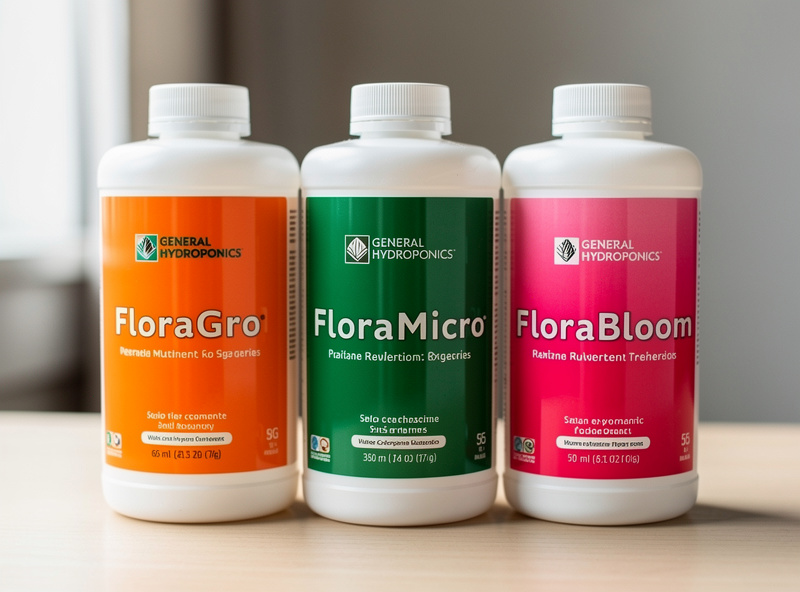
The Flora Series is General Hydroponics’ three-part hydroponic nutrient kit, sold as three separate quart or gallon bottles labeled FloraGro (NPK 2-1-6), FloraMicro (NPK 5-0-1), and FloraBloom (NPK 0-5-4). Used together at the right ratios, the three bottles supply every macronutrient and micronutrient a hydroponic crop needs from seedling through final harvest.
The three-bottle design exists because mixing the full nutrient profile into one bottle is chemically impossible at the concentrations needed for hydroponic feeding. Calcium (delivered through FloraMicro) reacts with sulfates and phosphates (concentrated in FloraBloom) to form insoluble calcium sulfate and calcium phosphate, which fall out of solution as a chalky white sediment. Splitting them across three bottles keeps every element soluble until the moment you mix them into the diluted reservoir, where the concentration is low enough to stay in solution.
The result is full ratio control. A grower can hit a high-nitrogen vegetative ratio for leafy greens, a balanced mid-cycle blend for transitioning crops, and a high-phosphorus-and-potassium bloom ratio for fruit set — all from the same three bottles, just at different mixing ratios. No one-part nutrient gives this range. For broader background on how multi-part nutrients compare to one-part and dry options, the complete hydroponic nutrients guide covers the trade-offs.
What Each Bottle Contains
The three bottles are not interchangeable — each carries a specific subset of the full nutrient profile. Understanding what is in each one explains why the standard mixing ratios change across the crop life cycle.
FloraGro (NPK 2-1-6). The vegetative driver. High potassium (K) for cell wall development and overall vigor, moderate nitrogen (N) for foliage growth, low phosphorus (P) because seedlings and young plants do not need much. FloraGro also supplies most of the magnesium and a small amount of secondary micronutrients. This is the bottle whose dose drops sharply once a crop transitions to flowering.
FloraMicro (NPK 5-0-1). The chelated micronutrient and calcium base. This bottle carries the calcium, iron, manganese, zinc, copper, boron, molybdenum, and the chelating agents that keep micronutrients soluble across the working pH range. Almost all the nitrogen in the Flora Series is delivered through FloraMicro, not FloraGro — the “5” on the label is the nitrogen percentage. Mix this bottle FIRST every time, before any other Flora bottle hits the reservoir.
FloraBloom (NPK 0-5-4). The flowering and fruiting driver. High phosphorus for flower formation and root mass expansion, high potassium for fruit sugar development, zero nitrogen so the plant shifts focus from leaf production to reproductive growth. Sulfur and additional magnesium also come from this bottle. The dose climbs steadily as a crop moves into bloom.
FloraMicro ships in two variants — regular and Hardwater. The Hardwater version cuts calcium sharply (the regular formula runs about 5% Ca, Hardwater about 1%) and is the correct pick if your tap water tests above 200 PPM background or above roughly 70 PPM calcium; using regular FloraMicro on hard water stacks too much calcium into the reservoir and locks out potassium. Sweden’s tap water runs hard enough in most municipalities that Hardwater is the bottle I keep stocked, not the regular one — I test every new water source before committing to a bottle. My EC meter for hydroponics guide covers the meter selection for testing your water.
Standard Flora Series Feeding Schedule
The official General Hydroponics feeding chart maps each crop stage to a specific dose of each bottle, measured in milliliters per gallon. The table below covers the full schedule for a fruiting crop (tomatoes or peppers) — the longest cycle and the most ratio shifts.
| Stage | Weeks | FloraGro | FloraMicro | FloraBloom | Target EC |
|---|---|---|---|---|---|
| Seedling / clone | 0-1 | 1 ml/gal | 1 ml/gal | 1 ml/gal | 0.4 – 0.6 |
| Early vegetative | 2-3 | 3 ml/gal | 3 ml/gal | 1 ml/gal | 0.8 – 1.0 |
| Late vegetative | 4-5 | 6 ml/gal | 6 ml/gal | 2 ml/gal | 1.2 – 1.5 |
| Transition to bloom | 6-7 | 4 ml/gal | 8 ml/gal | 4 ml/gal | 1.5 – 1.8 |
| Early bloom | 8-9 | 2 ml/gal | 10 ml/gal | 10 ml/gal | 2.0 – 2.4 |
| Mid bloom | 10-11 | 0 ml/gal | 12 ml/gal | 12 ml/gal | 2.4 – 2.8 |
| Late bloom / ripening | 12+ | 0 ml/gal | 8 ml/gal | 15 ml/gal | 2.0 – 2.4 (taper) |
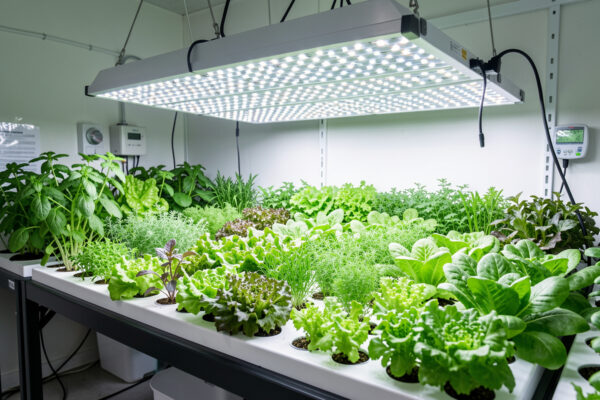
For leafy greens (lettuce, herbs, kale, spinach) the schedule is much simpler — stay in the early vegetative row for the entire crop cycle, never moving past 3-3-1 ml per gallon. Lettuce reaching harvest weight at EC 1.0 with this ratio is the most reliable result the Flora Series produces.
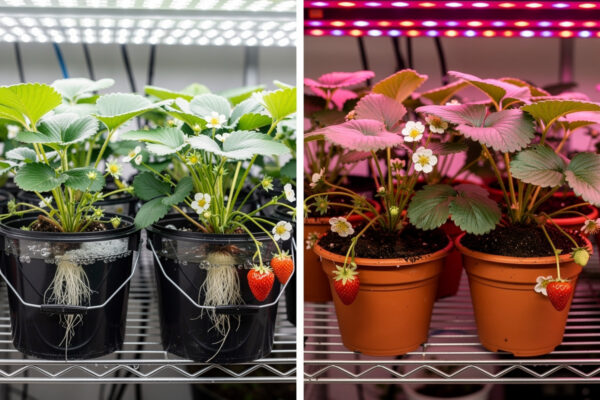
For strawberries, run the schedule but compress it: 2 weeks at the early vegetative dose, then jump straight to the early bloom row and hold there for the rest of the crop. Strawberries do not need the multi-stage transition that fruiting nightshades require.
Mixing Order and Reservoir Build
The Flora Series mixing order is FloraMicro first, FloraGro second, FloraBloom third. Skipping or scrambling this sequence can drop calcium out of solution as a white precipitate inside your reservoir within minutes. The order is not a suggestion — it is the only way the chemistry works at full doses. It’s a habit I don’t break even when I’m mixing four reservoirs back to back across the bench — Micro, wait, Gro, wait, Bloom, every single time, because the one time I got impatient and rushed it I ended up with a hazy reservoir I had to dump and remix from scratch.
The reasoning is straightforward. FloraMicro carries calcium. Adding it to a reservoir of plain water gives the calcium a large dilution volume to disperse into before any sulfate or phosphate arrives. FloraGro adds potassium and magnesium with minimal interaction at this stage. FloraBloom finally introduces sulfates and phosphates into a reservoir where calcium is already evenly dispersed and unlikely to precipitate.
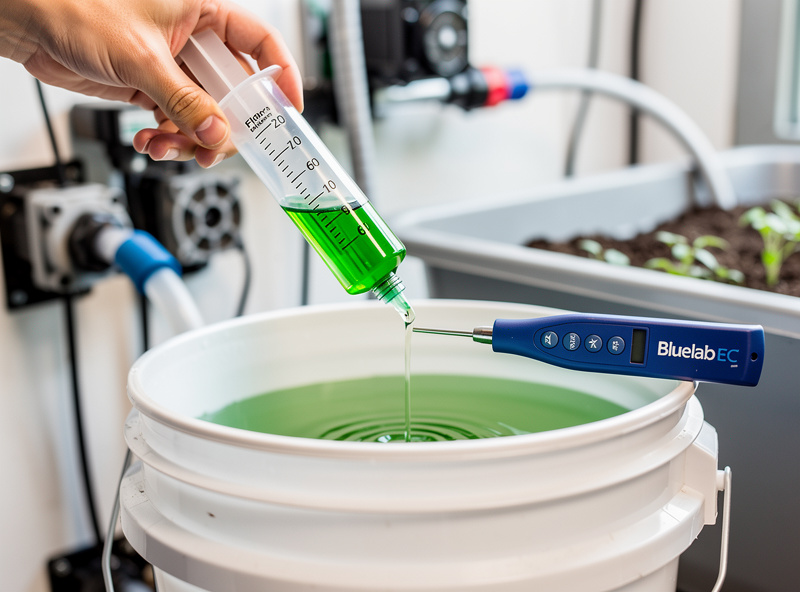
The reservoir build is straightforward. Fill the reservoir with the planned water volume; if your tap water is hard, off-gas chlorine for 24 hours or use a dechlorinator. Test starting EC and pH with a calibrated meter — the Bluelab Truncheon is the gold-standard EC pen. Add FloraMicro at the dose for your stage, stir 30 seconds, wait 2 minutes. Repeat with FloraGro, then FloraBloom. Confirm EC is in range, then adjust pH to 5.5 to 6.5 with a pH control kit — see pH Down for plants for the drop-by-drop math.
For a full walkthrough with measuring syringe technique and crop-specific ratios, see how to mix hydroponic nutrient solution.
The Lucas Formula — A 2-Bottle Variant
The Lucas formula is a community-developed Flora Series variant that uses only FloraMicro and FloraBloom at a fixed 8 ml and 16 ml per gallon throughout the entire crop cycle. FloraGro is skipped entirely. It traces back to grower forum posts from the mid-2000s and has stayed in circulation as one of the most-repeated recipes in the hobby ever since — I keep it mixed for the one DWC bucket I run as a lazy-Sunday control against whatever schedule I’m actually testing that season.
The advantage is simplicity — two bottles, one ratio, no schedule changes — and the trade-off is the loss of fine ratio control. In my own bench comparisons the gap versus a properly staged 3-part schedule is small on a single crop cycle and would only start to matter at commercial scale where every percent of yield is money. For a single DWC bucket, Lucas gets you most of the result the full schedule would with a fraction of the measuring and label-checking.
If you’re on hard water, run Lucas with FloraMicro Hardwater instead of the original — the dose stays the same, 8 ml Micro and 16 ml Bloom per gallon. You’re swapping the bottle, not scaling the recipe.
Adjusting the Schedule for Specific Crops
The official feeding chart is calibrated for medium-feeding fruiting crops. Real crops vary, and adjusting the schedule for the plant you are actually growing improves yields more than any supplement will.
Lettuce and leafy greens stay at the early vegetative ratio (3-3-1 ml/gal) for the entire crop, targeting EC 0.8 to 1.0 — pushing higher burns root tips within 48 hours. Tomatoes, peppers, and fruiting nightshades follow the full schedule with EC pushed to the upper end of each range during late bloom for maximum fruit size. Strawberries run early vegetative for 2 weeks, then jump to early bloom (2-10-10 ml/gal) and hold there because they crop continuously without a single transition point. Basil and hardier herbs hold the late vegetative ratio (6-6-2 ml/gal) throughout and tolerate EC up to 1.5 for stronger flavor.
Most Flora Series failures come from running the wrong schedule for the crop — lettuce at bloom-stage EC will burn, tomatoes at vegetative ratios through fruit set will be weak and undersized.
When to Switch to FloraNova or Another Product
The Flora Series rewards full ratio control across the crop life cycle. For single-crop systems that stay in one stage (lettuce, herbs only), FloraNova Grow alone gives identical results with one-third the measuring time. For budget operations with reservoirs of 50 gallons or more, MaxiBloom dry powder delivers comparable results at a noticeably lower per-gallon cost once you’re mixing at volume.
If you are getting inconsistent results despite correct mixing, the problem is almost never the Flora Series itself — check pH stability, EC drift, and reservoir temperature first, which is where I go first on my own bench before I ever suspect the bottles. My guide to common hydroponic mistakes that kill plants covers the diagnostic sequence. For brand alternatives, my roundup of the best hydroponic fertilizer for 2026 compares Jacks 321, Athena Pro Core, and Botanicare CNS17 Grow head-to-head.
Next Steps
The Flora Series rewards growers who actually use the ratio control. If you are buying three bottles and mixing them at the same ratio across the entire crop, switch to FloraNova or MaxiBloom and save the bottle space. If you will follow the schedule and adjust for your specific crop, the Flora Series matches anything else on the market.
For broader product context, my General Hydroponics complete brand guide compares Flora Series to FloraNova, MaxiSeries, and the supplement lineup. To know what to plant in your Flora-fed system, my list of the 15 best plants for hydroponic growing shows you what works fastest.
Frequently Asked Questions
What is the correct mixing order for GH Flora Series?
FloraMicro first, FloraGro second, FloraBloom last. Mixing out of order causes calcium to react with phosphates and precipitate as a chalky white sediment that locks calcium out of plant uptake. Add each bottle to a full reservoir of water with 30 seconds of stirring between additions.
How much FloraGro, FloraMicro, and FloraBloom should I use per gallon?
For early vegetative growth, use 3 ml of each bottle per gallon. For late vegetative, 6 ml of each. For peak bloom on fruiting crops, use 0 ml FloraGro, 12 ml FloraMicro, and 12 ml FloraBloom. Lettuce and leafy greens stay at 3-3-1 ml per gallon for the entire crop cycle.
What is the Lucas formula?
The Lucas formula uses only two Flora Series bottles — 8 ml FloraMicro and 16 ml FloraBloom per gallon — throughout the entire crop cycle. FloraGro is skipped. The formula trades fine ratio control for simplicity, and on hard water you swap in FloraMicro Hardwater at the same 8 ml and 16 ml dose rather than scaling the amounts up.
Do I need Hardwater FloraMicro?
Yes if your tap water tests above 200 PPM background hardness or above roughly 70 PPM calcium. Regular FloraMicro on hard water stacks too much calcium into the reservoir and locks out potassium. The Hardwater variant cuts calcium sharply, from about 5% in the regular formula to about 1%. Test your tap water with an EC pen before deciding which version to buy.
Can I use the Flora Series in soil?
Yes, at half the recommended hydroponic dose. Soil already supplies calcium and magnesium, so heavy hydroponic feeding can cause lockout. Most growers stay with the Flora Series only in hydroponic and coco systems where it was designed to perform.
How long does mixed Flora Series solution last?
In a clean covered reservoir with active aeration and stable pH, mixed Flora Series solution stays usable for 10 to 14 days. Without aeration or in warm conditions above 75 degrees Fahrenheit, expect 5 to 7 days before bacterial growth and pH instability force a reservoir change.