Walk into any conversation about grow lights and you’ll hit the spectrum debate fast: those old purple “blurple” panels that flood a room with red and blue, versus the newer white full-spectrum fixtures that look like daylight. It’s a genuinely interesting argument, rooted in real plant science, and it’s one I’ve settled for myself by growing the same crops under both on my bench. The short version: full-spectrum white wins for almost every hydroponic grower, but the reasons are more nuanced than “newer is better.”
The whole thing traces back to a piece of textbook biology that got over-applied. Chlorophyll absorbs most strongly in the red and blue bands, so early LED makers reasoned that a light delivering only red and blue would be maximally efficient — all the photons the plant “uses,” none wasted. That logic produced the blurple generation, and it’s not wrong so much as incomplete. Real plants are more complicated than a chlorophyll absorption chart, and once I watched them grow side by side, the gaps in that reasoning showed up clearly.
Why Red and Blue Aren’t Enough
Red light drives photosynthesis and flowering response efficiently, and blue light keeps plants compact and promotes sturdy vegetative growth — both genuinely important, which is why blurple panels do grow plants. The problem is what they leave out. Green light, long dismissed as “wasted” because leaves reflect a lot of it, actually penetrates deeper into the canopy than red or blue and drives photosynthesis in the lower and inner leaves that the top wavelengths never reach. On a dense crop, that deeper penetration is the difference between a plant that photosynthesizes throughout and one that only works at the surface.
There’s more to plant light response than raw photosynthesis, too. Plants read the ratio of wavelengths to make developmental decisions — far-red and the red-to-far-red balance influence stem extension and flowering signals in ways a crude red-blue mix handles poorly. A full spectrum gives the plant the complete signal set it evolved under, and in my side-by-side runs the full-spectrum plants simply come out sturdier and better-proportioned. This deeper-canopy advantage is exactly why I called full-spectrum the default in my main grow lights guide.
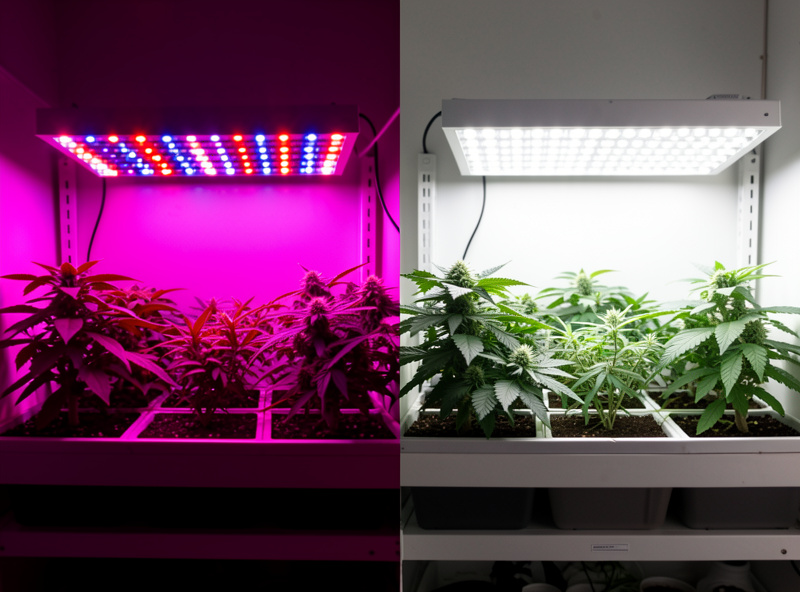
What I Actually Saw Growing Both Side by Side
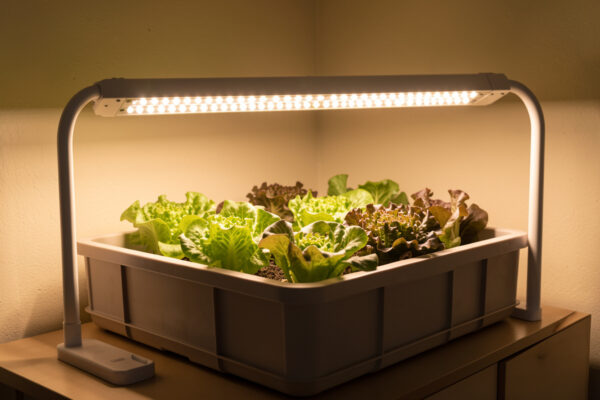
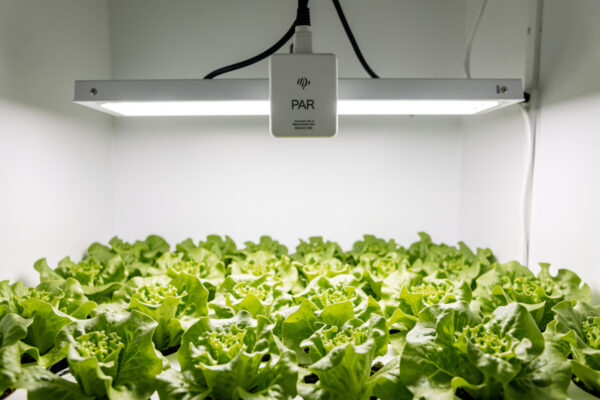
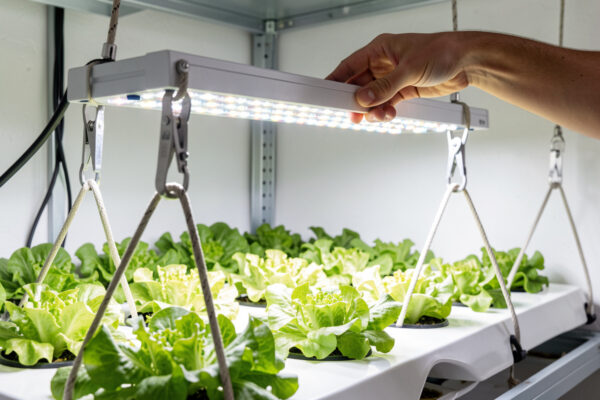
Theory is one thing; the bench is another. When I ran the same lettuce and basil under a blurple panel and a quality full-spectrum white at matched PPFD, the differences weren’t subtle once the plants matured. The full-spectrum plants were more compact and even, with shorter internodes and a denser, deeper-green canopy. The blurple plants grew — they weren’t failures — but they tended toward a slightly stretchier, looser habit and a thinner lower canopy, which fits exactly what you’d predict from poorer light penetration into the inner leaves.
The other thing I noticed was consistency across the tray. Because the white fixture’s broader spectrum penetrated better, the plants toward the center and lower down kept pace with the tops, whereas under blurple the lower leaves on a dense head lagged. For leafy greens where you’re eating the whole plant, an evenly photosynthesizing canopy isn’t a luxury — it’s yield. None of this is exotic; it’s the predictable result of giving the plant the full signal set instead of two narrow bands, and it’s why I never went back to magenta after the comparison.
The Practical Advantage Nobody Talks About: You Can See
Here’s the benefit that doesn’t show up on any spectral chart but matters every single day: under white full-spectrum light, you can actually see your plants. Under a blurple panel, everything is a uniform magenta haze, and that’s not a cosmetic complaint — it’s a diagnostic blind spot. The first yellowing of a nutrient deficiency, the first dusty speck of powdery mildew, the subtle color shift that warns of trouble in the reservoir — all of these are visible days earlier under natural white light and nearly invisible under magenta.
I catch problems early because I can read my plants, and you can’t read what you can’t see. For a measurement-driven grower, having the canopy lit in honest color is as valuable as any spectral nicety. It’s the same reason I switched off HPS, whose sodium-orange glow has the identical inspection problem — a point I make in my LED versus HPS comparison.
Where Red-Blue Still Earns Its Place
I won’t dismiss red-blue entirely, because it does have a narrow legitimate niche. For pure seedling and propagation light — where the goal is just to keep cuttings and starts ticking over cheaply before they go under the main fixture — a basic red-blue panel is inexpensive and adequate. Some growers also use targeted supplemental red or far-red alongside a full-spectrum fixture to nudge a specific response, which is a deliberate, knowledgeable use rather than a blanket grow strategy.
But “cheap seedling light” and “expert supplemental tweak” are the two real cases, and neither is “the main light for your hydroponic crop.” If you’re buying one fixture to grow a tote of lettuce or a tray of herbs from seed to harvest, full-spectrum white is the answer.
It’s worth being honest about why the blurple myth persisted as long as it did: those panels are genuinely cheaper to manufacture, and “only the wavelengths plants use” is a tidy marketing story that sounds efficient. For years the price gap was real and the early white horticultural LEDs weren’t great, so the trade-off was defensible. That’s no longer true — quality full-spectrum fixtures have come down in price and up in efficacy, and the small premium over a blurple panel buys you better growth, deeper canopy penetration, and the ability to actually inspect your plants. The economics that once justified red-blue as a main light have quietly evaporated. I lean on the spectrum thinking I worked out in my dual-use spectrum write-up when I want one light to do both jobs.
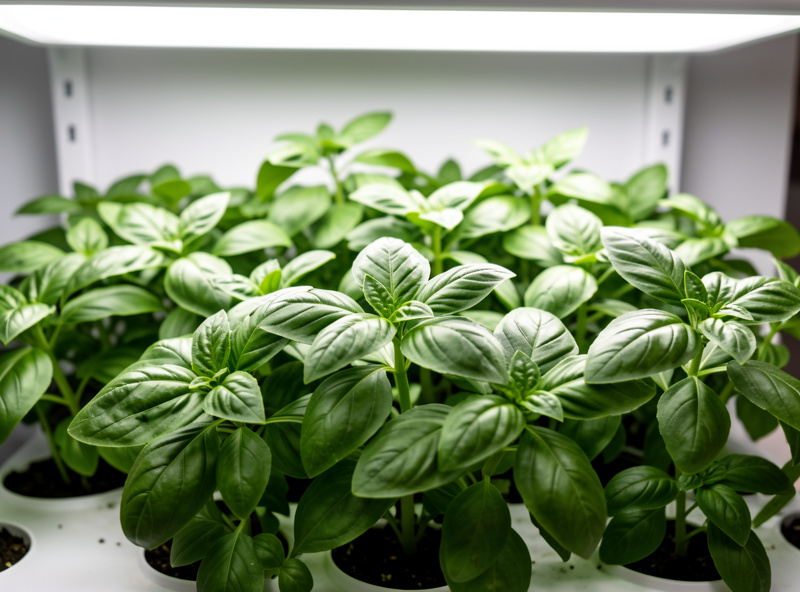
What “Full-Spectrum” Actually Means When You Buy
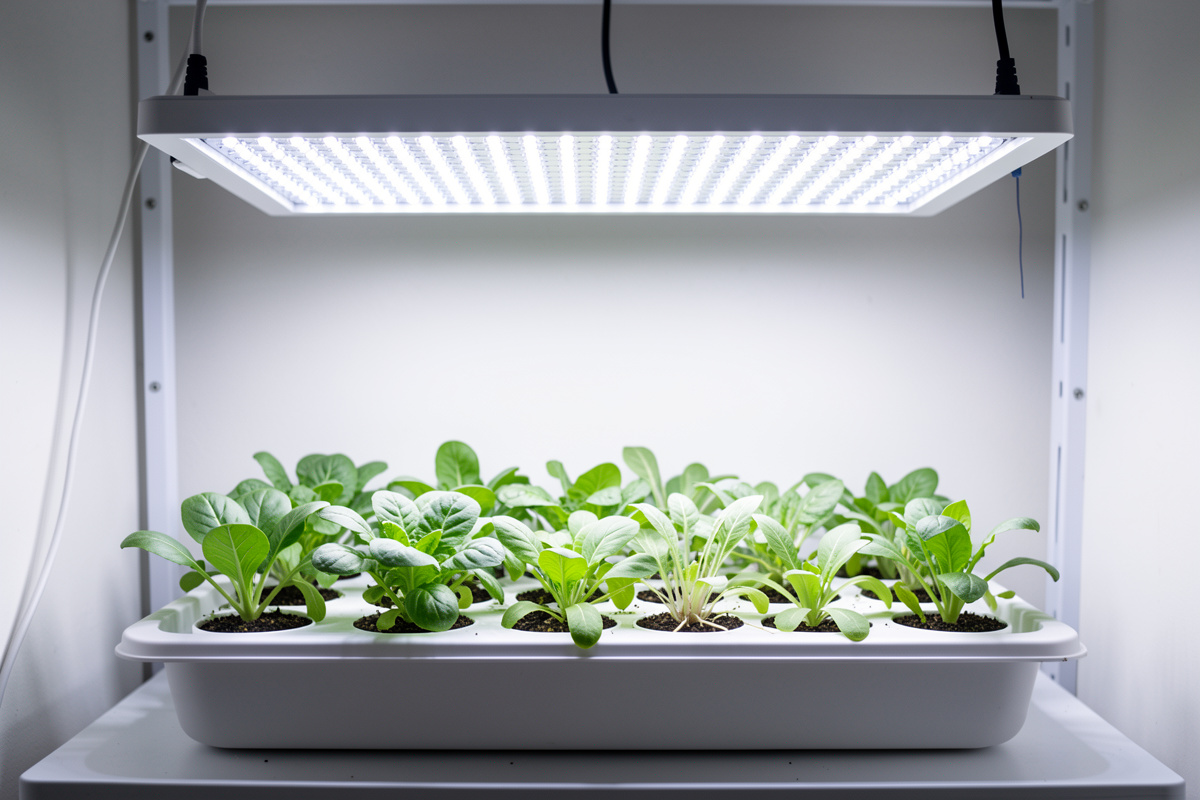
One caution: “full-spectrum” is a marketing term as much as a technical one, and not all white LEDs are equal. A quality full-spectrum fixture uses high-CRI white diodes — often warm white in the 3000K to 3500K range — frequently with supplemental deep red added to boost the photosynthetic punch. That combination delivers the broad, natural spectrum plants want plus the red weighting that drives growth. Cheaper “white” panels can be thin and cool-toned, missing the red they need.
Don’t buy spectrum on the word alone — look for a published spectral chart and, ideally, the efficacy figure in micromoles per joule. As always on my bench, the number is the honest part and the adjective is the marketing. Get a genuine full-spectrum white fixture with good efficacy, and the old red-blue debate stops mattering: you’ll have the complete light your plants evolved under, and you’ll be able to watch them thrive in honest color.
One thing worth understanding about the white-LED spectrum is where the red comes from. A white LED is actually a blue diode with a phosphor coating that converts some of that blue into the broader visible band, which is why pure white LEDs can run a little light on deep red — the wavelength plants lean on hardest for photosynthesis and flowering. That’s why the better horticultural fixtures don’t stop at white diodes; they pepper in dedicated deep-red emitters around 660 nanometers to top up exactly the band the phosphor under-delivers. When you see a “full-spectrum” panel with a faint pink cast to its white, that’s usually the deep-red supplementation doing its job, and it’s a feature, not a flaw. It’s the engineered middle ground between the crude all-red-and-blue blurple and a too-cool plain white — the complete spectrum, weighted the way plants actually want it.
Frequently Asked Questions
Is full-spectrum or red-blue light better for hydroponics?
Full-spectrum white light is better for almost all hydroponic growing. It penetrates the canopy more deeply, gives plants the complete developmental signal they evolved under, and lets you inspect for problems in natural color. Red-blue is now mainly a budget seedling option.
Why do plants need green light if they reflect it?
Plants reflect some green light, but the rest penetrates deeper into the canopy than red or blue and drives photosynthesis in lower and inner leaves. On a dense crop, that deeper penetration meaningfully improves overall growth compared with a red-blue-only spectrum.
What is wrong with blurple red-blue grow lights?
Blurple panels grow plants but leave out wavelengths that aid canopy penetration and development, and their magenta glow makes it nearly impossible to spot early deficiencies, pests, or disease. You catch problems much later when you cannot see your plants in natural color.
When should I use a red-blue grow light?
Red-blue panels make sense as a cheap seedling or propagation light, and experienced growers sometimes add targeted red or far-red to supplement a full-spectrum fixture. As the sole light for a full hydroponic crop, full-spectrum white is the better choice.
Are all full-spectrum LED lights the same?
No. Quality full-spectrum fixtures use high-CRI warm-white diodes, often with supplemental deep red, while cheaper white panels can be thin and cool-toned. Look for a published spectral chart and an efficacy figure in micromoles per joule rather than trusting the label alone.