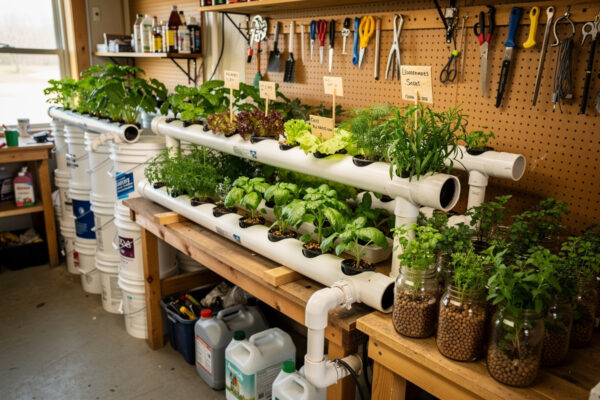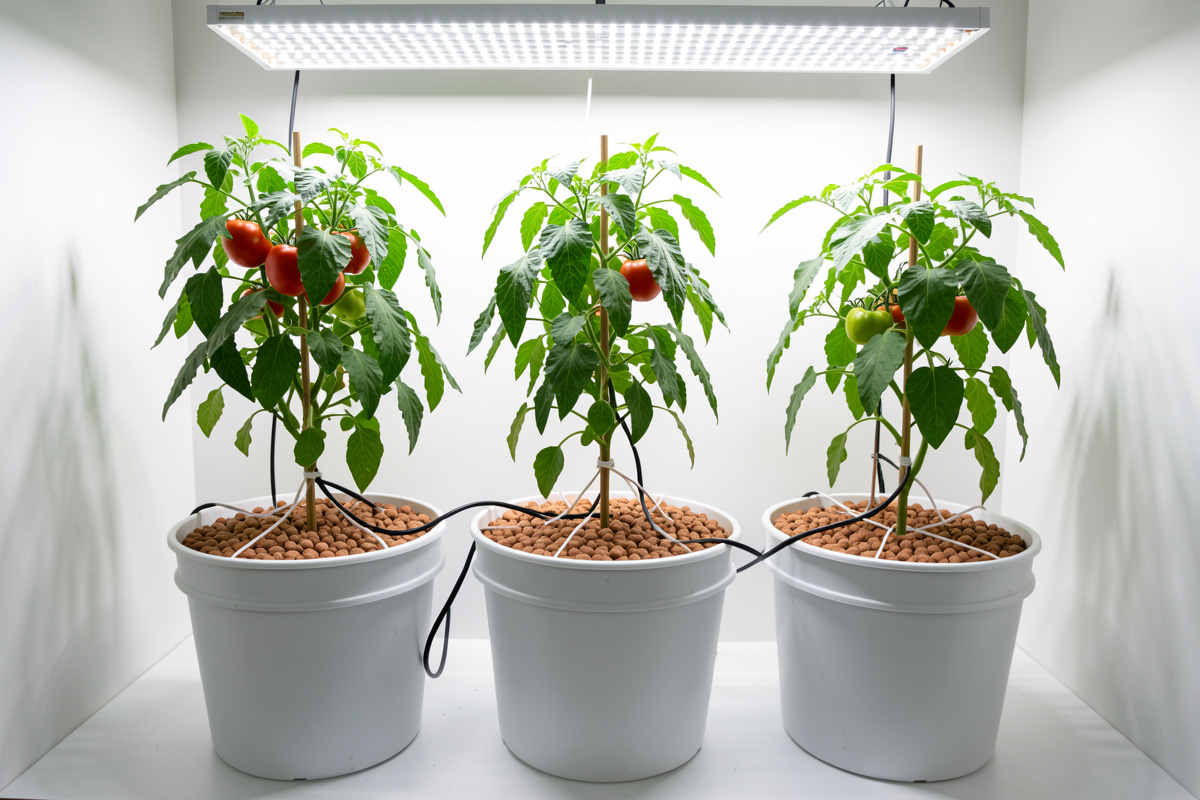
A 5 gallon bucket hydroponics system turns a standard hardware-store bucket into a deep water culture or drip reservoir big enough to grow a full tomato or pepper plant to harvest. At $30 to $60 a bucket, it is the cheapest way to grow heavy fruiting crops without soil, and the extra volume is exactly what makes it more forgiving than a small tub.
I run several of these alongside my smaller buckets because five gallons is a genuine sweet spot: large enough to buffer the EC and temperature swings that wreck a jar, small enough to lift, drain and tuck under a light. This guide covers the three ways to build one — single DWC, recirculating multi-bucket, and the Dutch bato drip style — and which to pick for what you want to grow.
Why five gallons is the right size
The magic of a bigger reservoir is stability. A large fruiting plant can drink a litre or more of water a day at peak, and as it pulls water out, the nutrient concentration in what is left climbs. In a one-gallon container that swing is violent — the EC can lurch upward between morning and evening. In five gallons, the same draw barely moves the needle, so the plant lives in a steadier chemistry and you check it less often.
The same buffering applies to temperature. A small container of water tracks room temperature fast, spiking past the danger zone on a warm afternoon; five gallons has the thermal mass to ride those swings out. That matters because warm water is where root rot starts — I keep any bucket below 68°F and treat 72°F as the line, with the full controls in the water temperature guide. The general rule of thumb for sizing is covered in how big a reservoir should be, and this build sits inside the wider DIY hydroponic builds guide.
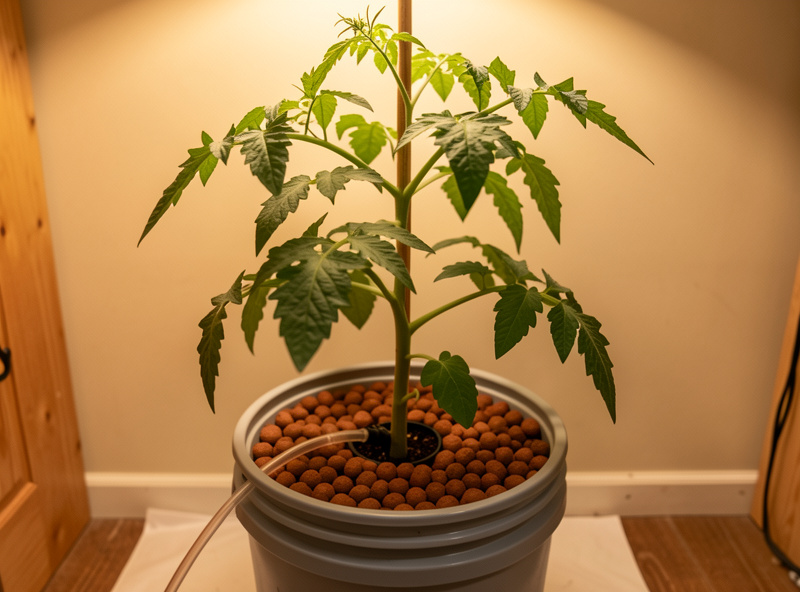
The three ways to build a 5-gallon bucket system
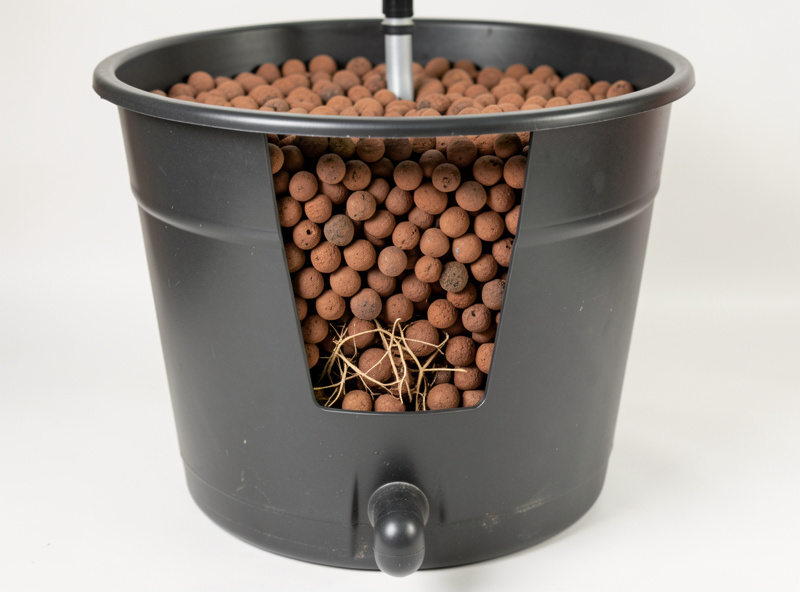
There is no single right build — there are three, and they suit different goals. A single DWC bucket is the simplest. A recirculating deep water culture (RDWC) system links several buckets to one reservoir so they all share the same water. A Dutch, or bato, bucket fills with clay pebbles and uses a top drip feed with a siphon drain, which suits very large, top-heavy plants. Here is how they compare.
| Build | How it works | Best for | Effort |
|---|---|---|---|
| Single DWC | One bucket, air stone, roots in water | One or two big plants | Lowest |
| Recirculating DWC | Several buckets share one reservoir | A row of matched plants | Medium |
| Dutch / bato bucket | Clay pebbles, top drip, siphon drain | Large vining tomatoes, peppers | Medium |
If you are building your first one, start with a single DWC bucket — it is the same principle as the smaller DIY DWC bucket, just sized up for a heavier crop. The Dutch bucket is a step toward a drip system and is covered in depth in the Dutch bucket guide; it shines when a plant gets too big and heavy for bare roots in water to support.
Building a single 5-gallon DWC bucket
The build mirrors a small DWC bucket with a few sizing changes. Cut a hole in the lid for a wide net pot — I use a larger 5- or 6-inch net pot for big plants so the root crown has room. Drop an air stone in the bottom, run tubing to an air pump sitting above the bucket, and fill with nutrient solution so the bottom of the net pot just sits in the water at transplant. Pack clay pebbles around the seedling for support, because a tomato will eventually need a stake driven down past the bucket or a trellis overhead.
You can build the whole thing from a bucket, a lid, a net-pot lid kit and an air pump — find a 5-gallon bucket net-pot lid kit on Amazon to skip cutting the lid yourself. As an Amazon Associate I earn from qualifying purchases. Size the air pump up for the larger volume; a big plant in five gallons wants vigorous bubbling to keep the dissolved oxygen high around a heavy root mass.
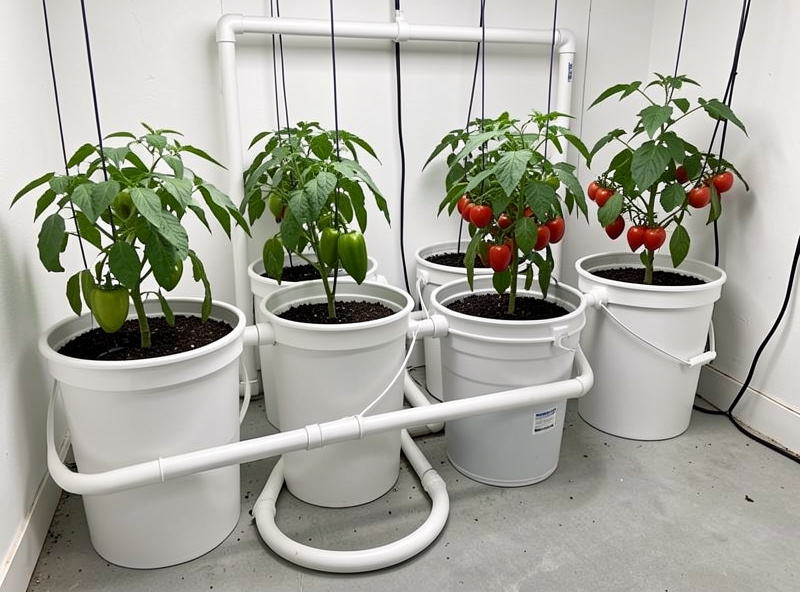
Scaling to a recirculating multi-bucket system
Once you want a row of plants, linking buckets makes life easier. In a recirculating DWC system, each bucket connects near the base to a common manifold, and a central reservoir with one pump keeps every bucket at the same level and the same chemistry. You mix nutrients once, you check EC and pH once, and you change the water once — instead of repeating it bucket by bucket. It is the single biggest labour saver when you grow more than two or three plants.
The trade-off is that a shared reservoir shares its problems too: a pathogen or a pH mistake reaches every plant. I run an air stone in each bucket as well as the circulation so oxygen stays high throughout, and I keep the central reservoir cool and clean. For why oxygen is so central to a big-root build, the mechanics are in the broader reservoir and dissolved-oxygen guides linked from the hub.
Running fruiting crops: EC, pH and support
Fruiting crops feed harder than greens, so the numbers climb. I start tomato and pepper seedlings around 1.4 mS/cm EC and work up to roughly 2.0 to 2.4 as they flower and fruit, holding pH between 5.5 and 6.0 throughout. I mix to those targets with a calibrated EC meter rather than guessing, because a heavy feeder punishes both under- and over-feeding. As always I change the reservoir on a schedule rather than just topping off, so the nutrient ratios stay balanced.
The other thing big plants need that greens do not is structural support. A fruiting tomato in a bucket gets tall and heavy, so plan the stake or trellis before you transplant, not after the vine flops. A stake driven through the clay pebbles to the bottom of the bucket, or a string trellis anchored overhead, keeps the plant upright through a months-long run. Get the support and the feed right and a single 5-gallon bucket will carry a tomato from seedling to a full season of fruit.
Sourcing buckets and avoiding the common mistakes
Not every 5-gallon bucket belongs around food crops. Use food-grade buckets — the kind that held frosting, pickles or other food, often stamped with a cup-and-fork symbol or a food-safe resin code — rather than ones that carried adhesives, paint or unknown chemicals. They are cheap and widely available from bakeries and restaurants, often free, and they spare you any worry about what is leaching into water that grows what you eat. Whatever the bucket held, it must end up opaque; light through the wall grows algae in the solution just as it does in any reservoir.
The two mistakes I see most are both about scale. The first is running too small an air pump for the volume — a big plant in five gallons needs vigorous aeration, and a weak pump leaves the deep water under the root mass stagnant. Size the pump up. The second is leaving support until the plant is already heavy; by then the stem has set and forcing it upright tears roots. Drive the stake or hang the trellis at transplant. I learned that one on my first bucket tomato — I left the stake until the vine had already flopped, and driving it in late tore roots and set the plant back a couple of weeks. Fix those two and a 5-gallon bucket is one of the most reliable producing systems you can build for the money.
Frequently Asked Questions
What can you grow in a 5-gallon bucket hydroponic system?
A 5-gallon bucket suits large fruiting and vining crops: tomatoes, peppers, cucumbers, and a single large plant per bucket. The volume buffers EC and temperature swings that a smaller container cannot, which is why it handles heavy feeders well.
Is a 5-gallon bucket big enough for a tomato?
Yes. Five gallons holds enough nutrient solution to carry one tomato plant through a full season, and the volume keeps the EC and temperature stable as the plant drinks heavily. Add a stake or trellis, since a fruiting tomato gets tall and heavy.
How many plants per 5-gallon bucket?
One large fruiting plant per bucket is the rule, such as a single tomato or pepper. You can grow a small cluster of leafy plants in one bucket, but big vining crops each need their own bucket so the roots and the water supply are not shared.
What EC should a 5-gallon bucket run for fruiting crops?
Start fruiting seedlings around 1.4 mS/cm and work up to roughly 2.0 to 2.4 mS/cm as they flower and fruit, holding pH between 5.5 and 6.0. Mix to those targets with a calibrated EC meter rather than measuring nutrients by the capful.
What is the difference between a DWC and a Dutch bucket?
A DWC bucket suspends bare roots in aerated water. A Dutch or bato bucket fills with clay pebbles and uses a top drip feed with a siphon drain, so the roots sit in moist media instead of standing water. Dutch buckets suit very large, top-heavy plants.