Hydroponic pests and diseases fall into two camps: water-borne root pathogens like Pythium that you fight with oxygen, cool reservoir temps, and clean process, and airborne pests like spider mites and fungus gnats that you fight with scouting, sticky traps, and targeted controls. Get the reservoir right and you prevent 80% of the trouble before it starts.
After running DWC, NFT, Kratky, and ebb-and-flow side by side for years, I can tell you the failure modes are predictable and the fixes are mostly about discipline, not chemistry. Soilless growing removes the soil-borne pest pressure that plagues dirt gardeners, but it hands you a warm, nutrient-rich, oxygenated tub of water that a handful of specific organisms absolutely love. This guide maps every common hydroponic pest and disease to its real cause and the control that actually works on my bench, with the dilution rates and reservoir targets I dial in rather than the vague “treat as needed” you see everywhere else. For the broader picture of where these problems sit, start with my guide to the most common hydroponic mistakes, then come back here for the pest-and-disease deep dive.
The Two Failure Modes: Root Pathogens vs Foliar Pests
Every hydroponic problem is either below the waterline or above it. Root-zone pathogens (Pythium, fungal root rot, slimy biofilms) thrive in warm, low-oxygen water and kill from the roots up. Foliar pests (spider mites, fungus gnats, aphids, whitefly) and airborne fungal diseases (powdery mildew, downy mildew) attack the canopy. The single biggest lever for the below-the-waterline group is reservoir temperature.
Here is the line I draw in my res logs: keep root-zone water at or below 68°F (20°C) and dissolved oxygen stays high enough that Pythium can’t get a foothold. Let it climb past 72°F (22°C) and dissolved oxygen falls off a cliff while pathogen reproduction accelerates — that combination is what actually rots roots, not “dirty water” in the abstract. Above the waterline, the rule is humidity and airflow: stagnant, 70%-plus humidity air is what lets powdery mildew and gnats establish. Diagnose which side of the waterline you’re on first, because the controls do not transfer between them.
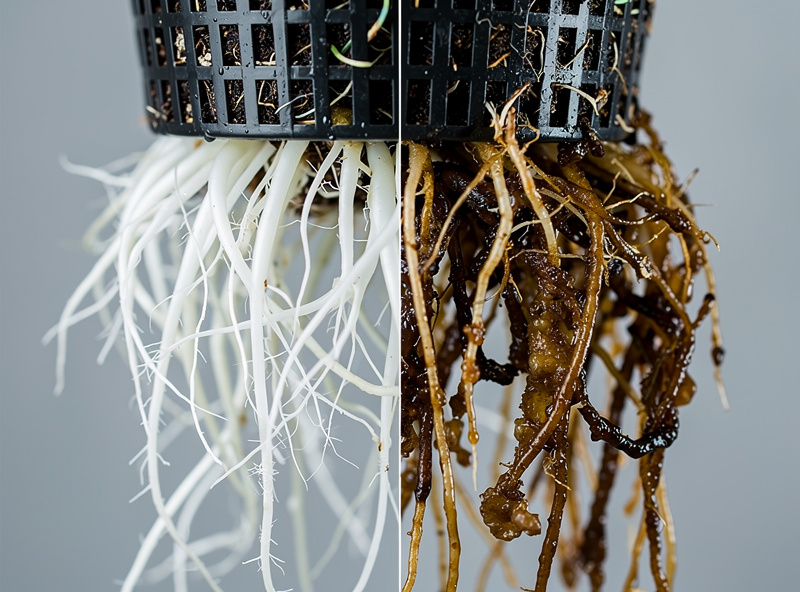
Hydroponic Pest and Disease Diagnosis Table
Use this as your triage chart. Match the symptom to the most likely cause, then jump to the section or linked guide for the full control protocol. The biggest diagnostic mistake is treating a nutrient deficiency as a disease — the table separates the two so you don’t dump fungicide on a plant that just needs more iron.
| Problem | Key Symptom | Real Cause | First-Line Control |
|---|---|---|---|
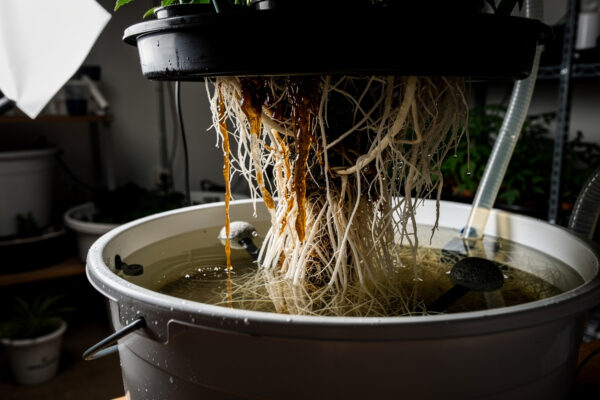
| Pythium / root rot | Brown, slimy roots; wilting in good light; rotten-egg smell | Reservoir above 72°F, low dissolved oxygen | Chill res below 68°F, add air stones, dose beneficial bacteria |
| Algae | Green slime on res walls, lids, and media surface | Light reaching the nutrient solution | Block all light: opaque res, cover net-pot collars |
| Fungus gnats | Tiny black flies around the base; larvae in media | Damp media surface, organic matter, algae | Yellow sticky traps plus BTI (mosquito bits) |
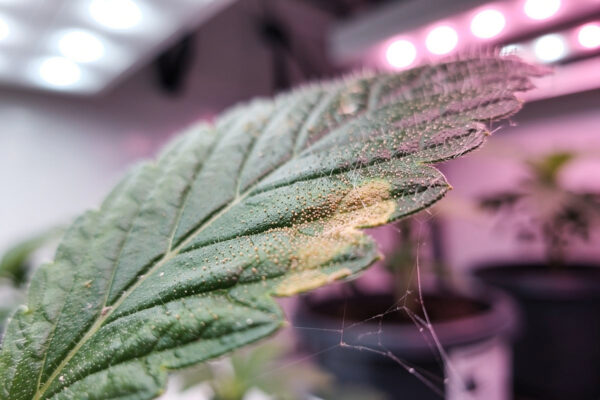
| Spider mites | Fine stippling on leaves, webbing on undersides | Hot, dry air below 50% humidity | Raise humidity, spray undersides, release predatory mites |
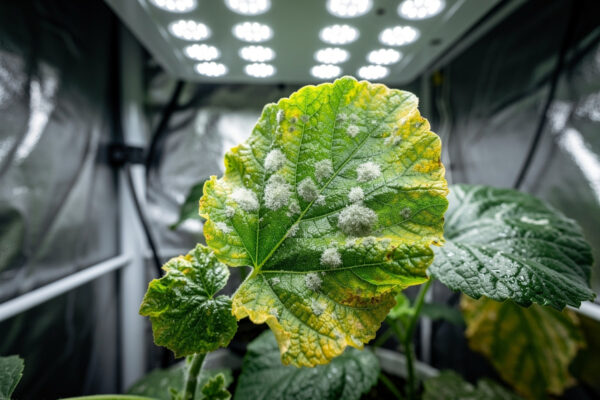
| Powdery mildew | White powdery patches on upper leaf surfaces | High humidity plus stagnant air | Improve airflow, potassium bicarbonate spray |
| Nutrient deficiency | Yellowing, spotting, or curling in a leaf pattern | Wrong EC, pH lockout, or missing element | Check pH 5.5–6.0, correct EC, fix the specific element |
| Aphids | Clustered soft green/black insects on new growth | Open windows, infested transplants | Knock off with water, insecticidal soap, ladybugs |
| Root aphids | Sudden vigor loss; waxy white specks on roots | Infested clones or media | Isolate, beneficial nematodes, full res sterilize |
Root Rot and Pythium: The Number One Killer
Root rot is the disease that ends more hydroponic grows than everything else combined. Pythium — an oomycete water mold, not a true fungus — takes hold when reservoir water runs warm and oxygen-starved, turning firm white roots brown, mushy, and foul-smelling within days. The tell I trust most is a plant wilting at midday despite a full reservoir: the roots can no longer move water even though it’s right there.
Prevention beats cure every time here. I keep dissolved oxygen high with air stones running 24/7, hold the reservoir below 68°F (a water chiller earns its cost in a Nordic summer when room temps still spike), and dose a beneficial Bacillus inoculant on every res change so the good microbes colonize the root surface before Pythium can. If rot has already started, a controlled hydrogen peroxide flush buys you time — about 2–3 mL of 3% hydrogen peroxide per liter (roughly 1 to 1.5 teaspoons per gallon) added to fresh solution — but understand it kills your beneficials too, so you re-inoculate afterward, never run peroxide and live bacteria together. The full diagnosis-and-rescue protocol lives in my dedicated guide to hydroponic root rot.
Algae in the Reservoir: Annoying, Rarely Fatal
Algae is the most common thing new growers panic about and the least dangerous. That green or brown slime on res walls, lids, and exposed media is just photosynthetic growth that appears anywhere light hits nutrient-rich water. It won’t kill plants directly, but it competes for dissolved oxygen and nutrients, fouls pumps and air stones, and — the real problem — it feeds fungus gnat larvae.
The fix is embarrassingly simple: algae needs light, so take the light away. Run opaque reservoirs, cover any clear tubing, and shade the gap around net-pot collars where light sneaks in (3D-printed collar caps are my go-to here). For an existing bloom, scrub the surfaces at your next res change and the problem rarely returns once light is blocked. I avoid throwing algaecide or excess hydrogen peroxide at a cosmetic issue — light discipline solves it for free. My full guide to algae in hydroponics covers clearing an existing bloom and sealing every light leak.
Fungus Gnats: Small Flies, Real Root Damage
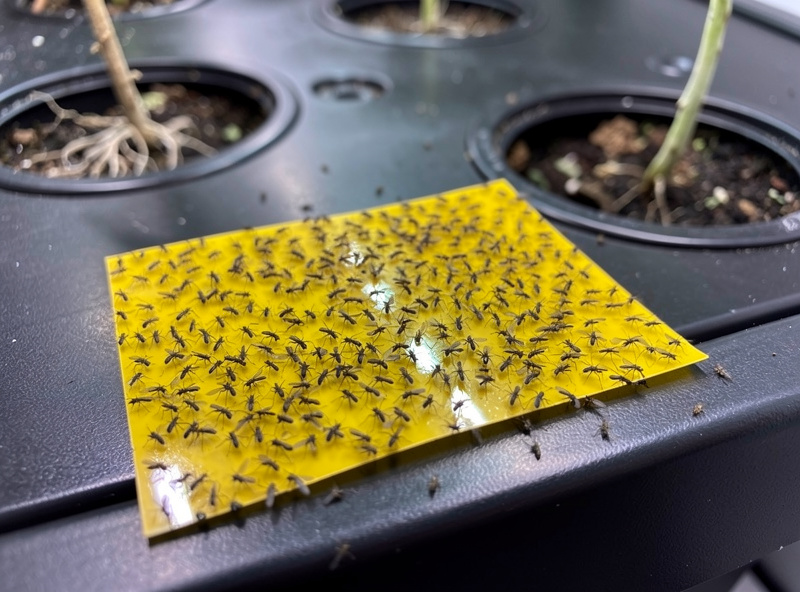
Fungus gnats are those tiny black flies that bounce around the base of your plants and across the reservoir lid. The adults are a nuisance, but the larvae in the media are the actual threat — they feed on root hairs and fine feeder roots and can open wounds that let Pythium in. They breed wherever the media surface stays damp and organic matter (or algae) is available, which is why a gnat problem and an algae problem usually arrive together.
I attack them on two fronts at once. Yellow sticky traps laid flat near the base catch the egg-laying adults and double as my early-warning monitor — the trap count tells me whether I’m winning. For the larvae, BTI (Bacillus thuringiensis israelensis, sold as mosquito bits or dunks) steeped in the top-off water is the specific, plant-safe biological control; it kills larvae without touching the plant or your beneficial root bacteria. Beneficial nematodes (Steinernema feltiae) are the heavier-artillery option for a stubborn infestation. Let the media surface dry between top-ups and you remove their nursery entirely. My complete fungus gnats guide walks through the two-front attack in detail.
Nutrient Deficiencies That Masquerade as Disease
Half the “my plant has a disease” messages I see are actually nutrient deficiencies, and the cure is the opposite of a fungicide. Yellowing leaves, brown spots, purple stems, and curling edges are usually the plant telling you the EC is wrong, the pH has drifted out of range, or one element is locked out. The pattern matters: where the symptom appears (old leaves vs new growth) and how it looks (uniform yellowing vs spots vs interveinal striping) points to the specific element.
Before you treat anything as a pathogen, check the two numbers that govern uptake. Hold pH between 5.5 and 6.0 for most crops — outside that band, elements like iron, calcium, and magnesium lock out even when they’re present in the solution, producing deficiency symptoms in a perfectly fed plant. Confirm your EC matches the crop and stage so the plant is neither starved nor burned. A calibrated EC meter and disciplined pH management resolve more “diseases” than any spray bottle. My guide to identifying hydroponic nutrient deficiencies breaks down each element by leaf pattern. When you do need to feed, my step-by-step solution mixing guide and the full hydroponic nutrients reference cover dialing in to a target EC rather than guessing.
Powdery Mildew: The Humidity Disease
Powdery mildew shows up as dusty white patches on the upper surfaces of leaves, spreading fast in warm, humid, still air. It’s a true fungal disease and one of the few that’s airborne rather than water-borne, which means your spotless reservoir won’t protect the canopy. Indoor and greenhouse grows are prime habitat because we run warm and often let humidity creep up without enough airflow.
The first and best control is environmental: get air moving with an oscillating fan, drop humidity below 60%, and never let leaves sit wet overnight. For active infections, a potassium bicarbonate spray (more effective and less phytotoxic than baking soda) shifts leaf-surface pH against the fungus; about 1 teaspoon (roughly 5 grams) of potassium bicarbonate per liter of water with a drop of mild soap as a wetting agent is my working rate, applied with lights off to avoid leaf burn. Remove and bin the worst leaves rather than composting them indoors. Crucially, airflow is prevention you only pay for once — sprays are the recurring tax you pay for skipping it. See my full powdery mildew guide for the exact spray rates and humidity targets.
Spider Mites: The Pest You Find Too Late
Spider mites are the pest most growers discover only after the damage is done, because they’re nearly invisible until the population explodes. The first sign is fine pale stippling across the leaves, like someone dusted them with pinpricks; by the time you see the tell-tale fine webbing on leaf undersides, you have a serious infestation. They thrive in hot, dry air below 50% humidity, which makes winter indoor grows under lights a perfect breeding ground.
I scout for them with a loupe on the undersides of leaves weekly — catching them early is the whole game. Raising humidity and improving airflow makes the environment hostile to them. For control, a thorough neem oil spray works as a repellent and growth disruptor: about 1 teaspoon (5 mL) of cold-pressed neem oil plus a few drops of mild soap per liter of warm water, a roughly 0.5% solution, sprayed onto leaf undersides in the evening or with lights off so it doesn’t scorch foliage. For a real outbreak, predatory mites (Phytoseiulus persimilis) are the biological control that actually clears them — they eat the spider mites and then die off once the prey is gone. My dedicated spider mites guide covers early scouting and the full treatment cadence.

The Control Arsenal: What Each Tool Actually Does
There’s no single miracle product, but a small kit covers nearly every situation. The mistake is reaching for the wrong tool — spraying neem at root rot, or peroxide at a leaf pest. Here’s how I think about each one and where it belongs.
Beneficial bacteria (Bacillus amyloliquefaciens-based inoculants such as Hydroguard) colonize the root surface and crowd out Pythium — preventive, dosed at every res change, never alongside peroxide. 3% hydrogen peroxide is a short-term oxygen-boosting flush for an active rot at 2–3 mL per liter, but it’s a reset, not a maintenance additive, and it wipes your microbes. An inline UV sterilizer kills water-borne pathogens circulating in a recirculating system — powerful in larger NFT/DWC builds, overkill for a single Kratky jar, and note it also degrades chelated micronutrients, so size and run-time matter. Neem oil is your foliar all-rounder for mites, aphids, and gnats at roughly 0.5% with an emulsifier, lights off. Yellow sticky traps monitor and reduce flying adults. BTI is the fungus-gnat-larvae specific. A calibrated pH/EC meter is the diagnostic that prevents the deficiencies people misread as disease. Match the tool to the failure mode and you rarely need more than two at once.
Prevention First: The Clean-Process Approach
I treat my hydro reservoir the way I treat a sourdough starter — clean process beats fancy ingredients. The vast majority of pest and disease problems are prevented, not cured, and the prevention checklist is short and cheap compared to fighting an outbreak. Integrated pest management (IPM) in a soilless system comes down to denying organisms the conditions they need.
Sanitize between crops: empty, scrub, and wipe down totes, lids, pumps, and air stones so you’re not carrying a pathogen population forward. Quarantine new plants and clones for a week before they join the main grow — bought-in transplants are the most common way mites and root aphids enter a clean room. Block light from the reservoir to kill algae at the source. Keep res temperature down and dissolved oxygen up. Run airflow across the canopy and hold humidity in the 50–60% band. Scout weekly with a loupe and sticky traps so you catch problems while they’re still small. Build these into the routine and pest control stops being a fire drill. If you’re just setting up, my beginner’s guide and equipment buying guide bake these habits in from day one.
How Your System Choice Changes the Risk
The method you run shifts which problems you’ll face. Deep water culture keeps roots permanently submerged, so it’s the most exposed to Pythium if the water warms — oxygenation and temperature discipline are non-negotiable there. NFT’s thin film can dry and stress roots during a pump failure, and recirculating designs spread a pathogen system-wide fast, which is exactly where an inline UV sterilizer pays off. Kratky and other passive setups have no pump to fail but no way to add oxygen mid-grow either, so they live or die on getting the water level and air gap right from the start. Ebb-and-flow’s wet/dry cycling actually suppresses some root problems but the damp media surface invites fungus gnats.
None of this changes the foliar pests — mites and mildew don’t care how you deliver water — but it absolutely changes your root-zone strategy. Pick the controls that match your build rather than copying a protocol written for a different system. My full guide to hydroponic systems breaks down each method’s strengths, and the plant growing guide covers crop-specific susceptibility.
The Cold-Climate Indoor Angle
Growing indoors in Sweden taught me that the seasonal swing flips your pest profile twice a year. Winter under lights runs hot and bone-dry near the fixtures — prime spider mite weather — while the room itself is cold, so I’m fighting low canopy humidity and dry air. Then summer arrives and the same room spikes warm enough that reservoir temperature becomes the Pythium risk it never was in January. The lesson is that there’s no static “ideal” setup; you read the conditions and adjust. A water chiller that sits idle for nine months earns its keep in July, and a humidifier does the same in February. Whatever nutrient line you run — I lean on the General Hydroponics trio and the Flora series schedule, with organic options when I want them — clean process and good measurement matter more than the brand on the bottle.
Frequently Asked Questions
What is the most common disease in hydroponics?
Root rot caused by Pythium is the most common and most lethal hydroponic disease. It thrives when reservoir water rises above 72F and dissolved oxygen drops. Keep water below 68F, run air stones, and dose beneficial bacteria to prevent it.
How do I get rid of root rot in hydroponics?
Lower reservoir temperature below 68F, boost oxygen with air stones, and flush with 3% hydrogen peroxide at 2 to 3 mL per liter of fresh solution. Then re-inoculate with beneficial Bacillus bacteria, since peroxide kills both the pathogen and your good microbes.
How do I prevent algae in my hydroponic reservoir?
Algae needs light to grow, so block all light from the nutrient solution. Use opaque reservoirs, cover clear tubing, and cap the gaps around net-pot collars. With light blocked, algae rarely returns after a single cleaning at your next reservoir change.
Are hydroponic systems more prone to pests than soil?
No. Hydroponics eliminates most soil-borne pests and diseases. Indoor setups face fewer pests overall, but warm reservoirs invite Pythium and dry air under lights invites spider mites. The pest pressure is different, not necessarily higher, and prevention is straightforward.
What hydrogen peroxide concentration is safe for hydroponic roots?
Use household 3% hydrogen peroxide at about 2 to 3 mL per liter, roughly 1 to 1.5 teaspoons per gallon, in fresh nutrient solution. It is a short-term treatment, not a daily additive, and it kills beneficial bacteria, so re-inoculate after using it.
How do I tell a nutrient deficiency from a disease?
Deficiencies follow a leaf pattern tied to pH and EC, like interveinal yellowing or purple stems, and improve when you correct the solution. Diseases like root rot produce brown slimy roots or wilting. Check pH 5.5 to 6.0 and EC before assuming a pathogen.