If you want the short version: for hobby DWC the best air pump is a commercial-class linear-piston or dual-diaphragm pump that delivers at least 1 litre per minute of air per gallon of nutrient solution, driving a real air stone or disc diffuser through wide-bore tubing with a check valve on every line. On my bench that works out to roughly a 45–70 LPM commercial pump for a row of buckets, not the $12 aquarium pump the kits ship with.
I have run deep water culture as my daily workhorse for years, right alongside NFT, Kratky and an ebb-and-flow bed, and the single most common failure I see new growers hit is under-aeration. They buy a system, drop in the tiny pump that came in the box, and then wonder why the roots go brown and slimy in the first warm week. Aeration is the gear layer sitting underneath dissolved oxygen, and dissolved oxygen is what keeps a DWC root zone alive. This guide is the buyer’s map to that hardware: how to size a pump, which diffuser to run, how to split one pump across a bucket row, how to make it quiet, and how to plumb it so a power cut does not siphon your reservoir onto the floor.
Why Aeration Is the Real Engine of a DWC System
In deep water culture the roots hang in nutrient solution 24 hours a day, so the only oxygen they get is what is dissolved in that water. Warm water holds less of it: solution at 68°F (20°C) holds roughly 9 mg/L of dissolved oxygen at saturation, and by 77°F (25°C) that ceiling has dropped closer to 8 mg/L. Push it warmer and a dense root mass burns through the supply faster than still water can replace it. The air pump is what forces that replacement, hour after hour, whether you are watching or asleep.
People think of the air stone as the important part. It is not — the pump is. The stone only shapes what the pump gives it. A strong pump behind a mediocre stone still oxygenates; a strong stone behind a gutless pump does nothing but gurgle. Everything downstream in this cluster — sizing, diffuser choice, manifolds, silencing, tubing — assumes you started with a pump that can actually move air against the back-pressure of water depth. That is why the buying decision starts here, and why I treat the aquarium pump in the kit as a throwaway to be replaced, not a component to be trusted.
If you are still fuzzy on why roots need oxygen at all, I laid out the full picture in my guide to dissolved oxygen in hydroponics. This article is the hardware that delivers on it. And if DWC itself is new to you, start with the complete DWC bucket-and-bubbles guide so the terms below land.
The One Sizing Rule I Actually Use
The number I have settled on across the buckets I run is simple: 1 litre per minute (LPM) of air output per gallon of solution, minimum, with 1.5–2 LPM per gallon on anything fruiting or running warm. A 5-gallon DWC bucket wants 5 LPM of genuine output at the stone. A four-bucket row of 5-gallon totes wants a pump rated near 40–50 LPM once you account for the back-pressure and split losses across a manifold.
The trap is that pump ratings are measured at zero back-pressure, into open air. Sink an air stone under 8–10 inches of water and the real delivered volume drops, sometimes 20–30% on a weak diaphragm pump. That is why I buy with headroom and why the aquarium pump rated “up to 20 gallon tank” disappoints in a bucket — it was never rated against a column of water. I break the full LPH/LPM math down crop by crop in my dedicated air pump sizing guide, including the DWC-per-gallon rule I dial mine in with.
Pump Types: What You Are Actually Choosing Between
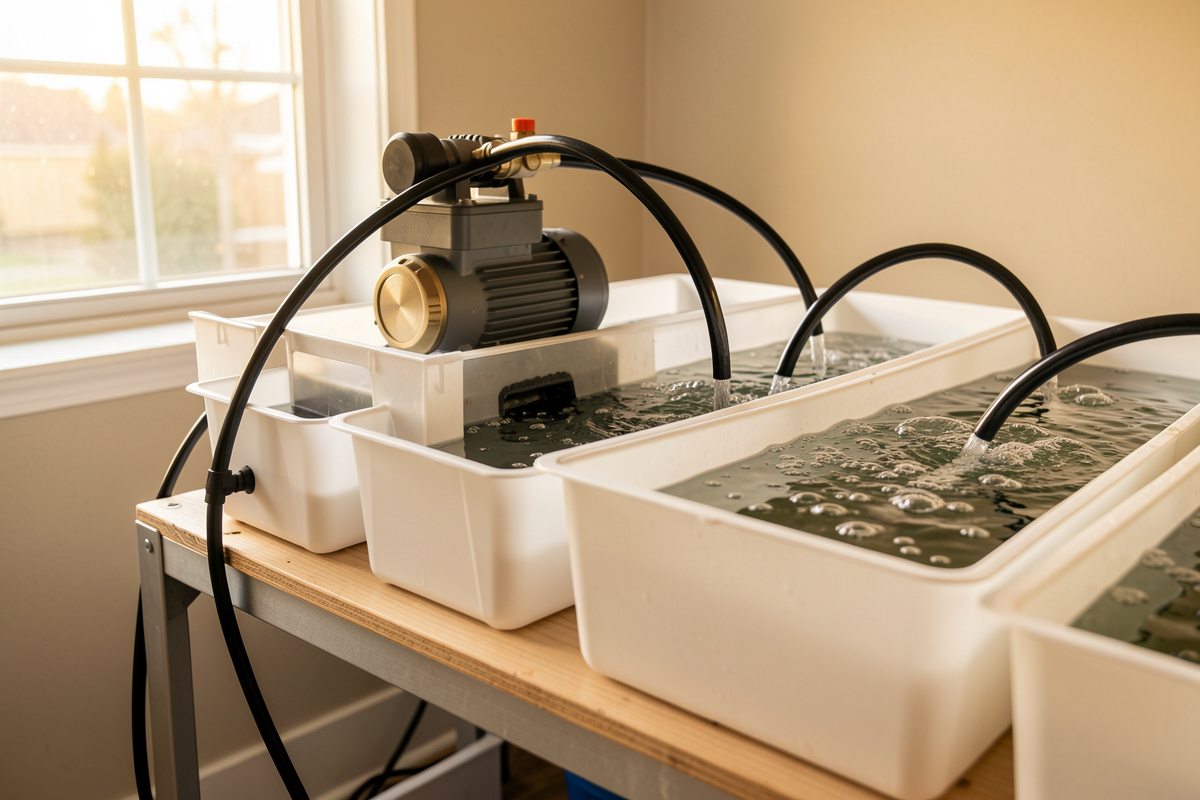
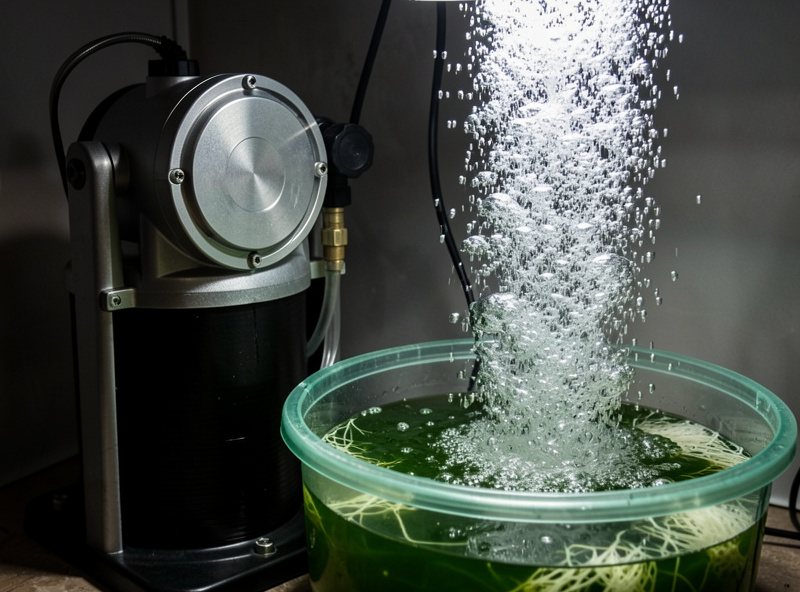
There are three families of air pump you will meet, and the price gaps between them tell you almost nothing about which suits a res. The cheap diaphragm pump vibrates a rubber membrane; the commercial linear-piston pump uses an electromagnetic rocker to drive one or two larger diaphragms; and the rotary-vane or regenerative blower sits at the commercial-greenhouse end and is overkill for a hobby bench. For hobby DWC you are really choosing between a good dual-diaphragm pump and a linear-piston commercial pump.
Diaphragm pumps are fine for a single bucket if you buy a decent one, but they lose output as the diaphragm ages and they buzz. Linear-piston pumps hold their rated output for years, run cooler, and shrug off the back-pressure of a deep res — which is exactly why they dominate once you are feeding more than one or two buckets. The full head-to-head, including which specific classes I keep on the bench, lives in my best air pumps for DWC comparison.
| Pump type | Typical output | Best for | Noise | Lifespan on a res |
|---|---|---|---|---|
| Aquarium diaphragm (kit pump) | 1–4 LPM | One small bucket, backup only | Buzzy, resonates | Fades in months |
| Dual-diaphragm hobby pump | 4–15 LPM | 1–3 buckets | Moderate hum | 1–3 years |
| Commercial linear-piston | 25–70 LPM | Bucket rows and manifolds | Low, steady drone | Years, rebuildable |
| Regenerative/rotary blower | 100+ LPM | Commercial greenhouse | Loud, needs isolation | Industrial |
My rule of thumb: one or two buckets on the desk, a good dual-diaphragm pump is honest value. Three or more, or anything I want to forget about for a season, and I want a linear-piston pump feeding a manifold. Paying commercial money for a single lettuce bucket is theatre; running a bucket row off a $12 aquarium pump is a root-rot invitation.
Air Stone or Disc Diffuser? The Bubble Actually Matters
Once the pump is sorted, the diffuser decides how efficiently that air becomes dissolved oxygen. Smaller bubbles have more surface area per volume of air and rise slower, so more oxygen crosses into the water before the bubble breaks the surface. A cylinder air stone throws a coarse-to-medium bubble and clogs from the inside; a bonded-glass or ceramic disc diffuser throws a fine, dense bubble curtain and covers more of the res floor.
I run disc diffusers in my larger totes because the bubble column is finer and the flat footprint sits better under a net-pot cluster, and I keep cylinder stones on the smaller standalone buckets where their shape fits. Neither is universally best — it depends on res geometry and how much pump you have to push them. I put them head to head, including how each one clogs and how hard each is to drive, in air stone vs disc diffuser.
Running Several Buckets off One Pump
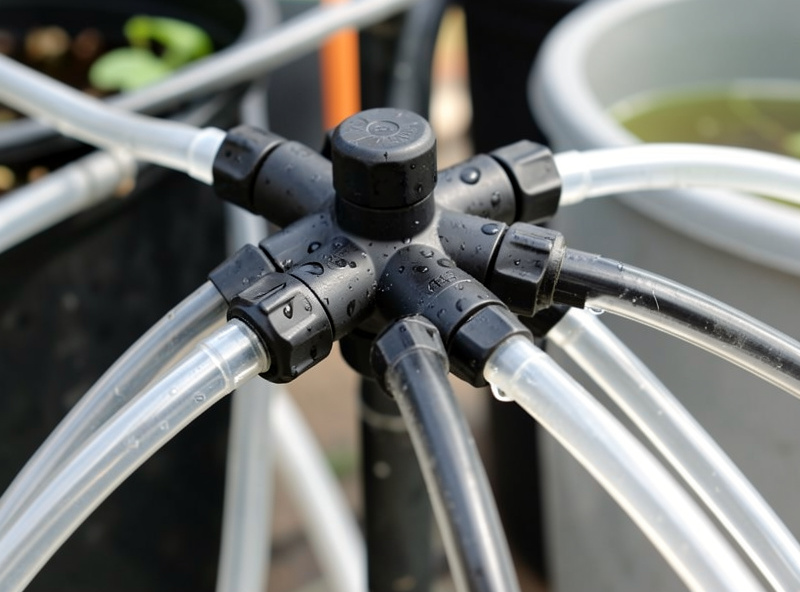
The moment you have more than one bucket, buying a pump per bucket is wasteful. One properly sized commercial pump feeds a manifold — a length of PVC or a gang valve with a barbed outlet per line — and splits the air across the row. The catch is balancing: air, like water, takes the path of least resistance, so a shallow bucket steals air from a deep one unless each line has its own adjustable valve.
I build my manifolds from PVC with individual ball valves so I can trim each bucket to an even boil, and I always oversize the pump so the sum of the lines still exceeds my 1 LPM-per-gallon target after splitting. The full build — parts, valve layout, and how I balance the outputs by eye — is in building an air manifold for multiple buckets. It is the single upgrade that makes a multi-bucket DWC setup feel like one system instead of a shelf of noisy boxes.
The Noise Problem Nobody Warns You About
An air pump runs 24/7, and in a spare-room grow it is often the loudest thing in the house. The buzz is rarely the motor itself — it is the pump vibrating against whatever it sits on, resonating like a phone on a table. Before buying a “silent” pump I try three free fixes: set the pump on a folded towel or foam pad, hang it so nothing hard touches it, and make sure it sits above the water line so it is not straining. A linear-piston pump is inherently quieter than a buzzy diaphragm, which is another reason I drifted toward them.
If your grow is anywhere near where you sleep, this matters more than the spec sheet. I go through every trick I use to kill the drone — isolation, enclosure, pump choice — in quiet air pumps for an indoor grow room. A pump you turn off at night because it is annoying is a pump that lets your DO crash overnight, so silencing it properly is a grow-health issue, not just a comfort one.
Check Valves and Tubing: The $2 Parts That Save the Res
Here is the mistake I made exactly once. An air pump sits above the res and pushes air down into the water. Cut the power — a timer trips, a breaker flips — and the pressurised water can climb back up the tubing, through the dead pump, and start siphoning. I came back to a puddle and a half-drained bucket because I had skipped a fifty-cent part. A one-way check valve on every air line stops backflow dead, and it also protects the pump from water reaching the diaphragm.
Tubing matters too: standard 3/16-inch airline is fine for a single stone, but split it across a manifold and you want wider-bore silicone or vinyl so you are not choking the flow before it reaches the buckets. I cover valve orientation (they are directional — fit one backwards and you get no air), tubing sizes, and the whole backflow story in air pump check valves and tubing. Fit the valve arrow pointing toward the res, not the pump.
Keeping the Bubbles Coming: Stone Maintenance
Air stones clog. Minerals from your nutrients and biofilm slowly seal the pores from the inside, and the first sign is a weaker, patchier boil even though the pump sounds the same. A clogged stone starves the res of oxygen exactly when a mature root mass needs it most. I clean mine on the same cadence as a res change: a soak in a weak acid or a dilute hydrogen-peroxide solution, a rinse, and a dry-out to blow the pores clear.
Some stones come back to full output; cheap ones do not, and past a point a $3 stone is not worth saving. My full restore routine — what to soak in, how long, and when to just replace — is in cleaning clogged air stones. Pair that with a clean reservoir and you close the loop, which is why I schedule stone cleaning alongside my normal reservoir cleaning routine.
Aeration, Temperature and Root Rot Are the Same Fight
Aeration does not work in isolation. The reason I obsess over air is that low dissolved oxygen and warm water together are the open door for Pythium — the brown-slime root rot that ends a DWC crop. Keep the res below 68°F (20°C) and the air stones running around the clock and you have removed the two conditions Pythium needs. Let the res drift past 72°F (22°C) with a weak pump and you are growing rot, not lettuce.
So the buying decision here connects straight to reservoir water temperature and to preventing root rot. Right-size the pump, run it 24/7, keep the water cool, and the root zone stays white and firm. Under-aerate and the best nutrients and lights in the world will not save the crop. For the wider context of how a reservoir is built and maintained, my hydroponic reservoir guide ties the whole water system together, and reservoir sizing feeds directly into how much air you need.
Redundancy: Planning for the Pump That Fails
A DWC res has no buffer. Kill the air for a warm afternoon and a dense root mass can suffocate before you notice, so I treat the pump as a single point of failure worth insuring against. The cheapest insurance is that spare aquarium pump you were about to throw out — keep it in the cupboard with a stone and a length of tubing already fitted, so a dead pump is a two-minute swap, not a lost crop. On a res I care about I run a second stone on a separate small pump so a single failure only halves the aeration instead of stopping it.
The other failure mode is power, not the pump. A tripped breaker or a blackout stops every pump on the bench at once. If your grow runs anywhere with unreliable mains, a small battery-backed pump or a UPS on the aeration circuit buys you hours, and it is the same sizing logic I use when I plan continuous pump operation in my off-grid hydroponics power guide. Aeration is the one load I never let go dark, because it is the one the roots cannot survive without. The passive exception is the Kratky method, which grows with no pump at all by leaving an air gap — useful to understand precisely because it shows what aeration is standing in for.
What It Costs to Run a Pump 24/7
Because aeration never switches off, the pump is a permanent load on your power bill, and it is worth doing the arithmetic before you assume a commercial pump is expensive to own. Wattage, not the purchase price, is what you pay for month after month. A little aquarium diaphragm pump draws around 3–5 watts; a dual-diaphragm hobby pump sits near 5–15 watts; a commercial linear-piston pump feeding a bucket row pulls roughly 20–40 watts depending on how hard you drive it.
Run the numbers the way I do in my res logs. A 30-watt linear-piston pump on 24 hours a day burns 0.72 kWh per day, which works out to about 263 kWh over a year. A 5-watt diaphragm pump on the same clock uses closer to 44 kWh a year. At a mid-range electricity price near $0.25 per kWh, that is roughly $66 a year to aerate a whole bucket row against about $11 for one lonely bucket — a gap of about a dollar a week. Here in Sweden, where winter power prices swing hard, I still never treat that as a reason to undersize: put the difference next to the cost of a single rotted-out DWC crop and the running-cost gap between pump classes is noise. Size for the oxygen your roots need first, run the pump easy so it draws less and lasts longer, and let the wattage fall where it falls.
What I Would Buy Today
If I were starting a two-to-four bucket DWC row from scratch, I would skip every kit pump and buy one commercial linear-piston pump rated around 45–60 LPM, a length of wide-bore silicone tubing, a check valve for every line, a PVC manifold with individual valves, and a disc diffuser per bucket. That package aerates a full bucket row with headroom, runs quiet, and lasts for years — and it costs less than replacing three dead aquarium pumps and one rotted crop. You can browse the pump class I mean with an Amazon search for a commercial hydroponics air pump, and a matching disc diffuser and air stone set.
As an Amazon Associate I earn from qualifying purchases.
The rest of this cluster drills into each decision. Start with sizing, pick your diffuser, then plumb it safely — that order has never let me down across the methods I run side by side.
Frequently Asked Questions
How big an air pump do I need for a 5-gallon DWC bucket?
Aim for at least 5 LPM of real output per 5-gallon bucket, which is 1 litre per minute per gallon. Because pumps are rated at zero back-pressure and lose 20-30% under 8-10 inches of water, buy with headroom and go to 1.5-2 LPM per gallon for fruiting crops or a warm res.
Is an aquarium air pump good enough for hydroponics?
For a single small bucket a good aquarium pump can work, but the kit pumps rated by tank size were never tested against a column of water and fade within months. For a bucket row or any warm res, a commercial linear-piston pump holds its output for years and is the better buy.
Should I run one big air pump or one pump per bucket?
One correctly sized commercial pump feeding a manifold with individual valves beats a pump per bucket on cost, noise, and reliability. Oversize it so total air still exceeds 1 LPM per gallon after splitting across the lines, and give each bucket its own valve to balance the flow.
Do I really need a check valve on the air line?
Yes. If the power cuts, pressurised water can siphon back up the tubing through the dead pump and drain the reservoir onto the floor. A one-way check valve on every line stops backflow and protects the pump diaphragm. Fit it with the arrow pointing toward the reservoir.
Air stone or disc diffuser for DWC?
Disc diffusers throw a finer, denser bubble curtain and cover more of the reservoir floor, which dissolves oxygen more efficiently but needs more pump to drive. Cylinder air stones fit small buckets and cost less. I run discs in large totes and stones in small standalone buckets.
How do I stop my air pump from being so loud?
Most of the noise is vibration, not the motor. Set the pump on foam or a folded towel, keep it above the water line so it is not straining, and choose a linear-piston pump over a buzzy diaphragm. A pump you never want to switch off is one that keeps your dissolved oxygen up overnight.
Related Guides
- How Many LPH of Air per Gallon? My DWC Aeration Sizing Rule
- Air Stone vs Disc Diffuser: Which I Run in My DWC Totes
- Best Air Pumps for DWC: Commercial-Class vs Aquarium Pumps
- Running Multiple Buckets off One Pump: Building an Air Manifold
- Quiet Air Pumps for an Indoor Grow Room: Killing the Buzz
- Air Pump Check Valves and Tubing: The Backflow Mistake I Made Once
- Cleaning Clogged Air Stones: Restoring Bubble Output
- Dissolved Oxygen in Hydroponics: Why Roots Need It