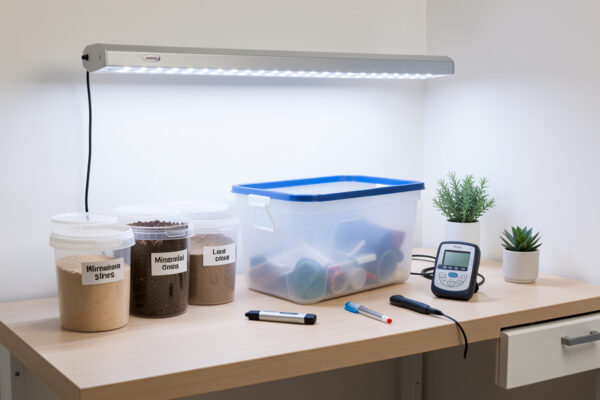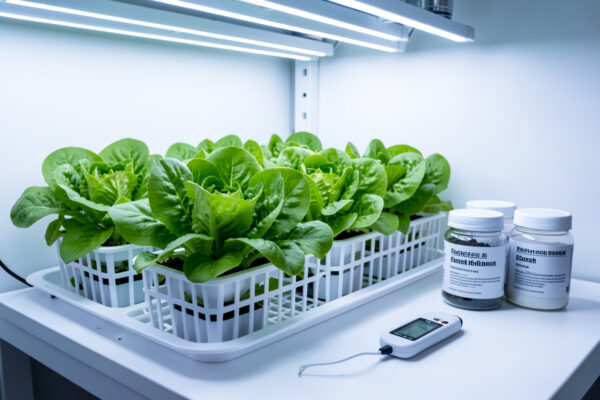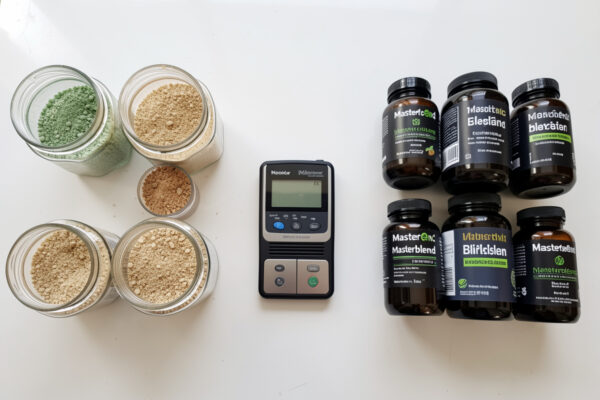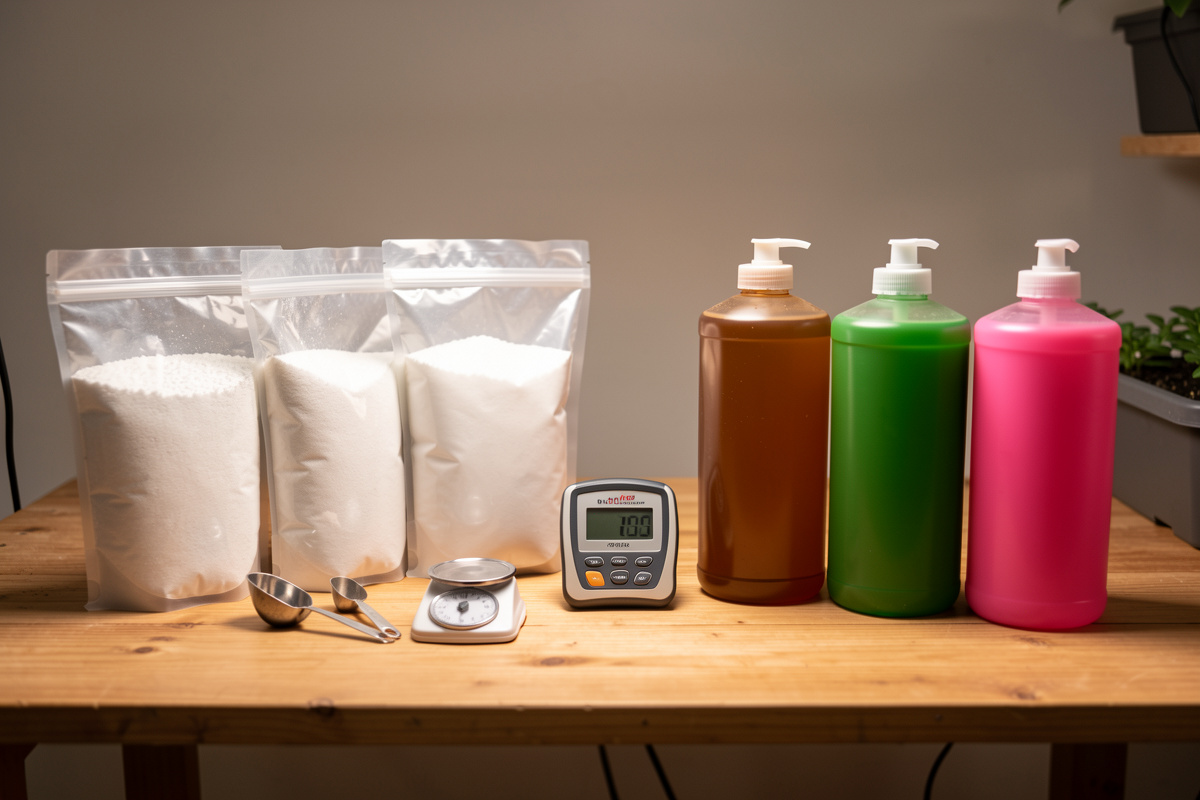
I run both on the same bench: Masterblend dry salts on my DWC totes and the General Hydroponics Flora trio on a small Kratky jar shelf. Across roughly a year of res logs, the dry kit landed solution at fractions of a cent per litre while the liquid trio ran several times costlier — that single number drives most of this decision.
The “Masterblend vs General Hydroponics” question comes up constantly, and the honest answer from someone mixing both is that neither is universally best. Dry salts win on cost and bulk; the liquid trio wins on simplicity and small reservoirs. Which one belongs on your bench depends on volume, budget, your temperament around a gram scale, and what you’re growing. I’ll walk you through exactly how I split mine, with the comparison table as the centerpiece.
The Core Difference: A Three-Salt Dry Mix vs a Three-Bottle Liquid
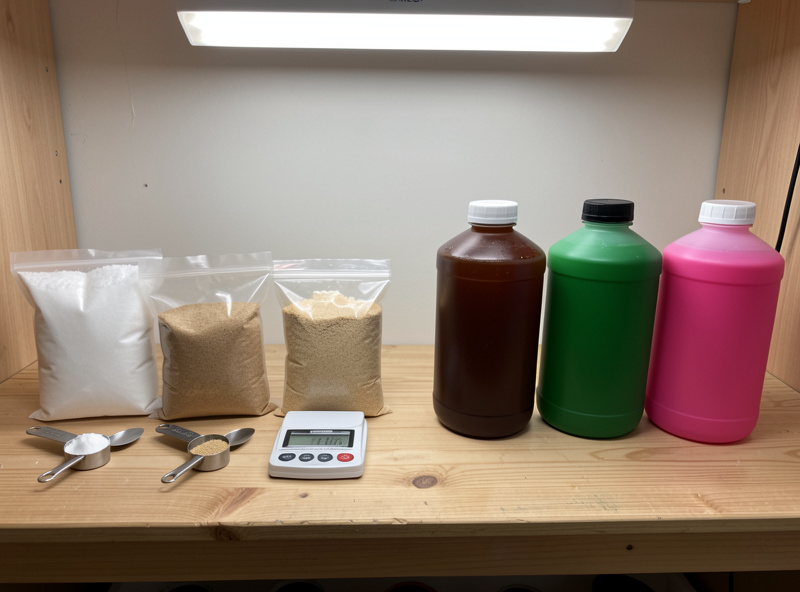
Masterblend is a dry-salt system you weigh and dissolve; GH Flora is a pre-dissolved liquid you pour and stir. Both deliver a complete feed in three parts, but one asks you to own a gram scale and the other asks you to own a measuring cup. That’s the whole personality difference.
On the dry side, “Masterblend” really means three salts together. The headline bag is Masterblend 4-18-38, the Tomato & Vegetable Formula — 4% N, 18% P2O5, 38% K2O plus chelated micronutrients. It is deliberately not complete on its own: it carries no calcium and only a little magnesium. You pair it with calcium nitrate (15.5-0-0, around 19% calcium) and Epsom salt (MgSO4·7H2O, roughly 9.8% magnesium and 13% sulfur) to build a full feed. My standard fruiting ratio is 2-1-2 by weight — Masterblend : Epsom : calcium nitrate — which at full dose per US gallon means 2 g Masterblend, 1 g Epsom, and 2 g calcium nitrate, landing me around EC 2.0–2.4 mS/cm (roughly 1000–1200 ppm on the 500 scale). I cover the full mixing math in my Masterblend 4-18-38 recipe.
The GH Flora trio — FloraMicro, FloraGro, and FloraBloom — does the same job in liquid form. You shift the ratio of the three bottles across a plant’s life instead of weighing salts. It’s genuinely harder to mess up: no scale, no separate dissolving, no hygroscopic calcium nitrate clumping in a Swedish winter. I break the bottle-by-bottle schedule down in my GH Flora series 3-part guide.
The Comparison Table: Dry Salts vs the Liquid Trio
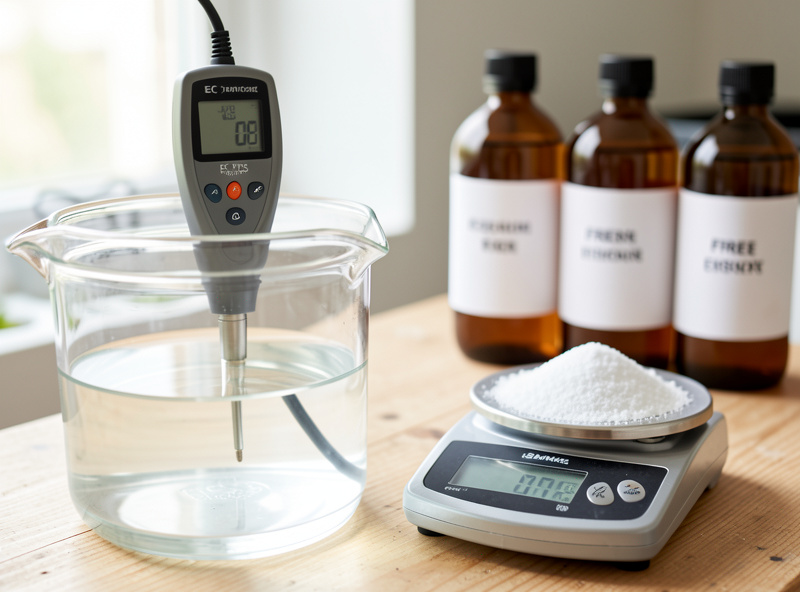
This is the table I wish I’d had before buying either. Every row below comes from running both systems on the same crops, logging EC and pH on each res change, and tracking what each one actually costs and demands week to week.
| Factor | Masterblend (dry salts) | GH Flora trio (liquid) |
|---|---|---|
| Form | Three dry salts: Masterblend 4-18-38, calcium nitrate, Epsom — you weigh and dissolve | Three liquids: FloraMicro, FloraGro, FloraBloom — pre-dissolved, pour and stir |
| Cost per litre of solution | Fractions of a cent at lettuce strength; a ~$30–40 kit mixes well over 1,000 gallons | Several times more per litre of finished solution |
| Convenience | Lower: needs a gram scale and separate dissolving each salt | Higher: measure by volume, no scale, faster top-offs |
| Mixing difficulty | Moderate: strict order matters (Masterblend, then Epsom, calcium nitrate LAST) | Low: FloraMicro first, then Gro and Bloom — hard to get wrong |
| Precipitation risk | Real if you concentrate or add calcium nitrate too early — white lockout precipitate | Low when you add FloraMicro first; calcium stays in solution |
| Shelf life | Long when kept dry; calcium nitrate is hygroscopic and will cake if it gets damp | Long sealed; once opened, settling possible — shake before each pour |
| Best-fit grower / crop | High-volume DWC, NFT, ebb-and-flow; fruiting crops; budget and bulk-driven growers | Small Kratky jars, single totes, beginners, anyone who hates weighing salts |
The short version: if you run real volume — multiple totes, NFT channels, an ebb-and-flow bed — the dry kit’s cost advantage compounds every res change. If you run one small reservoir or you’re still building confidence, the liquid trio’s pour-and-go simplicity is worth the premium.
A couple of rows deserve a caveat. “Cost per litre” assumes you’re mixing at the strengths I listed and not throwing away half-used reservoirs; if you let solution sit and go bad between uses, neither product is cheap. And “precipitation risk” on the dry side is entirely in your hands — at the dilute working strengths a hobby grower mixes, calcium nitrate added last to a well-stirred res almost never precipitates. The white-cloud horror stories come from concentrating salts together in a stock solution, which is a different game. I mix to working strength directly in the res and have never had a lockout from precipitation, only from pH drift, which is a separate issue both systems share.
Cost: Where Dry Salts Pull Decisively Ahead
On raw cost per litre of finished solution, it isn’t close — dry salts win by a wide margin. A single Masterblend kit dissolves into well over a thousand gallons at lettuce strength, putting my per-litre cost into fractions of a cent. The liquid trio is convenient but costs several times more for the same litre of feed.
The reason is simple: with liquids you’re paying to ship and store water. The active minerals are identical chemistry; you’re buying them already dissolved and packaged in bottles. For a windowsill of herbs that difference is trivial. For my four-tote DWC bench burning through tens of litres a week, it’s the entire reason Masterblend lives on that side of the room. If you want my full cost breakdown, I keep it in is Masterblend worth it. I won’t put numbers on what you’d “save” in any earnings sense — that’s not how I think about it — but the per-litre arithmetic is plain.
Convenience and Mixing: Where the Liquid Trio Earns Its Keep
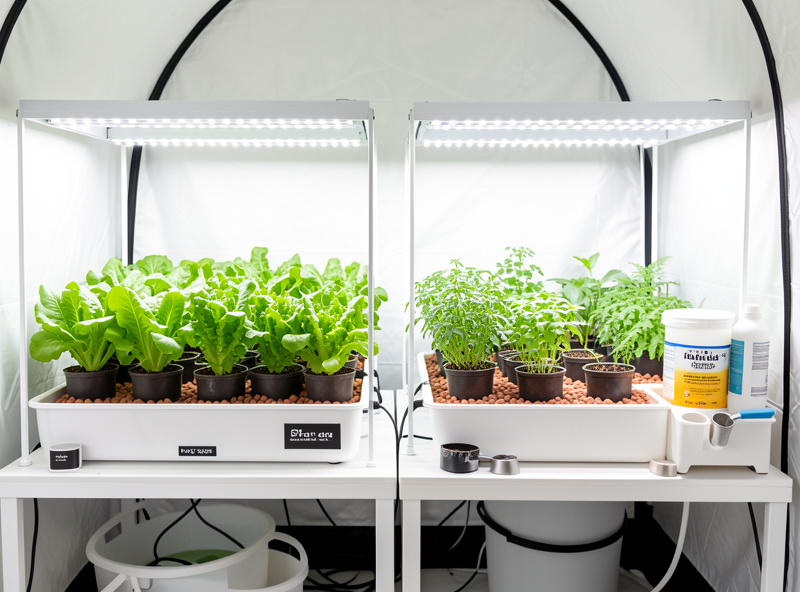
The Flora trio is simply easier to live with — you measure by volume and pour, no scale and no separate dissolving steps. That convenience is the liquid system’s whole pitch, and on a small reservoir it genuinely matters more than the cost premium.
With Masterblend, order discipline is non-negotiable. I dissolve each salt separately, then add them in sequence: Masterblend first, then Epsom, and calcium nitrate last. If calcium nitrate meets concentrated sulfate or phosphate too early, you get a white precipitate — minerals dropping out of solution before your plants ever see them, which reads as a lockout downstream. It’s not hard once it’s a habit, but it is a habit you have to build, and a cold Swedish garage makes the hygroscopic calcium nitrate clump if your storage is sloppy.
The Flora trio mirrors the same chemistry logic but hides it: FloraMicro goes in first, because it carries the calcium, and adding it to clean water before the others keeps calcium from binding with concentrated phosphate. Get that one ordering rule right and the trio is very forgiving. For the broader picture of how GH’s lineup fits together, see my General Hydroponics nutrients guide.
There’s a temperament dimension here that the spec sheet misses. If you enjoy the bench-science side of growing — calibrating a pen against 1.413 mS/cm reference solution, weighing salts to a tenth of a gram, tweaking a ratio for a specific crop stage — Masterblend gives you control the bottles can’t. You’re building the feed from base salts, so you can run a leaner calcium nitrate dose for leafy greens or push Epsom for a magnesium-hungry crop without buying a different product. If you’d rather spend that energy on the plants and not the chemistry, the trio’s three-bottle schedule does the thinking for you. I happen to like both moods, which is exactly why both live on my bench.
One more practical note on convenience: top-offs. A reservoir loses water faster than it loses nutrients as plants transpire, so between full res changes I’m topping off with plain or lightly fed water to hold EC. With the trio, a quick partial top-off is a 30-second pour. With Masterblend, if I’m not just adding plain water I’m back to the scale for a small weigh-out. On a big tote I plan res changes around that; on a tiny jar the liquid’s speed genuinely saves me fuss.
Shelf Life and Cold-Climate Storage
Dry salts store almost indefinitely when they stay dry; the liquid trio keeps fine sealed but can settle once opened. The real cold-climate caveat is calcium nitrate — it’s hygroscopic and will cake into a brick if it picks up humidity, which a Swedish winter garage delivers in spades.
I keep my Masterblend, Epsom, and calcium nitrate in sealed buckets with desiccant packs, and the calcium nitrate especially never goes back on the shelf with a loose lid. When it cakes, it doesn’t go bad chemically, but it becomes a pain to weigh accurately, and accurate weighing is the entire point of mixing to a target EC. A clumped salt that reads 2 g on my scale but is half trapped air gives me a res that comes in light, and then I’m chasing EC up with a second weigh-in. The Flora bottles dodge that problem entirely — they live on a shelf in my grow tent through the winter and the only maintenance is shaking FloraMicro before it pours, because the heavier components settle over months. Once opened, I treat an open bottle as a season-or-two item rather than something I hoard for years.
One thing growers underestimate: a dry kit is far more compact to store and ship than the liquid equivalent. The same nutrient load that fits in three small bags would be several heavy bottles of mostly water. If storage space or shipping weight matters to you — and in a small Swedish apartment grow it does — that’s a quiet point in the dry column that never shows up in a head-to-head spec sheet.
Dissolved Oxygen, Temperature, and Why the Nutrient Choice Is Only Half the Picture
Neither system fixes a warm, under-oxygenated reservoir. Whichever nutrient I run, I’m still watching res temperature and dissolved oxygen, because a stressed root zone will show deficiency symptoms that look like a feeding problem but aren’t. The nutrient is the easy variable; the res environment is the one that bites.
On my DWC totes the air stones run continuously, and I watch res temperature closely through the warmer months because warm water holds less dissolved oxygen and roots in a starved res start browning regardless of how perfectly I’ve dialed the EC. This is where I see growers blame their nutrient line for a problem that’s purely physical. If your Flora-fed Kratky jar or your Masterblend-fed tote throws yellowing, leggy growth, or stalled roots, check res temperature and oxygenation before you reach for a different bottle or bag. The chemistry in both products is sound; the failure point is almost always pH drift, a warm res, or a clogged air stone. I log EC, pH, and PPFD on every reservoir on every change precisely so I can rule the nutrient out fast and look at the environment instead.
This also explains why I don’t obsess over Masterblend versus GH Flora the way forums sometimes do. Both will grow excellent lettuce and excellent tomatoes if you mix to a sane EC, hold pH in band, and keep the res cool and aerated. The choice between them is about cost, convenience, and storage — not about one growing meaningfully better plants than the other when the rest of your setup is right.
How I Actually Split Them on My Bench
My rule of thumb: dry salts for volume and fruiting, liquid trio for small reservoirs and quick experiments. Volume, crop, and how much I want to fuss decide it — not brand loyalty. Both hit the same EC targets when I mix to a number instead of by feel.
My DWC totes and NFT channels run Masterblend because they move serious volume and I’m pushing fruiting EC of 2.0–3.5 mS/cm where the cost gap is largest. My Kratky jars and a single grab-and-go tote run the Flora trio because the volumes are tiny, the cost premium is negligible at that scale, and I value not dragging out the gram scale for half a litre. Across all of them I hold the same targets: 0.8–1.4 mS/cm for lettuce and leafy greens, 1.0–1.6 for herbs, 2.0–3.5 for fruiting, with pH parked at 5.5–6.0 (a touch higher, up to 6.2, for fruiting). The whole framework lives in my hydroponic nutrients complete guide, and both products slot under my Masterblend hydroponic nutrients hub.
If you want to handle either yourself, you can compare a Masterblend 4-18-38 complete kit against a General Hydroponics Flora trio and see which one fits how you actually grow.
As an Amazon Associate I earn from qualifying purchases.
Is Masterblend cheaper than General Hydroponics Flora?
Yes, by a wide margin per litre of finished solution. A ~$30–40 Masterblend kit mixes well over 1,000 gallons at lettuce strength, landing at fractions of a cent per litre. The GH Flora trio is convenient but costs several times more per litre because you’re paying to ship and store pre-dissolved water.
Is Masterblend complete on its own?
No. Masterblend 4-18-38 carries no calcium and only a little magnesium. You pair it with calcium nitrate (15.5-0-0, about 19% calcium) and Epsom salt (about 9.8% magnesium) to build a full feed — my standard fruiting ratio is 2-1-2 by weight of Masterblend, Epsom, and calcium nitrate.
Which is easier for a beginner, dry salts or the liquid trio?
The GH Flora trio. You measure by volume and pour, with no gram scale and no separate dissolving steps. The main rule is adding FloraMicro first. Masterblend demands a scale and strict mixing order, so it rewards experience and volume more than a first reservoir does.
What mixing order prevents precipitation?
With Masterblend, dissolve each salt separately and add them as Masterblend, then Epsom, then calcium nitrate LAST — calcium reacts with concentrated sulfate or phosphate and drops out as white precipitate if added too early. With the GH Flora trio, add FloraMicro first for the same calcium reason.
Can I mix Masterblend and GH Flora in the same reservoir?
I don’t, and I wouldn’t recommend it. Each system is balanced as a complete program on its own, and combining them makes your EC and nutrient ratios hard to reason about. I run them on separate reservoirs and mix each to its own target EC rather than blending the two chemistries.