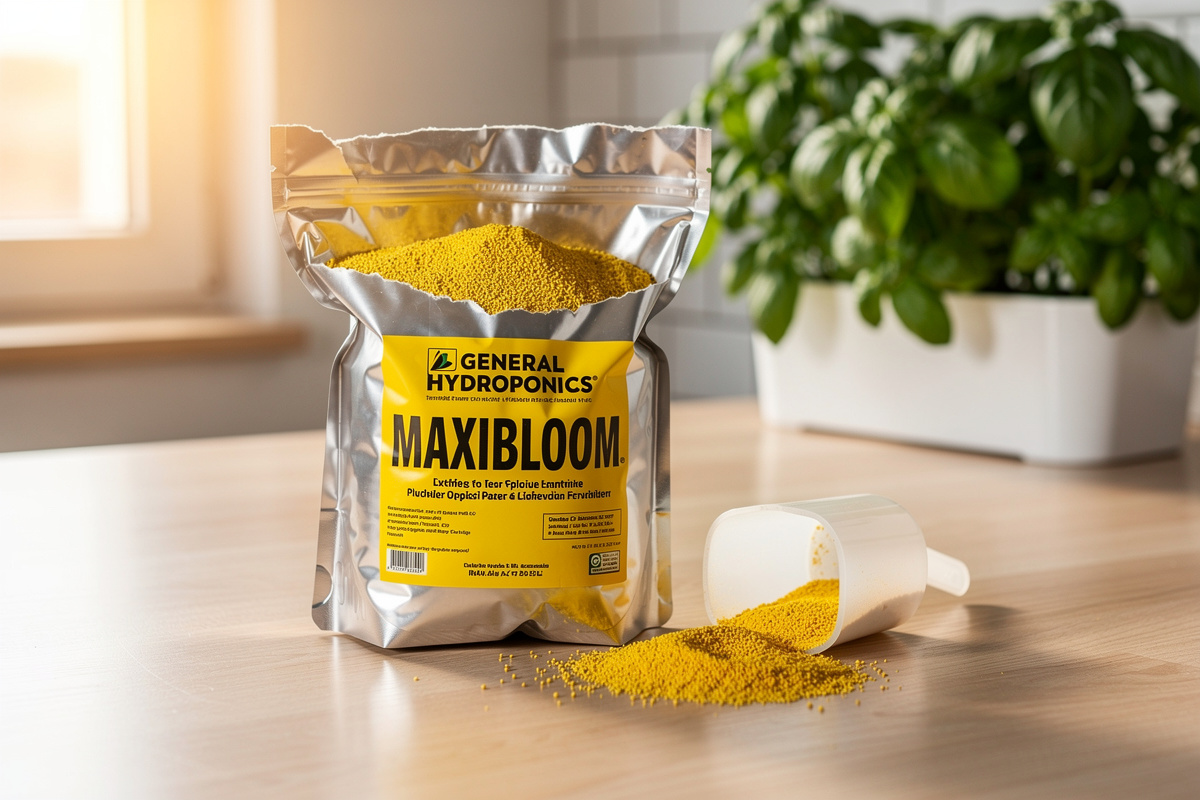
MaxiBloom is General Hydroponics’ dry powder hydroponic fertilizer at NPK 5-15-14, sold in a 2.2-pound resealable bag for roughly $13 to $17 depending on retailer. Mixed at 7 grams per gallon, it works as a single-product feed for the entire crop life cycle on most home crops — and it costs meaningfully less, in the ballpark of half, what an equivalent Flora Series feed costs per gallon of mixed reservoir.
MaxiBloom is technically marketed as a flowering-stage fertilizer (the name says “Bloom”), but the formulation is balanced enough that experienced growers run it as a single-product all-stage feed. The 7-gram solo recipe — published widely in hydroponic forums for over a decade — covers seedling through harvest on lettuce, herbs, basil, strawberries, and most fruiting crops at home scale. This guide walks through the dry-powder formulation, the weekly feeding schedule with EC targets, the mixing technique, and the storage practices that prevent the bag from clumping into a useless brick. For broader product context, see my General Hydroponics complete brand guide.
As an Amazon Associate I earn from qualifying purchases.
What Is MaxiBloom Made Of?
MaxiBloom is a dry crystalline blend of mineral salts at NPK 5-15-14 with calcium at 5 percent, magnesium at 3.5 percent, combined sulfur at 4 percent, and a complete chelated micronutrient package (iron, manganese, zinc, copper, boron, molybdenum). MaxiGro runs a similar secondary-nutrient profile (calcium 6 percent, magnesium 2 percent, combined sulfur 3 percent) — the two products are closer on secondary nutrients than the N-P-K numbers suggest, and the real split between them is nitrogen and phosphorus, not sulfur.
The dry-powder format eliminates the calcium-phosphate precipitation problem that forces liquid 3-part nutrients to ship in three separate bottles. With zero water content, calcium nitrate cannot react with phosphate or sulfate salts during shelf storage. The crystals only become reactive when they hit the reservoir water, where dilution keeps the ions dispersed enough to stay in solution.
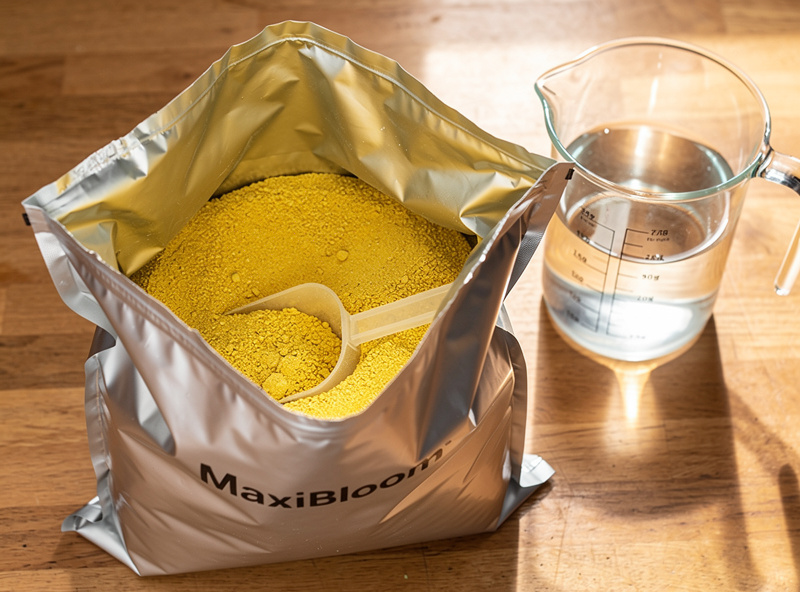
The trade-off is dissolution speed. Dry MaxiBloom takes 2 to 5 minutes to dissolve in cold water and can leave undissolved crystals at the bottom that slowly release over 24 hours, throwing off EC readings. Mixing into warm water (above 65°F) cuts dissolution time to under a minute and prevents the slow-release problem.
The 7-Gram-Per-Gallon “MaxiBloom Solo” Recipe
The MaxiBloom solo recipe is the single most useful piece of MaxiBloom knowledge for home growers: 7 grams (about 1.5 teaspoons) of MaxiBloom per gallon of water, used as the only nutrient through the entire crop life cycle. Adjust pH to 5.8 to 6.2 after mixing. Done.
The recipe traces back to hydroponic forum users comparing it against the full Flora Series schedule over years of home and small-commercial grows. In my own comparisons the gap to the full 3-part schedule is small on most crops and barely noticeable on lettuce and herbs — close enough that the dose simplicity advantage outweighs the small yield gap for most home growers.
The 7-gram dose lands at an EC of about 1.4 to 1.6 in standard tap water, which is in the comfortable range for vegetative-stage crops, mid-cycle fruiting crops, and most leafy greens. For fruiting crops at peak bloom, push the dose to 9 grams per gallon (EC 1.8 to 2.0) for the final 3 to 4 weeks. For seedlings and clones, drop the dose to 3 grams per gallon (EC 0.6 to 0.8) for the first 7 to 10 days.
For leafy greens specifically, the solo recipe at 5 grams per gallon (EC 1.0 to 1.2) is the entire lettuce feeding chart you need from seedling to harvest. No schedule, no transition, no second product.
Full Weekly Feeding Schedule
The official MaxiBloom feeding chart covers the entire crop life cycle with weekly dose adjustments. The table below tracks the schedule for a fruiting crop (tomatoes or peppers); leafy greens and strawberries have simpler schedules covered below.
| Stage | Weeks | MaxiBloom Dose | Target EC | Notes |
|---|---|---|---|---|
| Seedling / clone | 0-1 | 3 g/gal | 0.6 – 0.8 | Add CALiMAGic if RO water |
| Early vegetative | 2-3 | 5 g/gal | 1.0 – 1.2 | Stable pH 5.8 – 6.2 |
| Late vegetative | 4-5 | 7 g/gal | 1.4 – 1.6 | Standard solo recipe dose |
| Transition / pre-bloom | 6-7 | 7 g/gal | 1.4 – 1.6 | Hold steady through transition |
| Early bloom | 8-9 | 8 g/gal | 1.6 – 1.8 | Watch for tip burn — back off 1g if seen |
| Mid bloom | 10-11 | 9 g/gal | 1.8 – 2.0 | Peak nutrient demand |
| Late bloom / ripening | 12+ | 7 g/gal | 1.4 – 1.6 | Taper for cleaner finish |
For leafy greens, hold 5 grams per gallon for the entire crop. For strawberries, run early vegetative for 2 weeks then jump to 7 g/gal and hold through fruiting. For basil and harder herbs, run 6 to 7 g/gal throughout.
EC targets above are calibrated for tap water with a 100 to 200 PPM background. If you start from RO or distilled water, target EC drops by about 0.2 across all stages, and you must add CALiMAGic at 1 to 2 ml per gallon to compensate for the missing baseline calcium and magnesium.
Mixing Technique for Dry Powder
MaxiBloom mixes faster and more evenly with the right technique. Rushing the dissolution step is the most common cause of inconsistent EC readings.
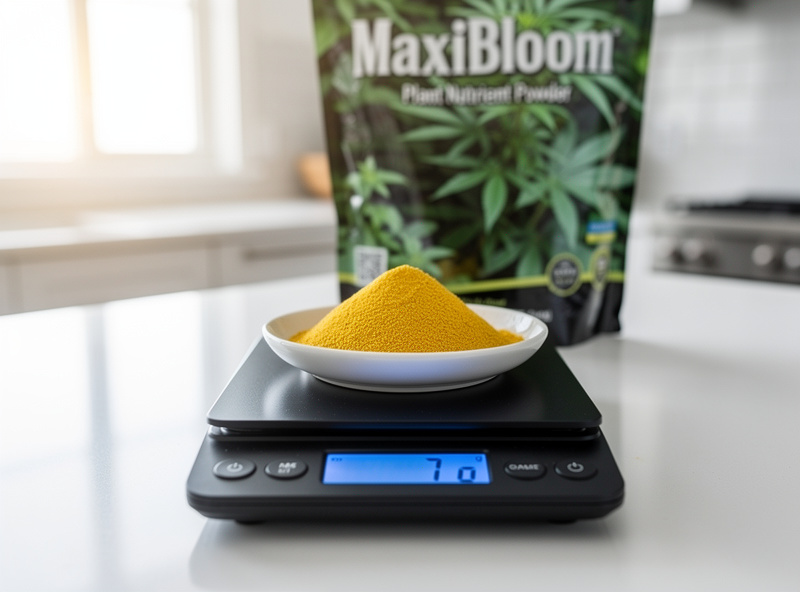
Fill the reservoir with the planned water volume. Warm water (65 to 75 degrees Fahrenheit) dissolves the powder in under a minute; cold water can take 5 minutes or more and risks undissolved crystal residue at the bottom of the reservoir. Weigh the powder dose with a digital kitchen scale that reads in 0.1 gram increments — the standard hydroponic teaspoon estimate (1.5 tsp = 7 grams) is close enough for most crops, but the gram measurement is more precise and worth the small scale investment for repeatable results.
Add the powder slowly while stirring with a clean spoon or aquarium-grade air stone, dispersing the crystals through the water column rather than dumping them at the bottom. Keep stirring until the water turns a slight tea color and you can no longer see crystal residue at the bottom. Wait 2 to 3 minutes for full dissolution, then test EC.
Adjust pH last. Fresh MaxiBloom in tap water typically lands at pH 5.6 to 5.9, often inside the target range without adjustment. If the reading is high, add pH Down one drop at a time. For full reservoir build technique applicable to any nutrient brand, see my step-by-step guide on how to mix hydroponic nutrient solution.
Cal-Mag Requirement for RO and Distilled Water
The MaxiBloom formulation assumes the source water provides some baseline calcium and magnesium. Tap water typically supplies 30 to 80 PPM of calcium and 10 to 30 PPM of magnesium, which the formula factors into its overall nutrient balance. Reverse-osmosis and distilled water have been stripped of these elements (background near zero), and using straight MaxiBloom in RO water produces calcium-deficient plants within 2 to 3 weeks.
The fix is straightforward — add GH CALiMAGic or another Cal-Mag supplement at 1 to 2 ml per gallon to the reservoir before adding MaxiBloom. The supplement raises baseline calcium back to about 60 PPM and magnesium to about 20 PPM, restoring the assumed water profile. Without this step, you will see classic calcium deficiency symptoms: blossom end rot on tomatoes, tip burn on lettuce, distorted new growth on basil.
If your tap water tests below 50 PPM background hardness with an EC pen — see my EC meter for hydroponics guide for how to test — you should also add Cal-Mag, even though the water is technically not RO. Soft tap water mimics the same calcium-poor profile.
Storage and Clumping
MaxiBloom is hygroscopic — the dry crystals absorb moisture and clump into hard chunks if the bag is left open or stored in a humid environment. A fully clumped bag becomes nearly unusable; chunks resist dissolution and dose accuracy collapses.
Reseal the bag immediately after every dose, squeezing the air out before zipping. Store in a dry cabinet or sealed plastic tote away from any water source. In humid climates above 60 percent RH, keep the bag inside a second sealed container with a silica gel desiccant pack — the same packets that come in shoe boxes work fine.
If a bag has already clumped, recover it by breaking the chunks back into powder with a clean rolling pin and passing through a coarse sieve before weighing. Heavily clumped bags with visible moisture absorption should be replaced — the chemistry has shifted enough that the original NPK no longer applies. I lost half a bag to a Swedish basement’s humidity before I started keeping desiccant packs in the tote; now it’s just part of the routine.
MaxiBloom vs MaxiGro
MaxiGro (NPK 10-5-14) is the vegetative companion product, same dry-powder format and similar pricing. Most growers buy one or the other — MaxiGro for leafy-green operations, MaxiBloom for fruiting operations or as the all-stage solo product. I keep both bags in the shop but reach for MaxiBloom far more often since most of what I run through it is a mixed bench of vegetative and fruiting crops.
MaxiGro technically wins on pure leafy-green systems for yield because of the higher nitrogen, though the gap is modest in my own comparisons. For mixed gardens or single-product simplicity, MaxiBloom solo is the easier call — the small leafy-green yield penalty is worth the inventory simplification. Switching between the two mid-crop is rarely necessary at home scale.
Cost Comparison vs Flora Series
A 2.2-pound (about 1000-gram) bag of MaxiBloom at $13 to $17 mixes about 140 gallons at the standard 7 g/gal dose — roughly $0.10 to $0.12 per gallon of feed. The Flora Series at an equivalent EC runs noticeably higher per gallon once you account for three separate bottles.
MaxiBloom lands somewhere in the ballpark of half the per-gallon cost of the Flora Series, with the gap mattering more as reservoir size scales up. For a single home reservoir the difference is a few dollars a year and not worth optimizing around. For a larger greenhouse setup running through several bags a season, the savings add up enough to matter. The trade-off is lost ratio control — MaxiBloom delivers a fixed NPK profile across all stages. For brand comparisons, see my best hydroponic fertilizer for 2026 roundup.
Next Steps
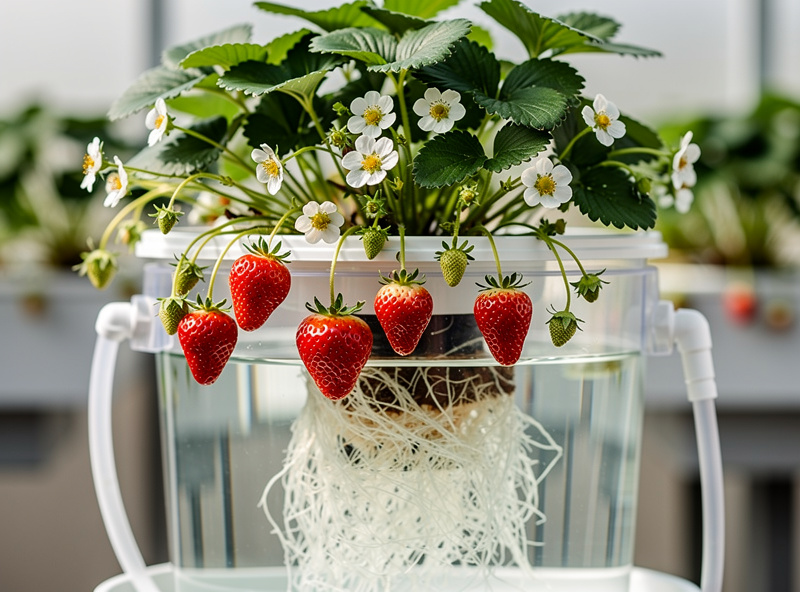
MaxiBloom solo at 7 grams per gallon is the simplest practical hydroponic nutrient setup that produces real results. Buy a bag of MaxiBloom, weigh out the dose, dissolve in warm water, adjust pH, and feed. For most home growers running a single DWC bucket or a small NFT channel, this is all the nutrient management you need.
If you outgrow the fixed-ratio limitation, the next step up is the FloraNova Grow and Bloom two-bottle line for vegetative-versus-flowering ratio control. From there, the GH Flora Series 3-part system is the ceiling for full N-P-K control across the crop life cycle. For background on what hydroponic nutrients actually contain, see my complete guide to hydroponic nutrients.
Frequently Asked Questions
How much MaxiBloom per gallon?
7 grams per gallon (about 1.5 teaspoons) is the standard solo dose used through the entire crop cycle. Drop to 3 grams for seedlings, climb to 9 grams for peak bloom on fruiting crops. Lettuce and leafy greens stay at 5 grams per gallon for the full crop.
Can I use MaxiBloom for the whole crop?
Yes. The MaxiBloom solo recipe at 7 grams per gallon covers seedling through harvest on lettuce, herbs, basil, strawberries, and most fruiting crops. The yield gap versus a full Flora Series feeding schedule is small for most crops, and the mixing is far simpler.
Why is my MaxiBloom not dissolving?
Cold water and clumped powder are the two causes. Mix into water above 65 degrees Fahrenheit and stir for 2 to 3 minutes for clean dissolution. If your bag has clumped from moisture absorption, break the chunks back into powder with a rolling pin and pass through a sieve before weighing.
Do I need Cal-Mag with MaxiBloom?
Only if you mix into reverse-osmosis or distilled water, or tap water testing below 50 PPM background. Add CALiMAGic at 1 to 2 ml per gallon before adding MaxiBloom. Without this, RO water grows calcium-deficient plants with blossom end rot on tomatoes and tip burn on lettuce within two weeks.
Is MaxiBloom or MaxiGro better for lettuce?
MaxiGro is technically the better choice for pure leafy-green systems because the higher nitrogen drives faster vegetative growth, though the gap is modest in practice. For mixed gardens or single-product simplicity, MaxiBloom solo at 5 grams per gallon still grows excellent lettuce.
How long does a 2.2-pound bag of MaxiBloom last?
At the standard 7-gram-per-gallon dose, a 2.2-pound bag mixes about 140 gallons of feed. For a 5-gallon home reservoir replaced every 2 weeks, one bag lasts roughly a year. For a 50-gallon greenhouse with weekly changes, expect about 3 to 4 weeks per bag.