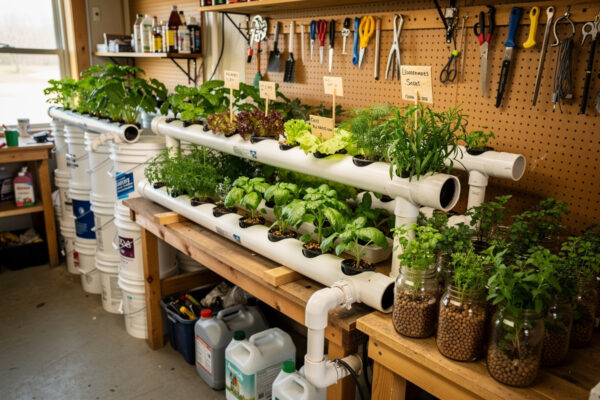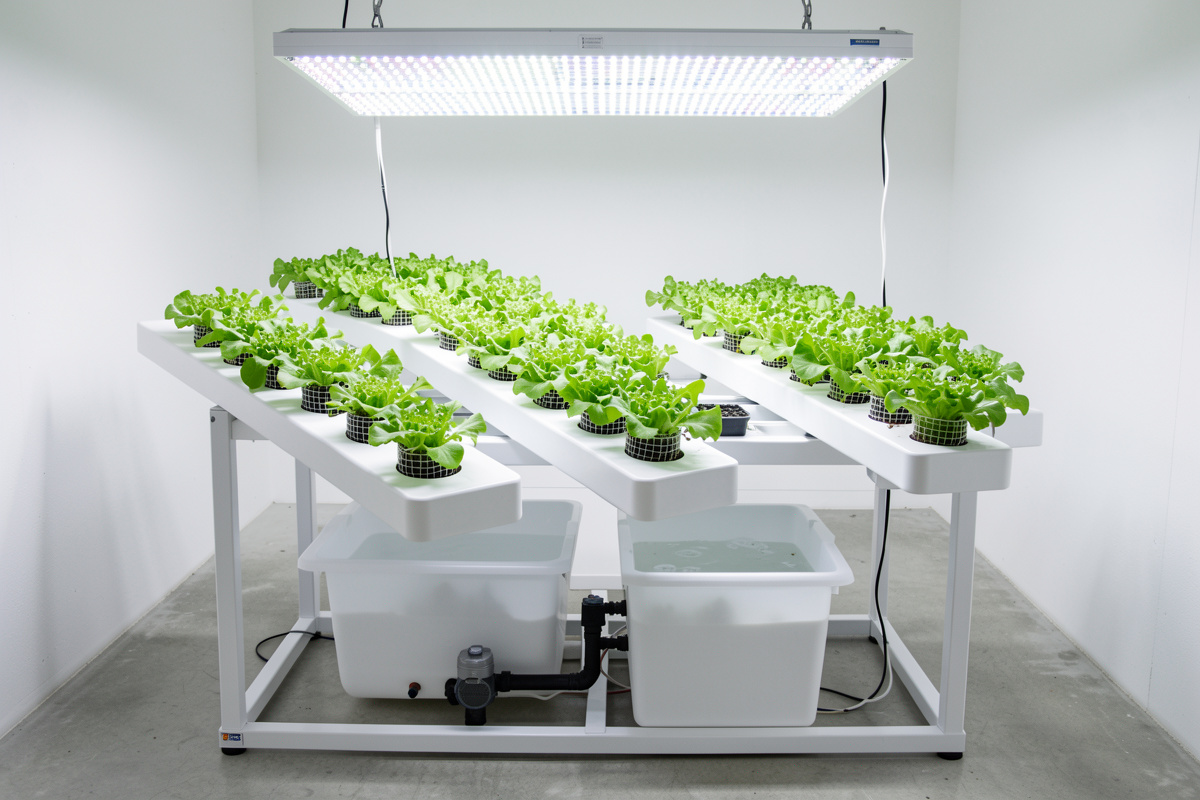
A DIY NFT hydroponic system in PVC runs a thin film of nutrient solution down sloped plastic channels so the roots of dozens of plants get water and oxygen at once. Built from standard square fence-post or round down-pipe PVC, a four-channel system costs $60 to $120 and grows leafy greens at a volume no single bucket can match.
The nutrient film technique is the build I reach for when one plant at a time stops being enough — a wall of lettuce or herbs feeding off one reservoir and one small pump. It is also the build most people get subtly wrong, because two numbers, slope and flow rate, decide whether the film stays thin and oxygenated or floods into a stagnant trough. I have tuned both on my own channels, and this is the complete PVC build with the settings that actually work.
Why PVC is the right material for an NFT build
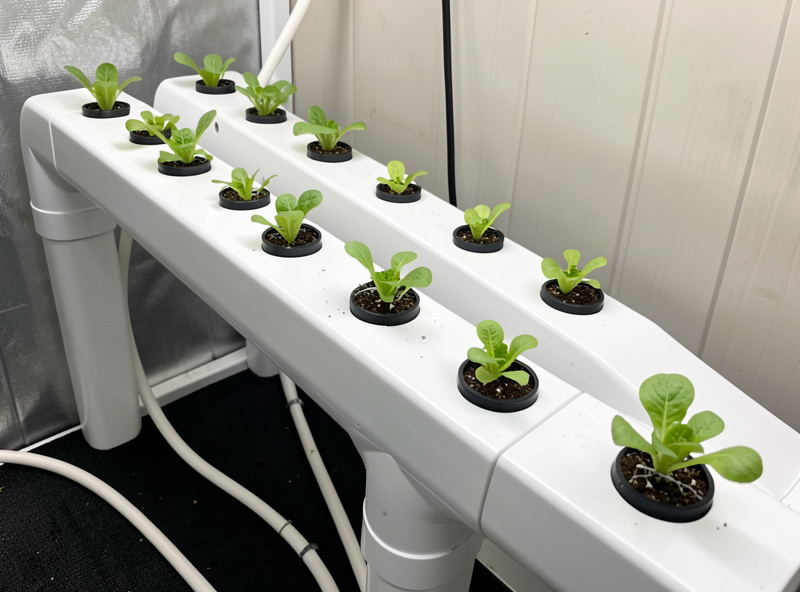
PVC is cheap, rigid, food-grade in the right grades, and comes in shapes that are almost purpose-made for NFT. Square fence-post profile is my first choice because the flat bottom keeps the film shallow and even across the width, which round pipe does not — in a round pipe the water pools in a narrow channel down the centre and the film is harder to keep thin. Round down-pipe still works and is often cheaper; you just accept slightly less even root wetting.
The principle is simple: a small pump lifts solution from a reservoir to the high end of each channel, gravity pulls a shallow film down past the roots, and the film drains back to the reservoir to recirculate. Because the roots are never submerged, they get exceptional oxygen — the same reason deep water culture works, achieved a different way. If you want the method theory, the NFT explainer covers it, and this build sits in the wider DIY hydroponic builds guide.
The parts and the critical dimensions
The bill of materials is short, but two dimensions matter more than any part choice: the slope of the channels and the spacing of the planting holes. Get those right and cheap pipe outperforms an expensive kit.
| Element | What I use | Why it matters |
|---|---|---|
| Channel | 3 to 4 inch square PVC fence post | Flat bottom keeps the film thin and even |
| Slope | 1 in 30 to 1 in 40 | Too flat pools; too steep starves the roots |
| Hole spacing | 6 to 9 inches for lettuce | Crowding shades and tangles roots |
| Net pots | 2-inch | Sits in the channel without blocking flow |
| Pump | Small submersible, 200 to 400 L/h | Drives flow to every channel head |
| Flow rate | 1 to 2 litres per minute per channel | Keeps the film replenished and oxygenated |
| Reservoir | Opaque, 5 to 15 gallon | Buffers EC and temperature |
A small submersible pump is the one part worth choosing carefully; undersize it and the far channels starve. You can find a suitable submersible pump on Amazon rated a little above your total flow need so it drives every channel with margin. As an Amazon Associate I earn from qualifying purchases.
Building the system step by step
Cut your channels to length and drill the net-pot holes at your chosen spacing — a hole saw matched to a 2-inch net pot. Cap both ends of each channel; at the high end, drill an inlet for the supply tubing, and at the low end, cut a drain hole that returns to the reservoir. Mount the channels on a frame at the 1-in-30 to 1-in-40 slope — that is roughly an inch of drop per metre. Run a manifold of small tubing from the pump to the head of each channel, set the pump in the reservoir, and plumb all the drains back into it.
Start the pump and watch the film. You are looking for a shallow sheet of water moving steadily past where the roots will sit — not a deep stream, not a dry trickle. Adjust flow at the pump or with a valve until each channel shows that thin film. Transplant seedlings raised in rockwool into the net pots once they have true leaves and a root or two poking through the cube, so the roots reach the film quickly.
Slope and flow: the two settings that make or break it
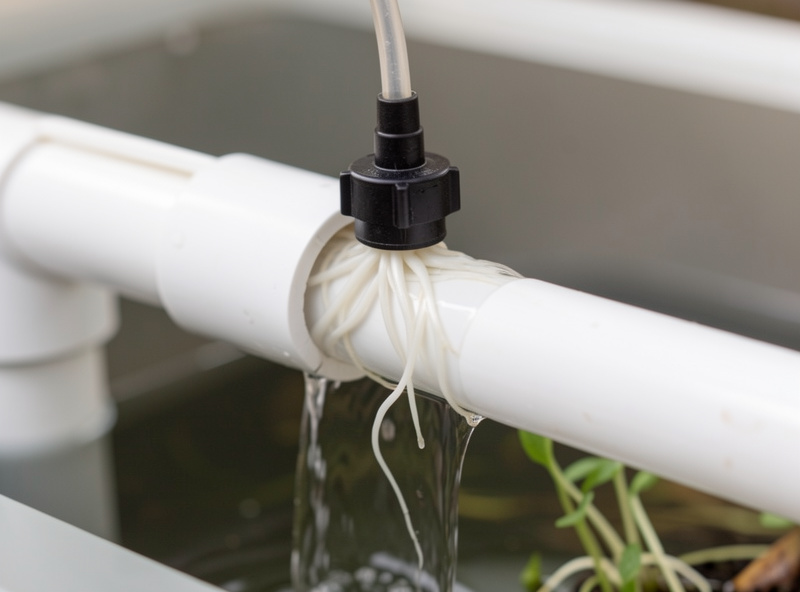
This is where NFT builds succeed or fail. Slope controls how fast the film drains: too flat and water pools into a stagnant, low-oxygen trough that invites root rot; too steep and the film races through too thin to wet the roots evenly. The 1-in-30 to 1-in-40 range is the sweet spot across the crops I run. Flow rate controls how often the film is refreshed; 1 to 2 litres per minute per channel keeps it oxygenated without flooding.
The classic beginner failure is a channel that looks fine empty but pools once roots fill it — the root mass dams the flow and water backs up. The fix is enough slope and enough flow to push past a mature root mat, plus not over-planting. My first NFT run taught me this directly — I set the slope too flat to be safe, and a mat of lettuce roots dammed the third channel within a few weeks, backing up into a stagnant pool that browned the roots before I caught it; steepening it to a true 1-in-30 ended the problem for good. Oxygen is the whole point, so if you ever see browning roots, check the film depth first; the mechanics are in dissolved oxygen in hydroponics.
Running the system: EC, pH and pump cycling
NFT recirculates, so the reservoir is the system and I watch it closely. I run leafy greens at roughly 0.8 to 1.4 mS/cm EC and hold pH between 5.5 and 6.0, mixing to a target EC with a calibrated EC meter rather than by feel; the recipe is in how to mix nutrient solution. Because the water volume is smaller relative to the plant count than in DWC, EC drifts faster, so I check it every couple of days and change the reservoir every one to two weeks.
I run the pump continuously for leafy greens. Some growers cycle it on a timer to save power, but in a small DIY build the film dries too fast between cycles and the roots stress, so unless your reservoir and channels are large I leave it running. A continuous thin film is the calmest, most productive state for an NFT system.
The one real weakness of NFT
NFT has a single Achilles heel worth knowing before you build: it depends entirely on the pump. In deep water culture the roots sit in a reservoir, so a pump or power failure buys you hours. In NFT the only water is the thin film, so when the pump stops the channels drain within minutes and the bare roots begin to dry. On a hot day that can cost you the crop before you notice.
I mitigate it two ways. First, I keep the reservoir generous so a brief outage is not catastrophic and the chemistry stays stable. Second, on anything I care about I put the pump on a smart plug that alerts me if power drops, the same control-loop habit I apply across my builds. If you grow somewhere with unreliable power, weigh that against the volume advantage — it is the one place a bucket is genuinely safer.
NFT versus DWC: which to build
If you want a wall of uniform lettuce and herbs from one reservoir, NFT wins on volume and water efficiency. If you want maximum simplicity and the most forgiving single-plant rig, a DWC bucket wins — no slope to get right, no channels to drain. Many growers, myself included, run both: NFT for greens at volume and DWC for the big individual plants. If floor space is tight, the same moving-water idea stacked vertically becomes a vertical tower, which fits far more sites into a small footprint.
Frequently Asked Questions
What slope should an NFT channel have?
Set the channels to a slope of 1 in 30 to 1 in 40, which is roughly one inch of drop per metre. Too flat and water pools into a stagnant low-oxygen trough; too steep and the film runs through too thin to wet the roots evenly.
What PVC is best for a DIY NFT system?
Square fence-post PVC, 3 to 4 inches, is best because its flat bottom keeps the nutrient film thin and even across the width. Round down-pipe also works and is often cheaper, but the water pools down the centre and wets roots less evenly.
How much does a DIY PVC NFT system cost?
A four-channel PVC NFT system costs $60 to $120, including the channels, a small submersible pump, net pots, tubing and an opaque reservoir. The pump is the part worth choosing carefully so every channel gets adequate flow.
What flow rate does an NFT system need?
Aim for 1 to 2 litres per minute per channel. That keeps a shallow, oxygenated film moving past the roots without flooding. Choose a submersible pump rated a little above your total flow need so the furthest channels do not starve.
Should the NFT pump run continuously?
For leafy greens in a small DIY build, run the pump continuously. The film dries too quickly between timer cycles and stresses the roots. Continuous flow keeps a calm, oxygenated film, which is the most productive state for the system.
What can I grow in a PVC NFT system?
NFT excels at fast leafy crops with light root masses: lettuce, spinach, chard, basil and most herbs. Heavy fruiting crops like tomatoes are a poor fit because their large root systems dam the channel and their weight needs more support.