Vining fruit crops — cucumbers, beans, squash and melons — need three things soil growers take for granted: a reservoir that won’t crash under a heavy feeder, a support structure rated for real weight, and enough light to ripen fruit. Get those right and a single indoor cucumber vine will out-produce a whole soil row. Get them wrong and you drown roots at week six.
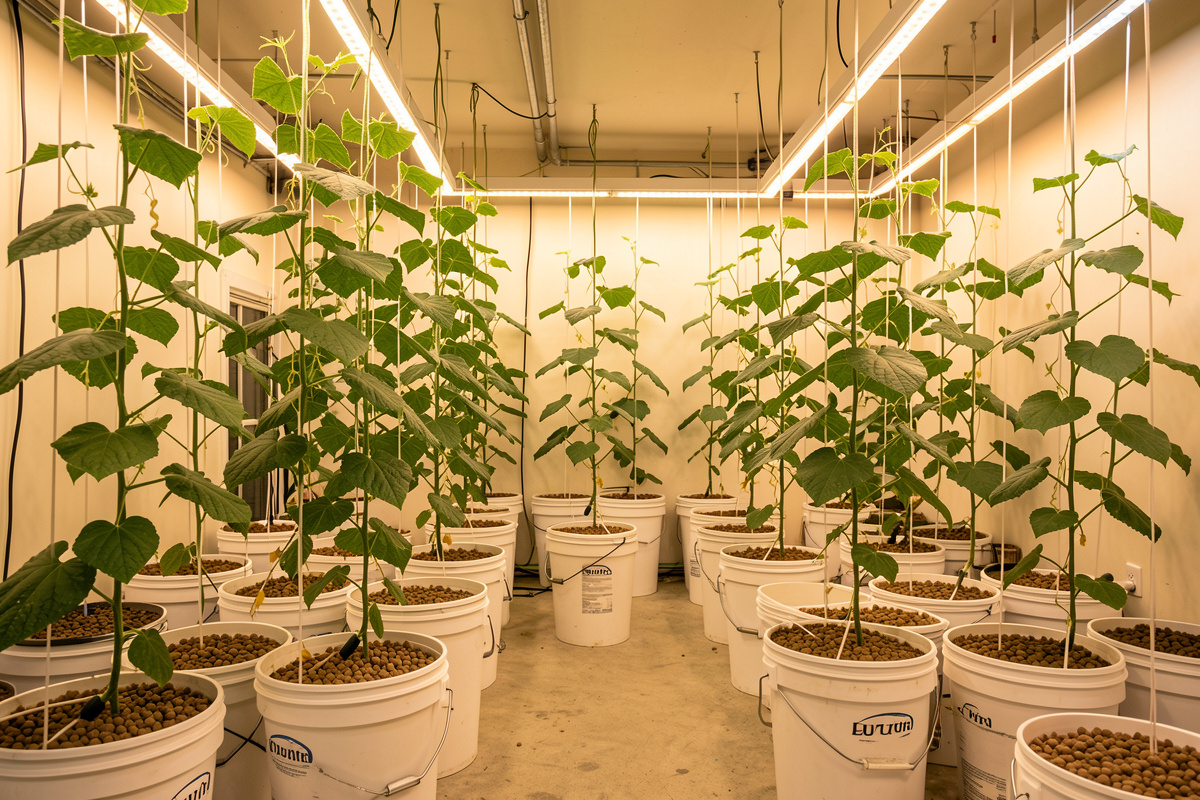
I run DWC, NFT, Kratky and ebb-and-flow side by side on my bench in Sweden, and the vining crops are where the differences between systems stop being academic. A lettuce head forgives a sloppy res. A cucumber pulling two liters a day does not. This guide is the map for the whole heavy-vining sub-territory on this site: which system to default to, what EC and pH each crop actually wants (numbers off my own pens, not repeated from a seed packet), how to hold the weight up without a greenhouse frame, and why the pollination step nobody mentions is the one that decides whether your melons set at all.
What Counts as a Heavy Vining Crop in Hydroponics?
A heavy vining crop is any indeterminate fruiting plant that keeps extending, keeps setting fruit, and pulls both water and nutrient faster than its root mass suggests. Cucumbers, pole beans, indeterminate squash, and melons all fit — they behave nothing like the leafy greens most hobby systems are built around.
The distinction matters because it changes every downstream decision. Lettuce, basil and the leafy crops that fill most beginner NFT channels are light feeders with shallow root demand and no fruit load to support. You can run a dozen of them off a modest reservoir and never think about it again. A single mature cucumber vine, by contrast, will transpire well over a liter on a warm day under bar lights, drop the reservoir level visibly, and concentrate the remaining salts so your EC climbs even though you added nothing. That is the whole game with vining crops: the plant is constantly changing the water chemistry underneath it, and your job is to notice before the plant does.
Tomatoes, peppers and strawberries are the other members of this club, and they already have their own homes on this site — see hydroponic tomatoes vs soil, peppers in a soilless setup, and hydroponic strawberries. This cluster fills the gap they leave: the cucurbits and legumes, and the trellising and pollination those sprawlers demand.
Which Hydroponic System Handles Heavy Vines Best?
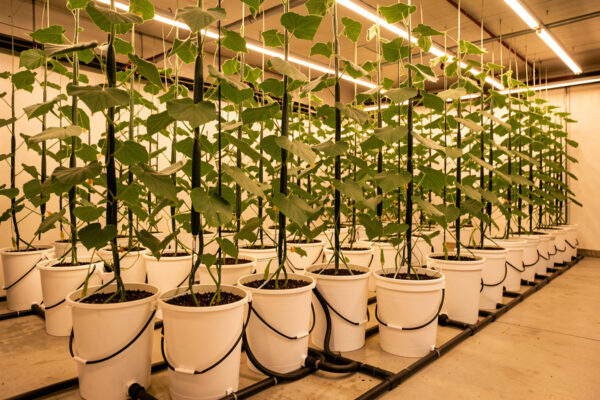
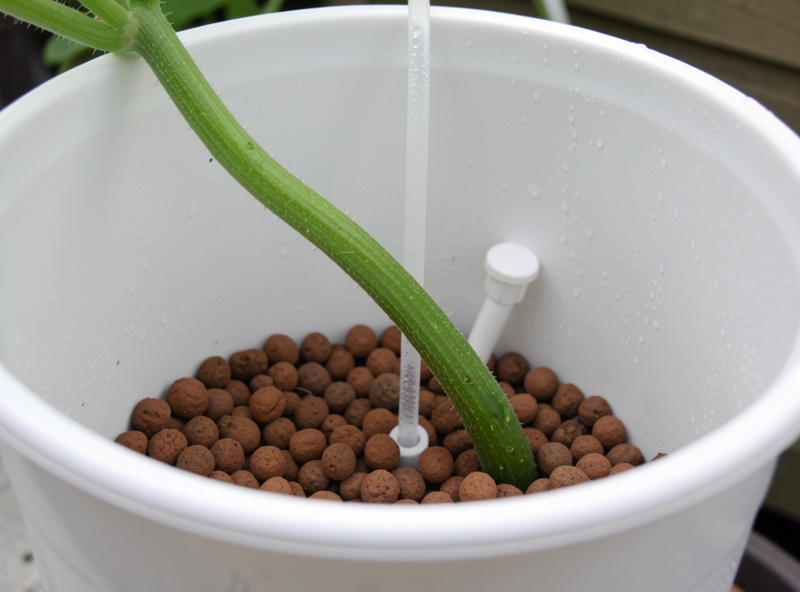
For heavy vining crops I default to Dutch buckets nearly every time. The large media volume buffers EC and temperature swings, the recirculating reservoir is big enough to feed a thirsty plant, and the drip line delivers oxygen-rich solution to a root mass that would suffocate in a small DWC tote. I explain the full reasoning in why I default to Dutch buckets for vining crops.
That doesn’t mean the other methods can’t grow a cucumber — they can. It means each one asks more of you as the load climbs. Straight DWC works if your reservoir is generous and your air stones never stop; small buckets cook and crash. Ebb and flow in a hydroton bed is my second choice for fruiting vines because the flood-and-drain cycle gases the root zone beautifully. NFT is built for leafy greens; a mature cucumber’s root mass will dam a channel and starve everything downstream. And Kratky — the passive method I love for teaching — simply can’t keep up with a plant that drinks faster than the falling water line can expose new root.
Here is how the four methods I run actually stack up for heavy vining crops, based on years of running the same crops across all of them:
| System | Vining-crop fit | Reservoir buffer | Root-zone oxygen | Hands-on load | My verdict |
|---|---|---|---|---|---|
| Dutch bucket (drip) | Excellent | High (large res + media) | High | Low-medium | Default for cucumbers, squash, melons |
| Ebb & flow (hydroton) | Very good | Medium-high | Very high | Medium | Strong second; great for beans |
| DWC (large tote) | Good if oversized | Medium | High (needs air 24/7) | Medium | Works with a big res and relentless aeration |
| NFT channel | Poor | Low | Medium | High | Root mass dams the channel — avoid |
| Kratky (passive) | Poor | Low | Falls as level drops | Low | Can’t feed a heavy drinker — teaching only |
If you take one thing from this table: match the reservoir buffer to the plant’s thirst, not to your shelf space. The most common mistake I see is someone putting a two-liter-a-day cucumber on a system sized for lettuce, then wondering why the EC and pH bounce all over the log.
What EC and pH Do Vining Fruit Crops Actually Want?
Most vining fruit crops run happiest around EC 1.8 to 2.8 mS/cm and pH 5.5 to 6.2, with the exact target rising as the plant moves from vegetative growth into heavy fruiting. Those are the ranges I hold on my own pens across every fruiting vine I run, and they are the single biggest lever on fruit quality.
The nuance the seed packets skip: EC is a moving target across a crop’s life, and it drifts on its own between res changes. When a cucumber is small and building leaf, I keep it lean — around EC 1.8 — so it puts energy into roots and canopy instead of getting salt-stressed. Once it’s flowering and sizing fruit, I push toward 2.5 and hold it there, because that’s when the plant is hauling the most nutrient. Melons get a deliberate late-stage EC bump to concentrate sugars. Beans, being legumes that partly feed themselves, want the leanest solution of the group — overfeed them and you get lush foliage and disappointing pods.
The pH band is narrower and less negotiable. Below about 5.5 and above 6.2 you start locking out nutrients even though they’re present in the water — calcium and magnesium go first, and the tell is the blossom-end and new-growth symptoms in this deficiency guide. I cross-check every reading against a pH pen and drops, because a drifting probe that reads 5.8 when the water is really 6.4 will quietly starve a crop for a week. The full method is in my EC meter guide and pH management notes.
| Crop | Veg EC (mS/cm) | Fruiting EC (mS/cm) | Target pH | Notes from my logs |
|---|---|---|---|---|
| Cucumber | 1.8 | 2.2–2.6 | 5.8–6.0 | Thirstiest of the group; watch res level daily |
| Pole/bush bean | 1.4 | 1.8–2.0 | 5.8–6.2 | Leanest feeder; overfeeding kills pod set |
| Zucchini/summer squash | 1.8 | 2.0–2.4 | 5.8–6.0 | Huge leaves transpire hard under lights |
| Melon | 2.0 | 2.5–2.8 | 5.8–6.2 | Late EC bump concentrates sugar |
Mix to a target EC, never by feel — I use the Masterblend 4-18-38 recipe as my dry workhorse and keep CalMag on tap for the calcium-hungry cucurbits. The full mixing method is in how to mix hydroponic nutrient solution.
How Do You Support Vining Crops Indoors Without a Greenhouse?
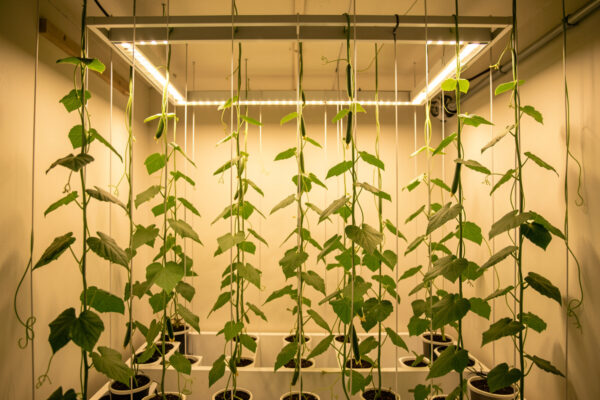
Indoors you support vines with vertical string or twine anchored to an overhead bar, letting the plant climb and then drape back down — the same lower-and-lean approach commercial greenhouses use, scaled to a spare room. It costs almost nothing and holds far more weight than the flimsy tomato cages sold for soil gardens.
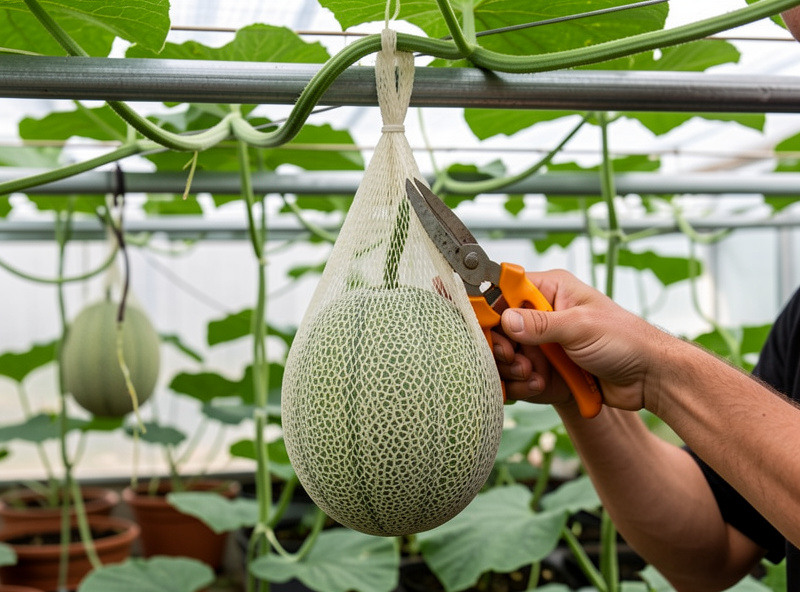
The mechanics matter more than people expect, because a heavy vine that falls takes fruit, stems and sometimes the whole plant with it. I run a horizontal support bar above each system, drop soft twine to every plant, and train the growing tip up the string with plant clips every foot or so. As the vine outgrows the bar I lower the whole string and let the lower, spent section drape — that keeps the productive top of the plant at working height instead of pinned against the lights. Fruit that hangs heavy, especially melons, gets its own individual mesh sling so the stem never carries the full load. The complete method, including the clip spacing and the drape geometry I’ve settled on, is in trellising hydroponic vines: the drape method I use.
One hard-won note: the 3D printer that feeds the rest of my network earns its keep here. I print my own trellis clips, sling hooks and string anchors because the store-bought clips crack under a loaded squash vine and the printed ones let me size the jaw to the exact stem diameter. It’s the maker crossover that pure-grower channels can’t replicate, and it’s cheaper by an order of magnitude.
Do Indoor Vining Crops Need Hand Pollination?
Yes — most fruiting vines grown indoors need hand pollination, because there are no bees in your spare room to move pollen from male to female flowers. Skip it and cucumbers, squash and melons will flower beautifully, set nothing, and drop tiny aborted fruit. This is the single most common reason a healthy indoor vine produces zero.
The good news is it takes minutes. Cucurbits carry separate male and female flowers on the same plant — the female has a tiny fruit already formed behind the bloom — and you transfer pollen with a small soft brush or by picking a male flower and dabbing it directly into the female. Beans are mostly self-pollinating and just need a bit of airflow or a gentle shake to set. Melons are the fussiest: their window is short, the flowers open for essentially one morning, and pollen viability drops fast once temperatures climb, so I do melon pollination first thing while the res and room are still cool. The full flower-by-flower walkthrough, including how to tell male from female and the timing that actually works, is in pollinating indoor fruiting vines by hand.
Crop by Crop: Cucumbers, Beans, Squash and Melons
Each of these crops earns its own full guide because the details that make or break them are crop-specific — but here’s the orientation so you know where to start.
Cucumbers are the crop I’d hand a beginner who wants fast, dramatic results. In a Dutch bucket with a good trellis they grow absurdly fast and crop for months. They’re also the thirstiest and the most sensitive to warm reservoirs. Everything — the EC schedule, the trellis, the pruning to a single leader — is in hydroponic cucumbers indoors.
Beans split into bush and pole types, and the choice changes your whole setup. Bush beans are compact and fast; pole beans want serious vertical support but crop far longer. The lean-feeding, nitrogen-fixing quirk of legumes trips up a lot of hydro growers who overfeed them out of habit — see growing beans hydroponically: bush vs pole.
Zucchini and summer squash are the space bullies of the group. Their leaves are enormous, they transpire hard under lights, and a single plant can dominate a tent. The trick is aggressive leaf management and honest support — hydroponic zucchini and summer squash: space and support.
Melons are the graduate exam. They demand the most light, the highest late-stage EC, individual fruit slings, and disciplined hand pollination — but a vine-ripened hydroponic melon is worth the trouble. The slings, the support, and the EC-for-sugar strategy are all in growing melons hydroponically: slings, support and sugar.
What Kills Vining Crops in a Res — and How I Prevent It
The two killers of hydroponic vining crops are a warm reservoir breeding root rot and a nutrient lockout from drifting pH. Both are preventable with instruments and habit, and both hit fruiting vines harder than any leafy crop because a heavy feeder has more root mass at risk and no margin for a stalled root system.
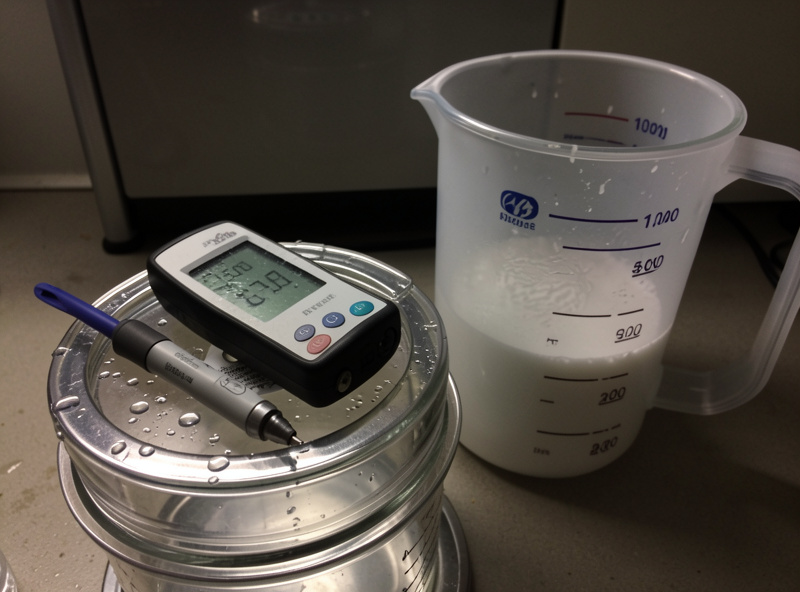
Reservoir temperature is the one I watch hardest in a Nordic summer, when the grow room warms and the res follows. Warm water holds less dissolved oxygen, and low oxygen is exactly what Pythium wants. My rule, identical across every crop I grow: keep the res at or below 68°F (20°C) and treat anything over 72°F (22°C) as a danger zone. I run air stones 24/7 and, on recirculating vine builds, an inline UV sterilizer. My full prevention protocol — including the beneficial Bacillus inoculant I dose every res change and the peroxide reset I use when things have already gone wrong — is in how to prevent root rot and the broader pest and disease guide.
I learned the oxygen lesson the expensive way. Early on I put a cucumber in an undersized DWC tote, let the room warm through a summer week without checking the res thermometer, and came back to slimy brown roots and a sour smell you never forget. The plant was finished. Now the thermometer reading goes in the log before I touch anything else, and I’ve never lost a vine to root rot since. Instruments over vibes — that sour-smell memory is why.
How Much Light Do Fruiting Vines Need — the Nordic Math
Fruiting vines are high-light crops that want a daily light integral (DLI) in roughly the 20 to 30 mol/m²/day range to fruit well — far more than the 12 to 17 that keeps lettuce happy. In a Swedish winter, where natural daylight is short and weak, you hit that number with LED bars run at a measured PPFD, or you don’t fruit. There is no vibes-based shortcut.
This is the edge of growing indoors at high latitude, and it’s why measurement isn’t optional here. I run full-spectrum LED bars at a distance I’ve verified with a PAR/PPFD meter, then do the DLI math — PPFD multiplied by photoperiod seconds, divided out to moles — to confirm the crop is actually getting what it needs rather than what the fixture’s marketing claims. A cheap fixture hung too high delivers a fraction of its rated output at canopy, and a fruiting vine starved of light will flower and then abort, mimicking a pollination failure. The controlled-environment research groups at Cornell CEA and the University of Arizona Controlled Environment Agriculture Center publish the DLI targets I sanity-check my own numbers against. For the “smart” side — running photoperiod on timers and smart plugs so the vines get a consistent day length — I treat the whole rig as a control loop: sensors, schedules, and intervention only when the loop fails.
What Growing Media Works Best for Vining Crops?
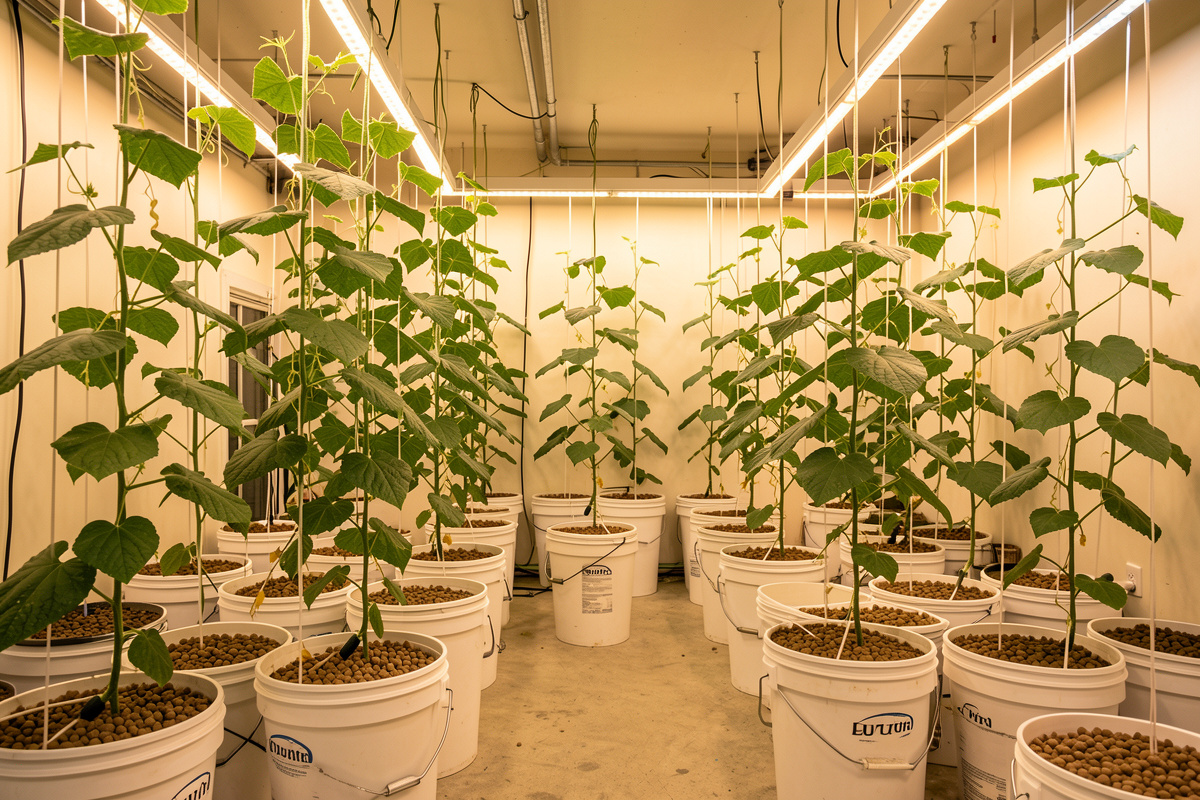
For heavy vining crops I default to hydroton clay pebbles, sometimes with a rockwool starter cube at the base for the young transplant. The pebbles drain fast, never compact, and let the root mass breathe under a plant that would suffocate in a dense medium — exactly what a two-liter-a-day cucumber needs.
The media choice is really an oxygen decision in disguise, and vining crops punish you for getting it wrong. Rockwool alone holds a lot of water and can go anaerobic around a big root system if you’re not careful with your irrigation cycles; it’s superb for propagation and leafy greens but I don’t love it as the sole medium for a mature fruiting vine. Clay pebbles swing the other way — they hold almost no water themselves, so they rely on your drip or flood cycle to deliver solution, and in exchange they keep an enormous amount of air around the roots. In a Dutch bucket that pairing is close to ideal: pebbles for the air, a drip line for the water, and a generous reservoir underneath. I compare the two media in detail, including how I reuse and sterilize pebbles between crops, in hydroton clay pebbles vs rockwool. The one habit I never skip: rinsing new pebbles hard before use, because the dust that comes off a fresh bag will cloud a reservoir and clog a drip emitter within a day.
How Far Apart Should You Space Vining Plants?
Give each heavy vining plant real room: roughly one Dutch bucket per plant with 18 to 24 inches between stems, and enough vertical run — six feet or more of trellis — for the vine to climb before you lower it. Crowd them and you trade yield for a humid, disease-prone jungle.
Spacing indoors is a light-and-airflow problem more than a root problem. When two squash plants overlap, the lower leaves of each shade the other’s canopy, your effective PPFD at those leaves collapses, and the still, damp air trapped in the middle becomes a nursery for powdery mildew. I’ve made this mistake — I once packed four cucumber buckets into a tent meant for two because I couldn’t bear to cull seedlings, and I spent the rest of that grow fighting mildew and pulling shaded, blind fruit. Now I plant fewer, stronger plants and let each one fill its space. A single well-lit, well-fed cucumber on a full trellis will out-crop two crowded ones, and it’ll do it without the disease pressure. The airflow point is not optional for the cucurbits: a small clip fan moving air across the canopy does as much for mildew prevention as any spray.
How Often Should You Change the Reservoir on a Heavy Feeder?
On a heavy vining crop I do a full reservoir change every 7 to 14 days, and I top off with plain pH-adjusted water in between as the plant drinks the level down. The faster a plant transpires, the faster the salts concentrate and the balance drifts, so a fruiting cucumber gets changed at the short end of that range.
The logic behind the cadence is worth understanding rather than memorizing, because it’s the difference between a stable crop and a bucking EC log. A vining plant drinks water faster than it takes up nutrient, so between changes the water level falls and the remaining solution gets saltier — your EC climbs on its own. Topping off with plain water dilutes that back down, which is why I keep a jug of pH-adjusted plain water next to every system and top off daily rather than pouring in more nutrient. But topping off doesn’t fix the ratio drift — the plant pulls some elements faster than others, so calcium or potassium can quietly deplete even while total EC looks fine. That’s what the full res change resets. My complete reservoir routine, sizing, and top-off method are in the reservoir guide, top-off notes, and how I clean a reservoir between crops. I dose a beneficial Bacillus inoculant at every change to keep the root zone biology on my side.
Should You Prune Vining Crops to a Single Leader?
For cucumbers and melons indoors, yes — I prune to a single main leader and remove most side shoots, which channels the plant’s energy into fruit and keeps the canopy open. Squash and beans get lighter management. The goal is always the same: light and air reaching every productive leaf.
Single-leader training is the technique that separates a productive indoor cucumber from a tangled mess. Left alone, a cucumber throws side shoots at every leaf node, and each one competes for light and airflow while contributing little fruit. I run the main stem up its string, pinch out the lateral shoots and tendrils, and remove the lowest leaves once they’ve done their job and started to yellow — that open architecture is the same reason a pruned tomato out-yields a bush. Melons get similar discipline, though I let a couple of laterals run to carry fruit. Squash I mostly let be, apart from stripping old lower leaves to fight mildew, because their growth habit is bushier than viny. The sensory tell that you’ve pruned enough: reach into the canopy and it should feel airy, not clammy — if the inside of the plant feels like a warm damp towel, you’re one mildew outbreak from trouble. Beans I barely touch beyond guiding them onto their support; they manage their own architecture.
Where Does Automation Actually Earn Its Keep?
Automation earns its keep on a vining crop in exactly three places: photoperiod timing, reservoir temperature, and topping off. Everything else is theatre until you’ve mastered the manual version. A smart plug running your lights on a fixed schedule is worth more than any expensive dosing controller you don’t yet understand.
I treat a hydroponic system the same way I treat a smart-home rig — sensors, schedules, and intervention only when the loop fails — and vining crops are where that framing pays off. The photoperiod is the first thing I automate, because fruiting vines want a consistent day length and my Nordic daylight can’t provide it; a cheap smart plug or timer running the LED bars to the minute removes the single most common human error, forgetting to switch the lights. The second is res temperature monitoring: a sensor that warns me when the water climbs toward that 72°F danger line saves crops in summer. Dosing automation — auto-adjusting EC and pH — is genuinely useful, but only once you can do it by hand and know what the numbers should be, because an automated doser fed a wrong setpoint will crash a res faster than any human. Start with timers, add sensing, and reach for automated dosing last.
When Do You Harvest, and What Should You Expect?
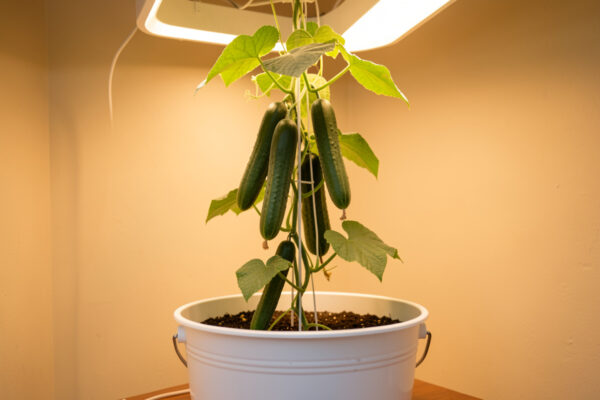
Harvest vining crops young and often — cucumbers at 6 to 8 inches, zucchini before they turn to marrows, beans while the pods snap crisp, melons only when the stem slips or the blossom end softens. Regular picking tells the plant to keep setting fruit; leaving a giant on the vine tells it to quit.
This is the part that rewards the whole build, and it runs counter to a beginner’s instinct to let fruit get big. A cucumber left to yellow and bloat pulls energy the plant would otherwise spend flowering, and production stalls within days — I pick mine every morning at 6 to 8 inches and a healthy vine just keeps coming. Zucchini is the same story on fast-forward; miss two days and you’ve got a baseball-bat marrow and a plant that’s stopped setting. Beans want picking while the pod is still slim and snaps clean. Melons are the exception that demands patience: they only sweeten on the vine, so you wait for the stem to slip or the blossom end to give slightly under a thumb, and you accept that the sugar you get is the sugar you earned with light and late-stage EC. Keep the harvest cadence tight and a small indoor vining setup produces far more than its footprint suggests — which is the whole reason I gave these crops their own cluster.
Frequently Asked Questions
What is the best hydroponic system for vining crops?
Dutch buckets. The large media volume and generous recirculating reservoir buffer the EC and temperature swings that a heavy feeder causes, and the drip line keeps the root zone oxygenated. Ebb and flow is a strong second. NFT and Kratky can’t feed a thirsty mature vine.
What EC should I run for hydroponic cucumbers and melons?
Keep cucumbers lean at about EC 1.8 mS/cm while vegetative, then hold 2.2 to 2.6 during fruiting. Melons start near 2.0 and get a late-stage bump toward 2.5 to 2.8 to concentrate sugar. Always mix to a target EC rather than by feel, and hold pH between 5.5 and 6.2.
Do indoor hydroponic vines need hand pollination?
Usually yes. Cucumbers, squash and melons have separate male and female flowers and no indoor pollinators, so you transfer pollen by hand with a soft brush or a picked male flower. Beans mostly self-pollinate with a little airflow. Skipping this is the top reason healthy indoor vines set no fruit.
How do you support heavy vining crops without a greenhouse?
Anchor vertical twine to an overhead bar, train each vine up with clips, and lower-and-drape the plant as it grows so the productive top stays at working height. Heavy fruit like melons gets an individual mesh sling so the stem never carries the full weight.
Why are my hydroponic vines flowering but not fruiting?
Almost always one of two things: no hand pollination, or not enough light. Cucurbits abort fruit without pollen transfer, and a vine starved below roughly 20 mol per square meter per day of DLI will flower and then drop fruit, which looks identical to a pollination failure. Check both.
What reservoir temperature is safe for fruiting vines?
Keep the reservoir at or below 68°F (20°C). Treat anything above 72°F (22°C) as a danger zone, because warm water holds less dissolved oxygen and invites Pythium root rot. Run air stones continuously and cool the res in summer.
Where to Start in This Cluster
If you’re setting up from scratch, read the system guide first, then the trellising method, then pick your crop: cucumbers for fast wins, beans for a lean-feeding change of pace, zucchini and squash if you have the room, or melons once you want the challenge. And whichever you grow, keep hand pollination in the routine — it’s the step that turns flowers into food.
If you print your own parts, the reservoir lids, net-pot collars and trellis clips I use are the same maker crossover that runs through the rest of my network — the same 3D printer that prints these hydro parts prints hose guides for my welding rig. Start with the system, dial the EC, hold the res cool, and hand-pollinate. That’s the whole game with vining crops.
As an Amazon Associate I earn from qualifying purchases. A few tools I’d tell any vining-crop grower to own: a calibrated EC/TDS meter, a pack of soft trellis clips, and a reliable air pump and air stone to keep the res oxygenated.