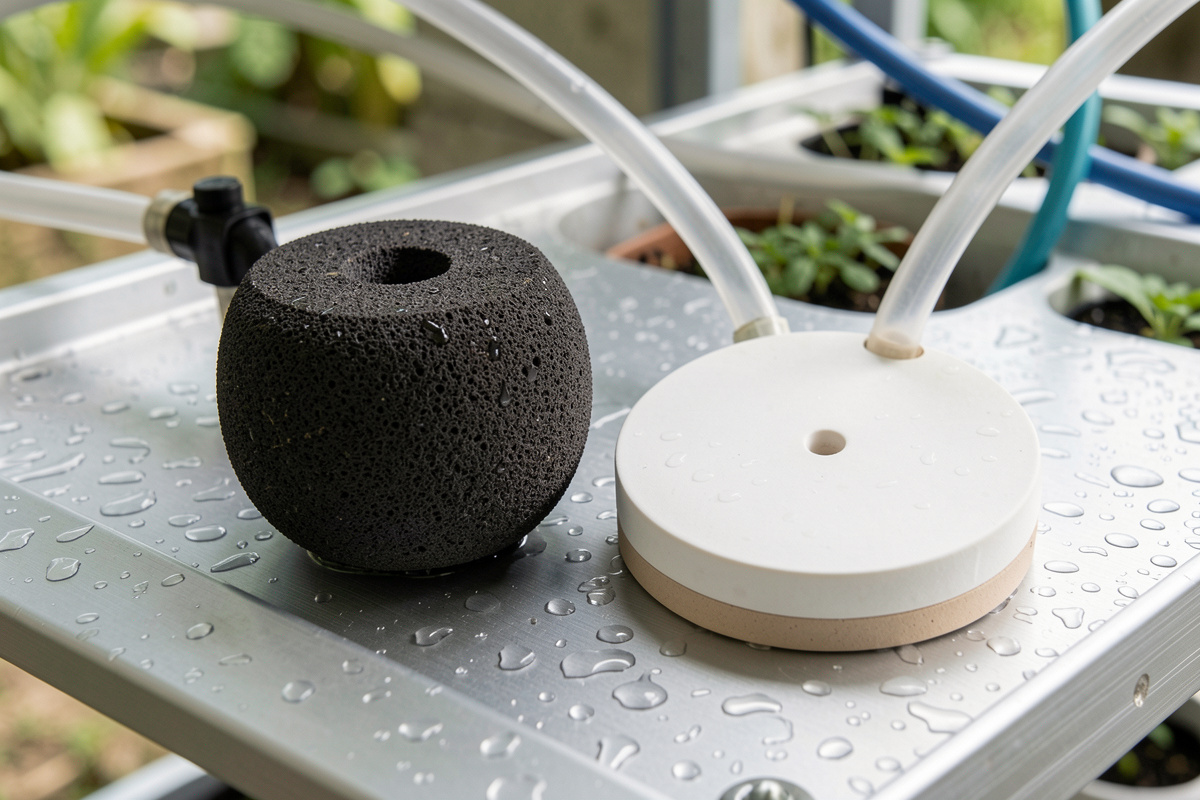
Air stone or disc diffuser for DWC? A disc diffuser pushes finer bubbles across a wider flat footprint, so it transfers more oxygen per liter of air, but it demands a stronger pump. I run cylindrical air stones in small standalone buckets and flat disc diffusers in my big totes, both sized to hit at least 1 LPM of air per gallon of reservoir.
That is the short version, and it holds across the methods I run side by side. But “which is better” is the wrong question. The two aerators solve different geometry problems, they age differently, and each one only performs if it is matched to the pump you already own. Below is exactly how I think about the trade-off on my bench, with the numbers from my res logs that actually drive the decision.
Bubble size is the whole game, and the disc wins it
Smaller bubbles transfer more oxygen, full stop. A disc diffuser produces a denser cloud of fine bubbles than a standard bonded-glass air stone, and that matters for two reasons: surface area and rise speed. A bubble’s oxygen exchange happens across its skin, and for a fixed volume of air, splitting it into many tiny bubbles multiplies the total surface area dramatically. A fine curtain of pinhead bubbles has far more gas-to-water contact than the same air pushed out as coarse bubbles.
The second factor is dwell time. Big bubbles are buoyant and shoot to the surface fast; a fine bubble drifts up slowly, so it stays in contact with the water longer and hands off more of its oxygen before it pops at the top. On my bench I watch this directly with a PAR meter for light but with my own eyes for aeration: a good disc looks like a shimmering fog, while a tired air stone throws lazy marbles.
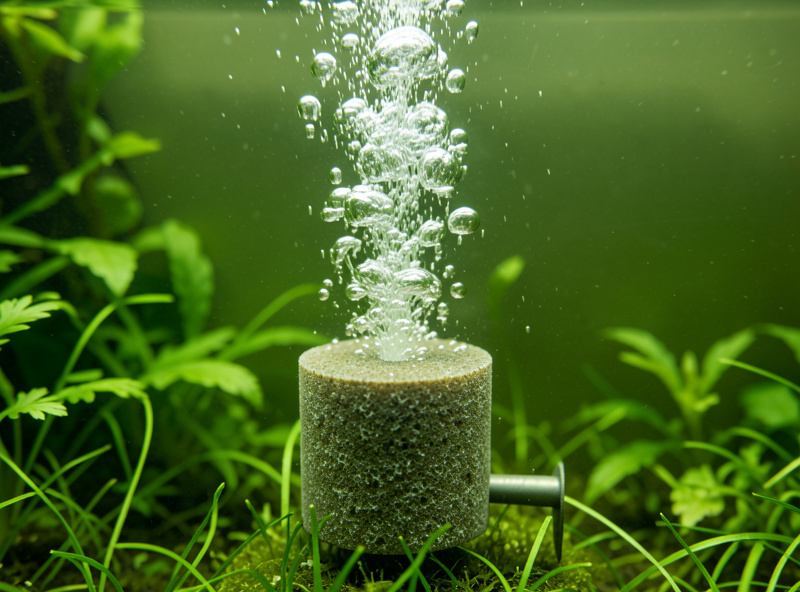
Why do I care so much about dissolved oxygen in the first place? Because in DWC the roots are sitting in the water, and their oxygen supply is whatever I can keep dissolved in that res. I cover the physics in depth in my guide to dissolved oxygen in hydroponics, but the headline number is this: DO saturation is roughly 9 mg/L at 68F and it slides toward 8 mg/L as the water warms to 77F. Warmer water simply holds less oxygen, which is why a finer bubble that transfers more efficiently earns its keep in a warm room.
Coverage: a flat disc curtain versus a narrow column
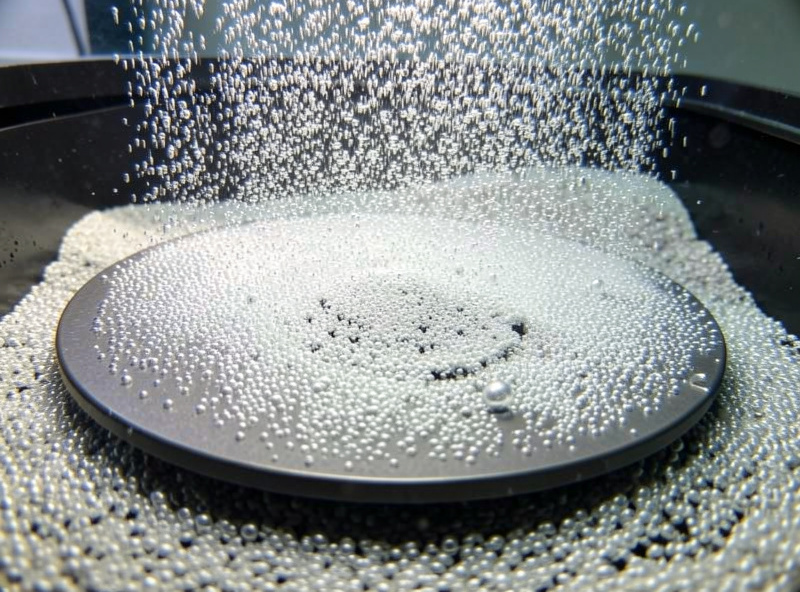
Footprint is the second reason I split my aerators by vessel size. An air stone, whether it is a cylinder or a small block, releases bubbles from a compact zone, so you get a column rising over one spot. A flat disc diffuser lies on the floor of the reservoir and pushes bubbles up across its whole face, producing a wide curtain rather than a single plume.
In a small standalone bucket that column is plenty; the water volume is tiny and convection carries the oxygen everywhere within minutes. In a big recirculating tote it is not. A single air stone in one corner of a long tote leaves dead water at the far end, and dead water near warm roots is exactly where Pythium gets a foothold. Spreading a disc’s curtain across more of the floor keeps the whole res moving. When a tote is genuinely large I would rather run two or three discs, or a disc plus a manifold split, than trust one aerator to cover it.
That manifold point matters enough that I built a whole rig around it; if you are splitting air across several outlets, my air pump manifold guide walks through how I balance the drops so one diffuser doesn’t starve the others. And whichever aerator you pick, the rule I never break is that the air runs 24/7 — root oxygen is not a daytime-only need.
Back-pressure: the finer diffuser wants a bigger pump
Here is the trade nobody mentions on the product page. The finer the pores, the harder it is to force air through them, and the deeper the diffuser sits, the more the water column pushes back. Both effects are back-pressure, and back-pressure is where an underpowered pump quietly fails you.
Two numbers from my res logs anchor this. First, air pumps are almost always rated at zero back-pressure — free air on the bench — and under 8 to 10 inches of water a typical diaphragm pump loses about 20 to 30 percent of that rated output. Second, my working target is at least 1 LPM of air per gallon of reservoir, and I bump that to 1.5 to 2 LPM per gallon for fruiting crops or a warm room. Now stack those: if your pump is already losing a third of its output to depth, and you then bolt on a fine disc that resists airflow more than a coarse stone, an air stone might bubble happily while the disc barely fizzes.
That is the core reason I don’t just tell everyone to buy discs. A disc is the better aerator only when the pump can drive it. Sizing the pump correctly is its own topic — I walk through the math in how to size a hydroponic air pump and give my specific picks for deep-water setups in my roundup of the best air pumps for DWC. If you are still choosing the pump itself, start at my best air pump for hydroponics hub and come back here to pick the diffuser that matches it.
How they clog, and how each one ages
Both aerators clog, but they fail differently, and knowing the mode tells you which to run. An air stone is usually bonded glass or ceramic — sintered grit glued into a shape. Over weeks it accumulates mineral scale and a slimy biofilm inside those pores, and because the pore paths are deep, that gunk is hard to fully flush. A bonded-glass stone tends to lose its fine bubbles first, coarsening as the small pores block, so it degrades gradually into a worse version of itself.
A flat disc is typically a molded ceramic or sintered membrane with a broad, shallow surface. It also scales up, but because the working face is wide and flat it is easier to scrub, soak and inspect. When a disc goes it more often blocks in patches — one zone stops bubbling while another still works — which is easy to spot visually. Either way, mineral scale is the enemy, and a periodic soak keeps both alive far longer; my full routine is in the guide to cleaning a clogged air stone, and the same soak works on a disc.
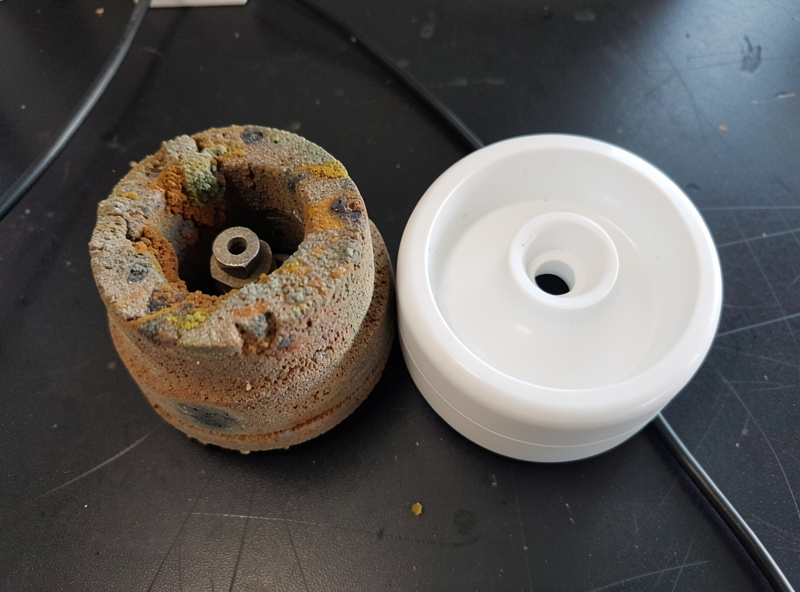
The reason I stay on top of clogging is that a fading aerator quietly starves the roots, and starved roots in warm water are the classic setup for root rot. Keeping DO up is the front line of preventing root rot in hydroponics, and it works hand in hand with keeping the res cool — I hold mine at or below 68F (20C) as the safe zone and treat anything above 72F (22C) as the danger zone where Pythium takes off. More on that in my notes on hydroponic water temperature.
Cost, and which one I actually run where
On price the two are close enough that it rarely decides anything. A quality air stone and a quality disc diffuser land in the same ballpark, and both are cheap relative to the pump, the reservoir and the nutrients. What actually decides it is vessel size and the pump you own.
Here is how I split it across the systems I run: in small standalone DWC buckets I run a cylindrical air stone. The volume is small, the depth is shallow, back-pressure is low, and a modest pump drives a stone with room to spare — a disc there is overkill. In my big totes I run a flat disc diffuser, sometimes two, because the wide curtain covers the floor and keeps the whole res oxygenated end to end, and my totes are paired with pumps sized to push a fine diffuser. The one caveat: if a grower has a weak pump and a deep tote, I tell them to keep the air stone rather than choke a disc they can’t drive.
| Factor | Air stone | Disc diffuser |
|---|---|---|
| Bubble size | Coarser to medium | Very fine, denser cloud |
| Coverage | Narrow rising column | Wide flat curtain |
| Pump draw | Low back-pressure, easy to drive | Higher back-pressure, wants a stronger pump |
| Clogging mode | Coarsens gradually, deep pores hard to flush | Blocks in patches, wide face easy to scrub |
| Material | Bonded glass / ceramic | Molded ceramic / sintered membrane |
| Cost | Low | Low, comparable |
| Best use | Small standalone buckets | Big totes with an adequate pump |
If you want to grab both and test them in your own res the way I did, a quick search for hydroponic disc diffusers and air stones pulls up the common formats. Run each in the same bucket for a week, watch the bubble field, and let your own eyes and DO reading decide.
As an Amazon Associate I earn from qualifying purchases.
The broader context for all of this lives in my overview of DWC hydroponics — the aerator is one piece of a res that also needs the right EC, pH, temperature and volume dialed in. Get the pump-to-diffuser match right, keep the water cool and moving, and the choice between a stone and a disc becomes exactly what it should be: a small optimization, not a make-or-break decision.
Is a disc diffuser better than an air stone for DWC?
A disc diffuser transfers more oxygen because it produces finer bubbles across a wider footprint, but only if your pump can drive it. In small buckets a plain air stone is plenty; discs shine in large totes.
Why do smaller bubbles add more oxygen?
Splitting the same air into many tiny bubbles multiplies the total gas-to-water surface area, and fine bubbles rise slowly so they stay in contact with the water longer. Both effects raise the oxygen transferred per liter of air.
Does a disc diffuser need a bigger air pump?
Usually yes. Finer pores and reservoir depth both create back-pressure, and pumps lose roughly 20 to 30 percent of their rated output under 8 to 10 inches of water. A weak pump may drive a stone but barely fizz a fine disc.
How often do air stones and disc diffusers clog?
Both scale up with minerals and biofilm over weeks. Air stones coarsen as deep pores block and are hard to fully flush; discs tend to block in patches on their wide, easy-to-scrub face. A periodic soak keeps either working.
How much air does my DWC reservoir need?
Run at least 1 LPM of air per gallon of reservoir as a minimum, and 1.5 to 2 LPM per gallon for fruiting crops or a warm room. Run the air 24/7, since roots need dissolved oxygen around the clock.